Home Index Web Stuff Copyright Links Me

Acer palmatum


Archive entry 03.11.19
Archive entry 25.10.20

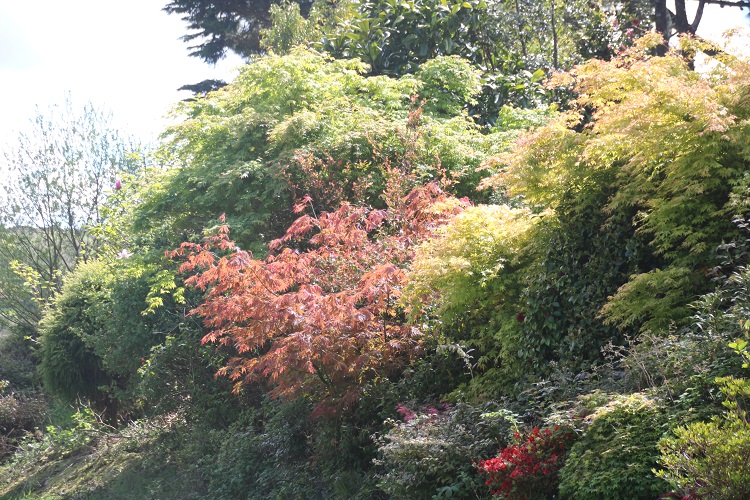
Just a few leaves and branches from this treelet. I bought this as a small seedling back in the days when unicorns still walked the earth, and before the wrinkles in my face could be used to conceal a small invading army. It sat for years in a tasteful earthenware pot outside the front door ... looking tasteful!
Eventually, I decided it deserved a chance to expand a bit, and planted it out in the woods, where it has grown more in the last three years than it did in the preceeding decade.
Acer palmatum makes a charming large shrub or small tree. Not a lover of windy conditions, I am hoping that the little bit of shelter it gets will be enough. If the autumn isn't too blustery then I can hope for a reasonable display of autumn colour. In the early spring of 2006 I bought a selection of recently grafted cultivars from a plant fair. They were very cheap, and I wanted more for the garden. They are currently sitting in pots , and starting to show some signs of distinctiveness, however they are still very small, and I don't really know what to expect from them. I have included some pictures where possible. I am happy to accept that any text I write is probably going to be hogwash!
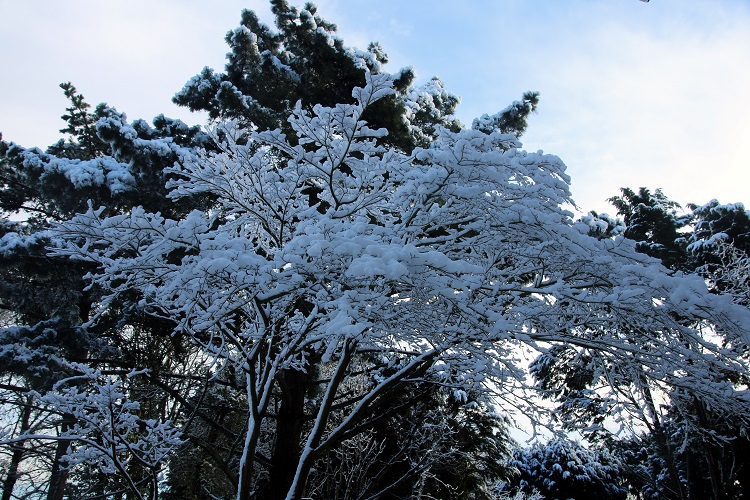
Cold weather is a terrible trial for fresh Acer leaves, but fortunately this shower of snow in April was as short lived as it was unexpected.
It has continued to grow substantially, and now I need to remove some of the surrounding vegetation if it is going to continue to develop as a tree.
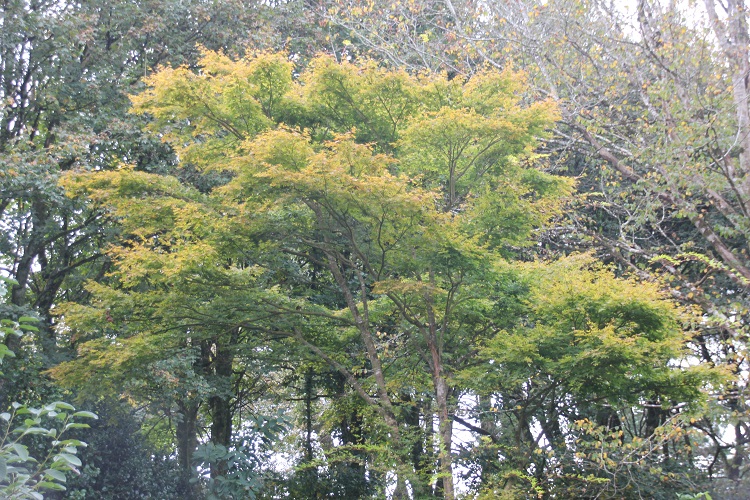
I have finally had to face the fact that it is growing in the way again. The options were to cut it down or dig it up, and I thought it was worth trying to save. It lifted surprisingly easily, with a good root ball and moved a couple of yards to a new position in a row of other trees. Since replanting it has leafed out well and taken the summer heat (ha ha!) without trouble so I think it will survive.


5th April 2006


7th April 2008 29th March 2009 17th February 2011


Writing in the Journal of the Royal Horticultural Society in 1998, Karan Junker says:

"Flowers are the most obvious way to bring colour to the garden, but they seldom last for long. Leaves, in contrast, offer more permanent displays, and Japanese maples are among the most beautiful of all foliage plants, renowned for the unusual shapes and changing colours of their seasonal attire. Cultivars may be bright pink and orange in spring as the new leaves unfold, offer yellow, green, red or purple through the summer, all merely the build-up to the extraordinarily vivid displays of autumnn's reds, oranges and yellows. Leaf variegation adds a further dimension of interest.
Acer palmatum (Japanese maple) is a small deciduous tree which has been in cultivation in Japan for at least four centuries. It is sometimes referred to there as the mountain maple, as on the main island of Honshu it is found at altitudes up to 1,100m (3,600ft). It is also indigenous to forested areas in Korea and China and as far south as Taiwan. Easily propagated from seed, and naturally a highly variable species, many cultivars have been selected and named. This began in Japan but increasingly occurs elsewhere as the genetic pool of material around the world has expanded with the species horticultural popularity. Selected individuals are propagated vegetatively, usually by grafting.
Leaf shapes vary as dramatically as colour. The basic design has pointed lobes, in common with most acers, but there is tremendous variation in this theme. The number of points can range from five to eleven, and the divisions can be relatively shallow or run as far as the midrib. The degree of serration along the edges of the lobes also varies widely. Cultivars belonging to the aptly-named A. palmatum Dissectum Group are particularly graceful, with a fern-like, feathery outline to their leaves.
The larger-growing cultivars make greceful additions to wilder, wooded areas or are ideal specimen trees within the garden. They make small trees or large shrubs up tp 10m (33ft). These tend to be the most robust plants and although they are generally green or purple, they do give some of the best autumn colour. there is a wider range of brightly coloured, compact cultivars, more shrubs than trees, which may be grown freestanding in favourable sites, or within a border. These also make excellent patio subjects in large pots, particularly in areas with unsuitably shallow or chalky soils. The even smaller, truly dwrf cultivars are suited to the smallest of gardens.
Shape and habit also varies with Japanese maples. Some are stiffly upright, while others develop a broad head, or they may be arched and almost pendulous. Although pruning is not a requirement, they can tolerate quite harsh treatment - even transplanting satisfactorily when quite large. Their immediate environment plays a major role in determining growth rates, and will tend to conmtrol their ultimate height. Long-lived and often slow-growing, it is probably more realistic to consider size in 10 or 15 years - as I do here - rather than 'ultimate' height."


10th November 2012 1st December 2016 22nd November 2019


17th January 2023 3rd May 2024 2nd October 2025


References:
  • Junker, Karan - 'A Plant for all seasons', Journal of the RHS, Vol.123 , No.10 , p.720 (1998).
  • Harris, Gordon - 'Japanese Maples', The Plantsman, Vol.3 , No.4 (1982).
  • James Armitage, Dawn Edwards, Neil Lancaster, John G. Hillier and Roy Lancaster (eds), The Hillier Manual of Trees and Shrubs, 8th edition, 2014.
  • Trees and Shrubs online, https://www.treesandshrubsonline.org/articles/acer/acer-palmatum/ , accessed 07.10.2026.