JEARRARD'S HERBAL
That's enough introduction - on with the plants!
To navigate this site use the links above or the detailed links at the bottom of this page.
... out in the garden.
18th October 2026
Mahonia japonica .
It has been a bright week that has felt like the last warm flush of autumn. I noticed how early it was getting dark and started to think about getting some logs into the house for the stove
in case it turned cold suddenly. I think it rained in the week but I slept through it. In the morning I couldn't decide if the grass had been rained on or if there had just been a heavy dew.
I think it had rained, I got wet trudging around the garden with a camera.
Chlorophytum krookianum is rushing to ripen seed before the weather chills. It has taken advantage of the long, hot summer to produced seed pods - it doesn't usually manage.
It is a good thing, I would really like some more seedlings.
The first autumn colour is showing. Mahonia japonica had a dozen growths that had turned shining scarlet. Quite by chance I caught them from behind with the sun at the right angle
and they were the brightest thing in the garden.
18th October 2026
Hedychium coccineum .
The Hedychium couldn't match the Mahonia for exuberance, though they tried hard. This selection of H.coccineum came from Burncoose Nursery
but I think it is just the standard commercial stock, imported from India. It has done really well this year,
enjoying the heat and only growing to a moderate height in the drought. That said, it is still 2m tall but that is more manageable than the 3m it would reach in the greenhouse, getting tangled in the roof in
the process.
I am looking at the rest of the hedychium bed. There are plants with buds forming that I have never seen in flower. If the autumn weather stretches out for a few more months
it will be a remarkable year. It could happen. A few winters ago the first very cold weather was a snow shower in January that stopped the dahlias flowering.
18th October 2026
Crocus sativus .
The autumn has thrown up a few surprises. Every now and then I get beguiled by packs of bulbs in the local garden centre and do something reckless in a pot.
In 2022 I fell for Crocus sativus again. I had no expectation of long term success but I thought it might produce a crop of flowers
and some fresh saffron for the autumn. In the event it was rather feeble. I got a handful of flowers and enough saffron to stain my fingers.
However, in a clay pot on the south side of the house, the corms didn't die. They have been dividing and increasing and now I have a potful of
struggling corms and a single flower. It is a strange bonus born of the summer drought. I'm not expecting any improvement in subsequent years
but this single ragged flower is more precious to me than its delicious stigma. And there is another bud coming.
18th October 2026
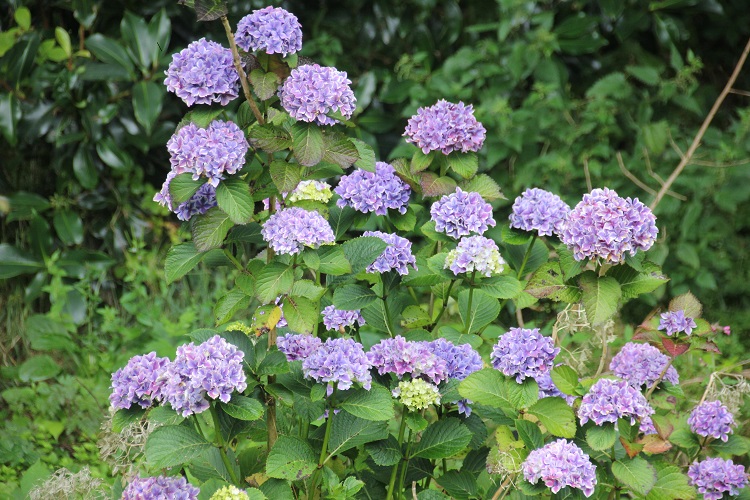
Hydrangea macrophylla 'Hortmagreclo' .
The drought this year was long but there must have been moist interludes because the hydrangeas stood it well. There was some seasonal drooping, and H.serrata
lost most of its foliage, but for the most part the hydrangeas kept their heads and got on with it.
Once the first autumn rain arrived H. macrophylla 'Hortmagreclo' perked up and carried on with the autumn display.
It is possible that in a wetter year it might have produced a second flush of flowers in September but there is a satisfying uniformity to the bush now.
It is a fairly modern, compact cultivar developed in Holland for the pot plant trade but it has made a very satisfactory garden plant
with green flowers in summer that develop mulberry tones in old age.
The Red Admiral is not feeding from the flowers, just resting in the sunshine.
To find particular groups of plants I grow, click on the genus name in the table above. Click on the "Index" box at the top of the page for the full list.
I have a lot of good intentions when it comes to updating this site, and I try to keep a note
about what is going on, if you are interested.
If you want to contact me, the address is incompetentjohnMONKEYjohnjearrard.co.uk
When typing the address in, please replace MONKEY with the more traditional @ symbol! I apologise for the tiresome performance involved, but I am getting too much
spam from automated systems as a result of having an address on the front page.
Perhaps my MONKEY will fool them.