Home Index Web Stuff Copyright Links Me

Adiantum venustum


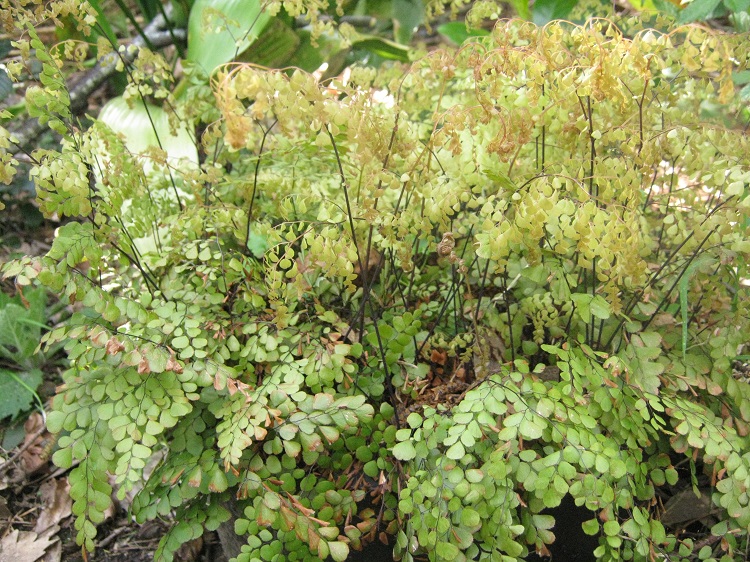
This has been the best of the hardy Maidenhair ferns here, prospering in a decent soil in a moist shady location, and also doing rather well in a pot.
I have seen it growing in dense sheets over rocks in a couple of sheltered local gardens and I am trying it in more and more places round the garden. Where it is suited, it makes a magnificent low cover. The new fronds in early spring are wonderful.
It has recently been suggested that the traditional "A. venustum" of gardens is misidentified and the plant is actually A. tibeticum. I am not well enough informed yet to have an opinion so I am retaining the name here and accepting that there will be some confusion as the situation clarifies.

Wikipedia says:

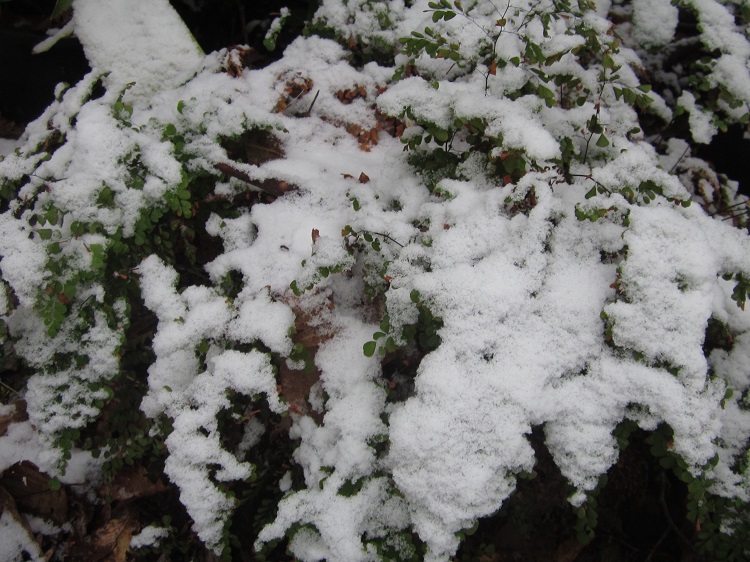
"Adiantum venustum, the evergreen maidenhair or Himalayan maidenhair, is a species of fern in the genus Adiantum of the family Pteridaceae, native to China and the Himalayas. It is a slow to establish plant that usually grows on moist rocks and soil with a good amount of humus and dead leaves. It is very hardy, largely evergreen to −10 °C, when it becomes deciduous. It is also known as black Hansraj in India for its black stalks at the fronds.
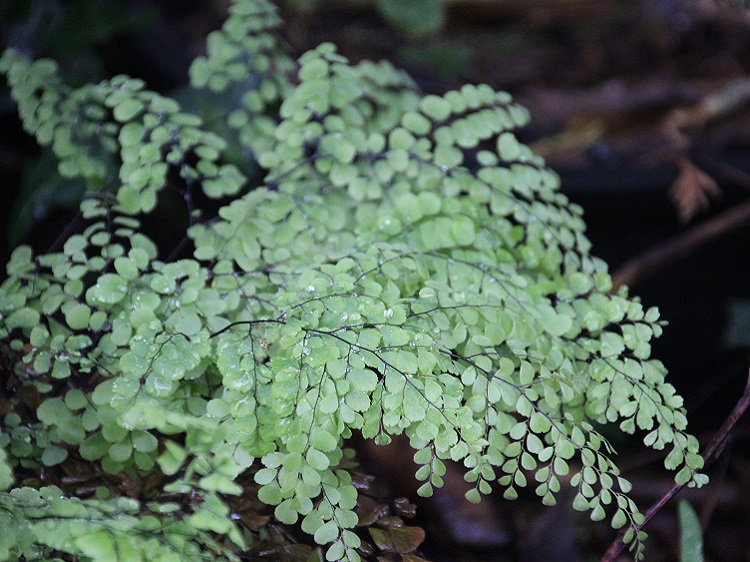
It typically grows to 15–25 cm tall and up to 0.9 meters wide. The soft green fronds are triangular, with numerous fan-shaped segments on each frond, with black stems. The roots are rhizomatous. The whole plant forms a slowly spreading mat."

Sue Olsen says:

"Epithet means "graceful" or "beautiful".
The branching rhizome is creeping, eventually supporting a colony of elegant evergreen fronds. The black stipes, with a token cluster of basal scales, glisten and are one-half of the frond length. The broadly triangular, tripinnata leaf blades greet the gardener in early spring with a flush of salmon-colored frothy feathers. The pinnae, likewise triangular, are staggered alternately along the slightly zig-zag rachis. Pinnules on thin, dark stalks are somewhat asymmetrical and conical with short straight edges and a flared, rounded finish to the outer edge. The whole reminds me of a mitten with small, terminal fingers providing notches for the two fertile segments that protect the sori."


12th September 2006


Chelsea Physic Garden says:

"Adiantum venustum, commonly known as the Maidenhair Fern, is a delicate fern native to the Himalayas. Though not as widely used in herbal medicine as other ferns, it has been traditionally valued for its ability to promote relaxation and soothe the respiratory system. In some regions, it has been used in remedies to treat coughs and colds. In folklore, ferns are often seen as symbols of protection. "

Edulis say of A. tibeticum:

"A particularly handsome and rather undergrown member of the Adiantum venustum complex, A. tibeticum forms a delicate colony of creeping rhizomes, from which arise erect, glossy chestnut-black stipes carrying finely divided, fresh-green fronds. The ultimate pinnules are characteristically fan-shaped and thin-textured, giving the plant the airy elegance expected of a maidenhair fern without making it quite as fussy as some of its tropical relatives.
Originally described from south-western Tibet, A. tibeticum is a Himalayan and south-western Chinese species, occurring from Afghanistan through Pakistan and the western Himalaya to Nepal, Tibet and south-central China. The type was collected at Gyirong in Tibet at approximately 2,800–3,200 m, growing beneath forest.
There is, however, an important horticultural trap here. Plants sold in the trade as Adiantum venustum are sometimes actually A. tibeticum (or another member of the A. venustum group). The names A. venustum, A. tibeticum and A. venosum have consequently become rather muddled in horticulture. A. venosum is a separate species, and should not simply be used as an alternative name for A. tibeticum. The latter has also been reduced by some authors to Adiantum venustum subsp. tibeticum, but Kew’s current treatment accepts A. tibeticum as a distinct species.
The distinction is worth maintaining in a botanical nursery catalogue: if a plant has arrived labelled A. venustum, it is worth checking the frond architecture and, ideally, its provenance rather than automatically perpetuating the name. A. tibeticum itself was formally described by Ren-Chang Ching and Y.X. Lin in 1980.
Nomenclature: Adiantum tibeticum Ching & Y.X.Lin, Acta Phytotaxonomica Sinica 18(1): 104 (1980). Synonym: Adiantum venustum subsp. tibeticum (Ching & Y.X.Lin) Khullar.
Trade note: A. tibeticum should not be treated as synonymous with A. venustum. The latter is a separate name, and mislabelling within this group appears to have contributed to considerable horticultural confusion."


4th April 2012 21st January 2013 18th April 2020


References:
  • Junker, Karan - 'A Plant for all seasons', Journal of the RHS, Vol.123 , No.10 , p.720 (1998).
  • Elliott, Jack - 'Leucojum - the snowflakes', The Plantsman, Vol.14 , No.2 (1992).
  • Grounds, Roger - 'Ferns' , Pelham Books, 1974
  • Hoshizaki, Barbara Joe and Moran, Robin C. - 'Fern Growers Manual', revised and expanded edition , Timber Press, 2001
  • Olsen, Sue - 'Encyclopedia of Garden Ferns' , Timber Press, 2007
  • Rickard, Martin - 'Gardening with Ferns' , David and Charles, 2005
  • Chelsea Physic Garden, https://shop.chelseaphysicgarden.co.uk/products/pod1051036?gad_source=1&gad_campaignid=22347260550&gclid=EAIaIQobChMI-qWWleLSlwMVlJJQBh2FaSW5EAAYASAAEgJ66vD_BwE , accessed 24.10.2026.
  • Edulis, https://www.edulis.co.uk/products/adiantum-venustum?srsltid=AYCX9vJpK91C_1LU42pGMOBlUWMuQ_6jLJt7bq4EvESlKj4cvGnCXuiq , accessed 25.10.2026.