 |
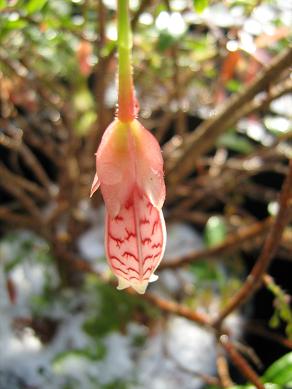
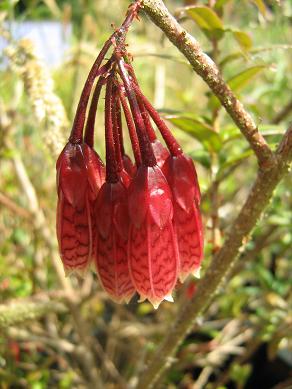
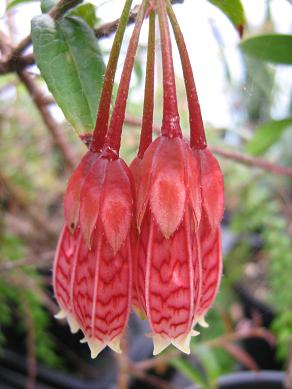
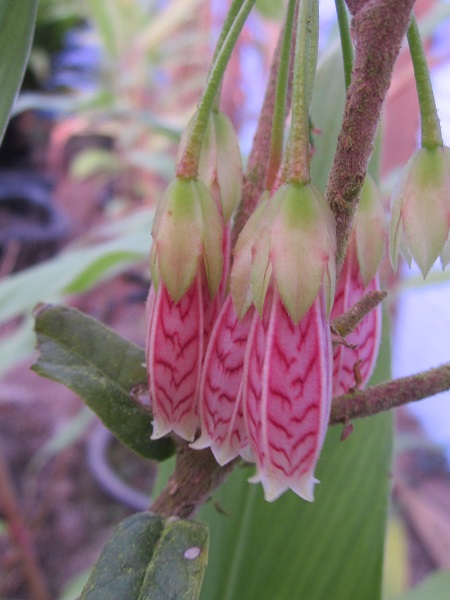
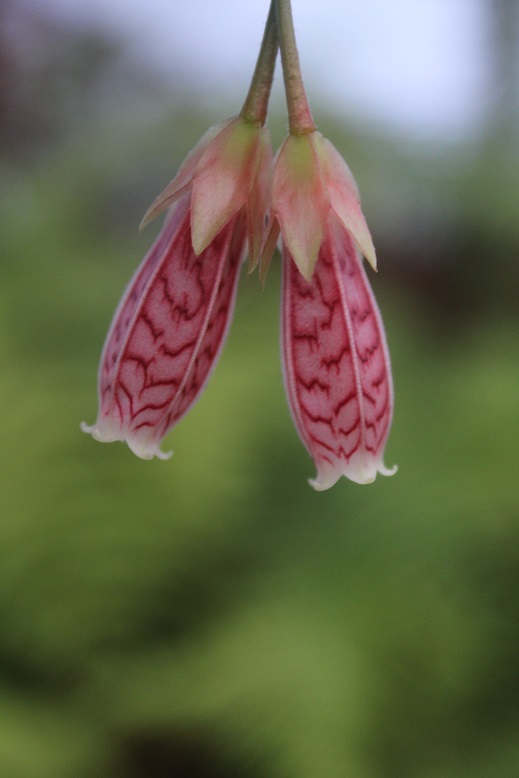
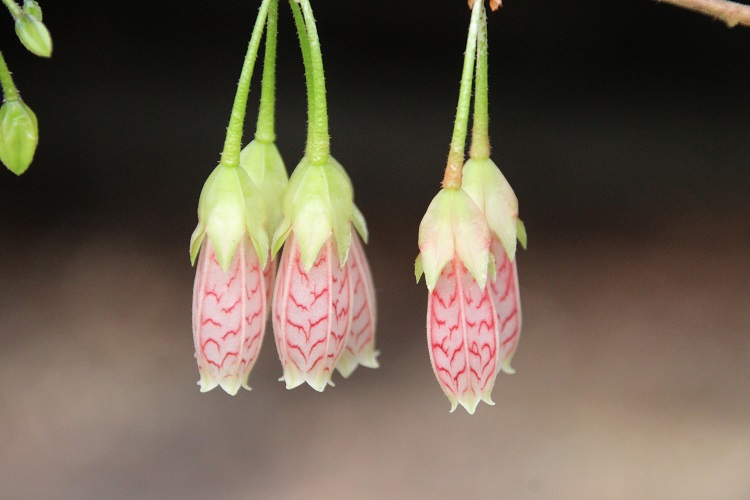
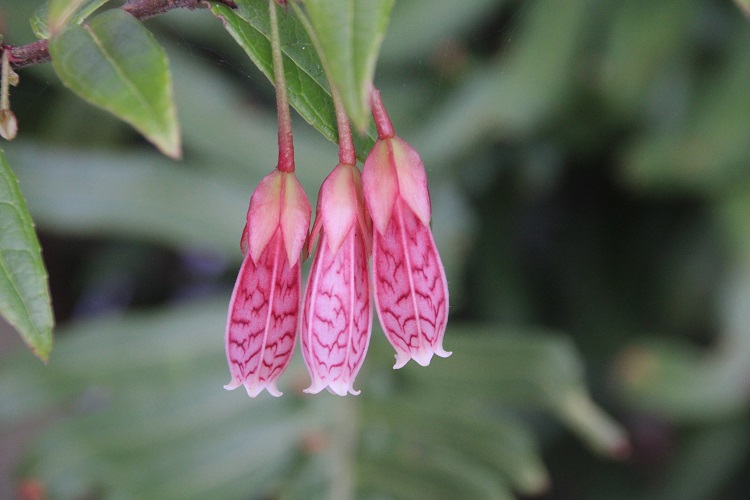
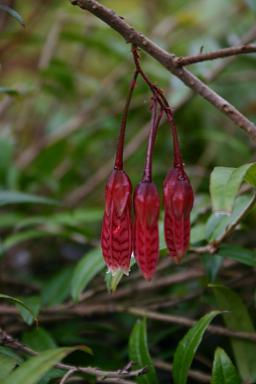
A glorified Heather relative. Started flowering this year in May, and still going strong at the end of November. For many years I have had problems growing Agapetes, but
the wet weather this year seems to have suited this one. Brittle twiggy sprawling growth. The plants has astonished me by flowering right through the winter. In a brief flurry of snow in April it was still flowering. The low temperatures seem to have produced rather paler flowers than usual, but they have carried on opening. By July, the flowers are back to full colour.It has now flowered for a year and a half without a break, which is quite an achievement. I tried it in the ground in the Hedychium house but it was too dry. it has been much better since I potted it into a bark mix and moved it back into a shady part of the greenhouse. An entry in Rogers Trees and Shrubs (?) says: "An arching leafy shrub with hanging pinkish flowers barred with crimson; a hybrid between A. incurvata and A.serpens, raised bym Miss talbot at Ludgvan, Cornwall around 1946. Stems to,1.5m; leaves 4-4.7cm long, 1-1.3cm wide, finely toothed, calyx red. Flolwers about 2.5cm long. Less colourful than A. serpens but said to be hardier and easier to grow than either parent. For moist but well-drained soil in shade and shelter. Min -5DegC." Writing in 'The Plantsman' in 1986, Argent and Woods said: "The effect creted by the densely massed flowers makes this a particularly striking shrub. Although intermediate between both parents in a number of characters, it more closely resembles A. incurvata from which it differs by the stems being hairy with onlky occasional bristles, the leaf margins being almost entire, the pedicels hairy with both glandular and eglandular hairs, and the flowers darker. This hybrid probably does not look any better than A. incurvata but is more vigorous and perhaps because of that it is thought to be hardier than both parents. Certainly it grew for ten years against a wall at west Porlock, Somerset whereas A. serpens died after a few years (Haddon, 1961). A specimen in flower and fruit was exhibited before the scientific committee of the Royal Horticultural Society on 6th September 1949. The plants had been grown in the open except for winter protection, the fruits had been produced without artificial pollination and contained many white seeds." W. Arnold-Forster wrote in 'Shrubs for the Milder Counties': "A beautiful hybrid between thentwo species has lately been raised by Miss G.Talbot at Ludgvan, in Cornwall. this is intermediate in habit between the two species, not stiff like rugosum. but with the arching growths mush less trailing than those of serpens. The flowers are slightlylonger than 1 inch, with crimson-red calyx, the lantern of a more crimson red than that of serpens, with the acute-angled pencilling of serpens and a greenish-white lip as in rugosum. The plant has the curious nodules on the root which characterise serpens. The lesaf is intermediate between the two, slightly toothed at the edge. The plant is not so brilliant in colour as serpens, but has the advantage of being a much heartier grower than rugosum and of having a less lax habit than serpens. It is a very vigorous and free-flowering plant, easily propagated from cuttings." |
|
| 25th May 2007 | ||