 |
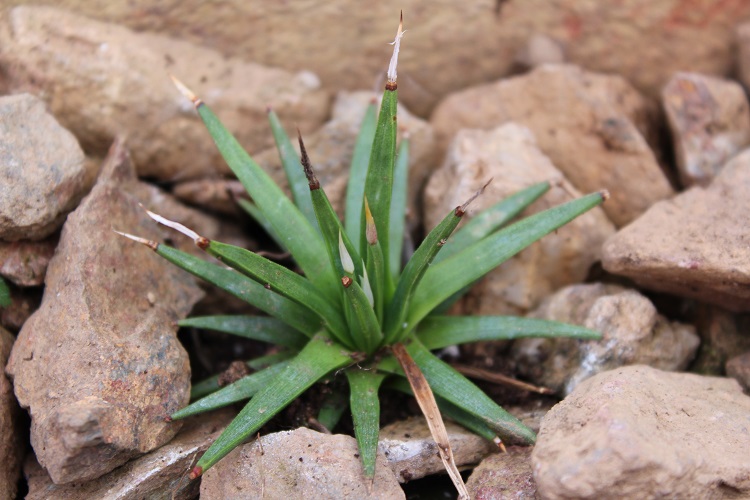
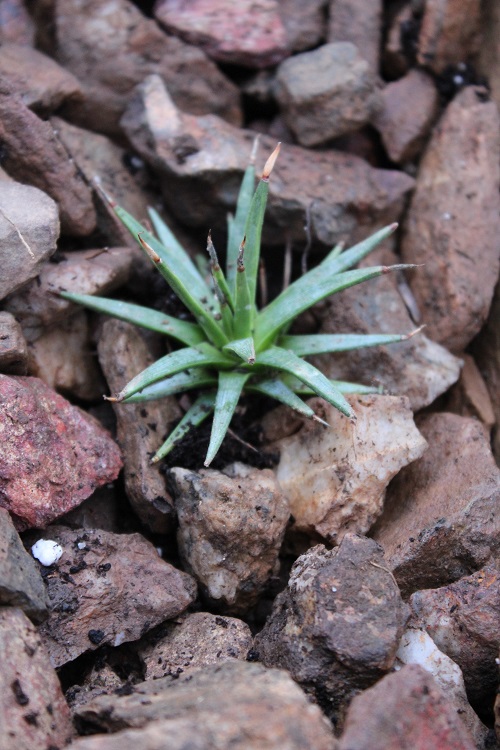
A newly discovered species from a cliffside in Mexico. It grows distinctive tufts of white hait from the leaf tips as it matures.
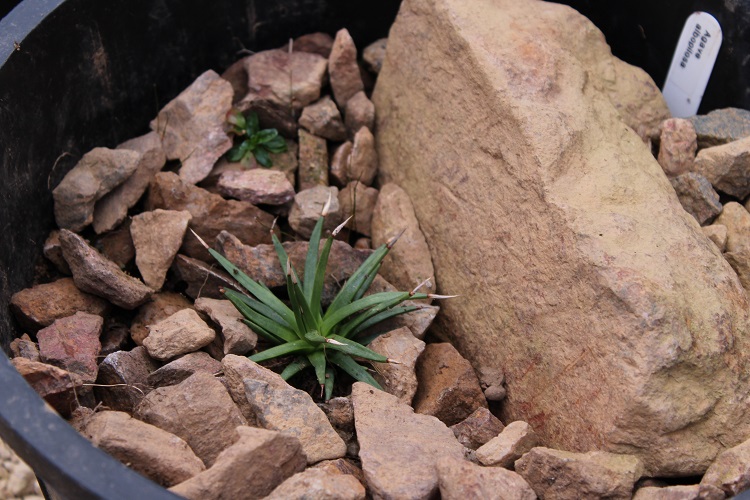
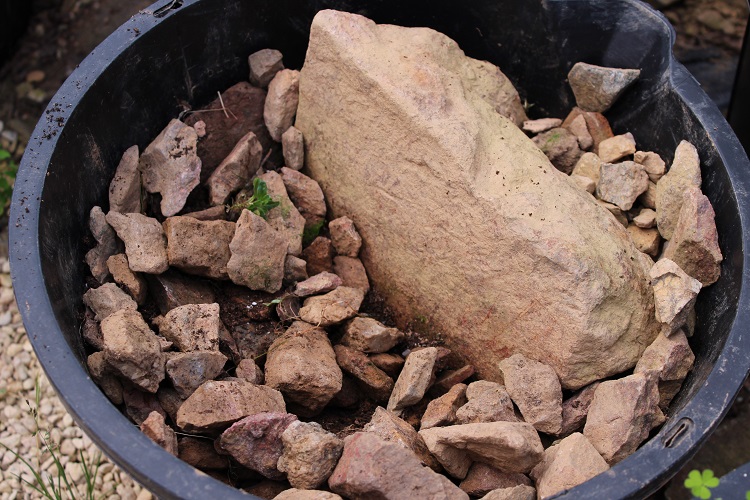
I was lucky enough to obtain a young seeding and it has been slowly increasing in size for a couple of years. Unfortunately there was a bit of a tragedy in spring 2016, and I lost it (to be exact, somebody stole it one night) so this is all I have to show. In the unlikely event that I can get another, I will try again. Pictures in habitat show perfect spiny globes of leaves with the sunlight shining on the white hairs. Quite wonderful. Llifle says: "The scattered populations of Agave albopilosa are found in a high altitude area of the nature reserve of La Huasteca in the Sierra Madre Oriental (Mexico). It is highly prized by collectors. 1000 up to 1500 metres above sea level. Habitat and ecology: These small saxicolous agaves grow on exposed areas glued to small fissures in a narrow ribbon of sharp limestone rock that juts straight up out of the earth. Though the natural habitat this species does experience some cool, and foggy days. The populations are formed by scattered solitary individuals or small colonies. The achievable plants are severely depleted, however, the plants growing on the steep walls of the cliffs are currently endangered. The white hair agave (Agave albopilosa) is an extra small species forming solitary or clustered balls of numerous, narrow leaves. It is unique in the genus and distinguished by the very peculiar full ring of white hairlike fibres just underneath the terminal spine. From a distance it looks like cotton balls on the end of each leaf, however the new leaves do not carry hair, but the horny area around the terminal spine looks a bit like the tip of a triangular wooden pencil that opens like a mesemb capsule to reveal the snow-white fibres. They could act as the areoles in cacti, and may serve as a capacitor and water sensor. For a plant that lives on vertical cliffs, it can be effective. This plant lives in the same manner of a bromeliad Tillandsia. Would it also absorbs moisture through its leaves and absorb water drops through its leaves? It is very slow growing and will grow to around 30 cm in diameter. Three year old seedlings are the size of a tennis ball. The plant was first found in the mid-1990s, but not described and given a scientific name until 2007." Plant Delights Nursery say: "Agave albopilosa is simply the most amazing agave species ever discovered, and one that took the succulent world by storm when it was first published in 2007. The small population of Agave albopilosa was discovered growing on a remote, nearly vertical, 3,500'-5,000' cliff in the mountains southwest of Monterrey in Nuevo Leon, Mexico. In the wild, Agave albopilosa grows with the winter-hardy Agave bracteosa, Agave victoriae-reginae, and Agave lechuguilla. At 1' tall x 20" wide, Agave albopilosa resembles Agave victoriae-reginae, which many botanists theorize was one of its ancient parents. The main difference between the two is that at agave puberty (around 3 years old) the tips of the narrow, green, upturned leaves develop little white tufts of hair. Agave albopilosa is as rare as proverbial hen's teeth since it does not usually offset and seeds have been insanely scarce. Our offering represents very limited three-year-old nursery propagated seedlings. We anticipate it could be as hardy as Agave victoriae-reginae, once it attains some size. Agave albopilosa has proven very easy to grow in containers." |
|
| 22nd November 2014 | ||