 |
I remember growing this in the 1970's but I have no idea what happened to the plant. Since then I have grown it a number of times, losing it to cold a few times
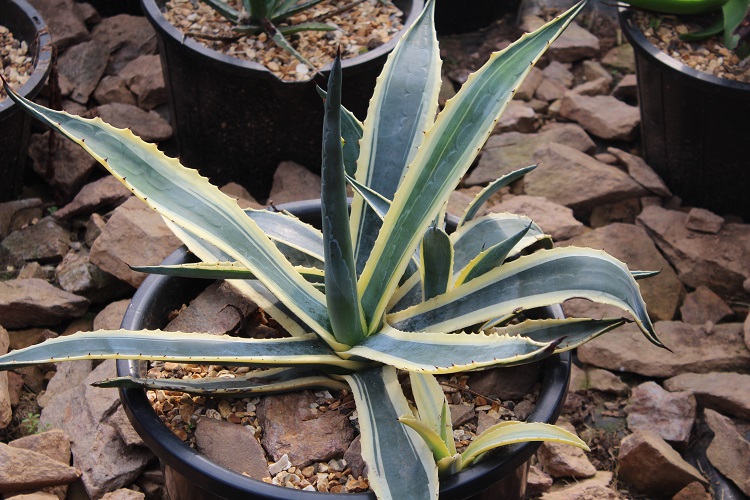
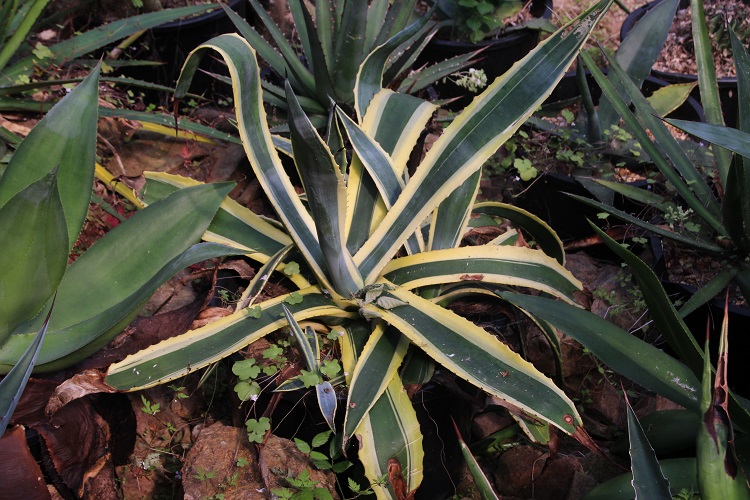
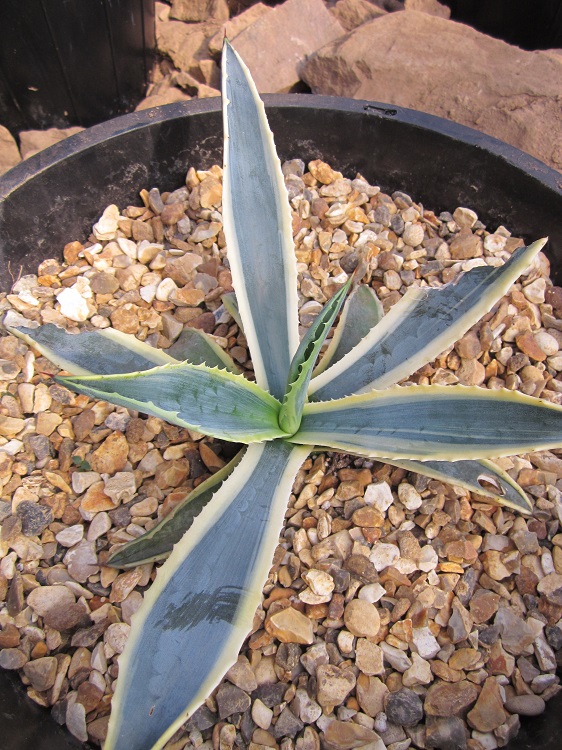
but more often losing it to neglect. Finally I planted one in the Agave house and it is growing in leaps and bounds. When I first moved to Cornwall one of the local wonders was a large plant growing in the tiny front garden of a local cottage. It was substantially larger than the garden could really accommodate and the heavy, rigid, spiny leaves hung out over the front wall to introduce themselves in a friendly fashion to the unwary. Eventually it flowered, a giant spike of magnificence, and it died. It wasn't replaced. Mine is still young, but growing in a much smaller space so there is a problem in the pipeline. A problem that I am going to whistle gaily and ignore! Horticulture Unlimited in Arizona say: "The plant forms a large rosette of twisted silvery-green leaves and strips of bright yellow along its leaf margins, giving it the appearance of a striped ribbon. Its sword-like leaves stand upright to about four to six feet tall and wide, growing in a stiff rosette. The leaves are armed with small brown hooks and it has a sharp, spiny tip on each leaf. Agave americana has many variegated forms that show differences in the leaves and names. Like most agaves, it produces a flower stalk only once in its lifetime, after ten to twenty years. The flower stalk grows to twenty feet or more, producing exotic, pale yellow blossoms. After blooming, the mother plant dies. The plant likes full sun and reflected heat, but can also take partial shade. It is drought-resistant, but will take light watering from either irrigation or natural rainfall during the hot, summer season. Variegated century plant produces offsets by underground rhizomes and tubers that can be easily propagated. The plant will grow in most soil, but prefers natural soil without any amendments added. It is hardy to thirteen to fifteen degrees Fahrenheit. Watch for signs of the agave snout weevil and treat it if needed. Use it as a dramatic, ornamental, or specimen plant in desert landscapes for its outstanding features. It can also be used in xeriscape or tropical landscape settings, or planted in tubs or large containers. This strikingly beautiful desert accent makes a dramatic statement and focal point in any landscape. The variegated century plant is native to Mexico, but has naturalized itself in Mediterranean and desert climates." San Marcos Growers say: "Agave americana var. marginata (Variegated Century Plant) – A large rosette-forming succulent to 5 to 6 feet tall by 6 to 8 feet wide with upright slightly wavy gray-green leaves that have strong cream to yellow margins. As with other Agave americana varieties this plant has yellow-green flowers that attract hummingbirds, but plants do not bloom until they are several decades or so old (not a century!) and the main flowering plant dies after flowering with suckers emerging around its base. Plant in full sun. Irrigate occasionally to not at all. Cold hardy to 15 degrees F or less. This large plant can be dramatic in the landscape - give it plenty of room and situate it away from traffic. Great on a hillside." |
|
| 14th September 2013 | ||