|
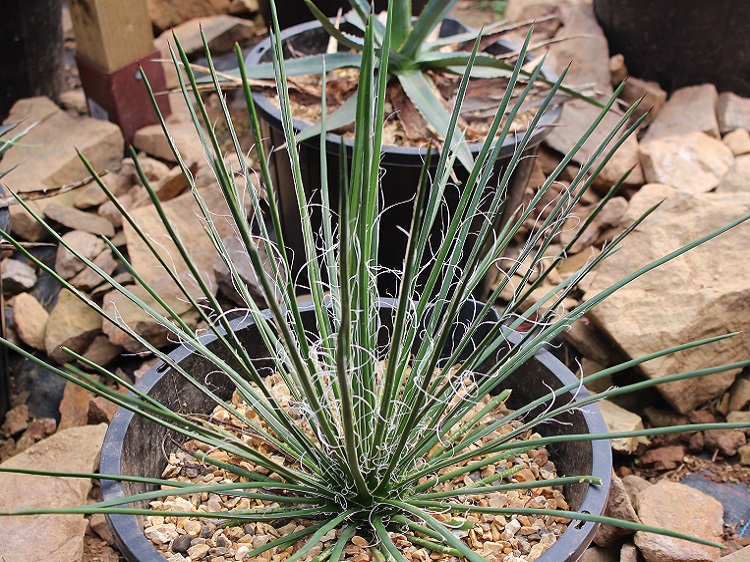
An attractive species with long flexible leaves (but they still have a dangerous spine on the end). Grows only in a very small area
in the Mexican state of Nayarit but seedlings are now becoming available. This is partly because of its beauty, but mostly because it tends to flower and die
without leaving offsets, so seed is collected and grown! I had hoped that it would be as tough as A.filifera, but some sharp frosts through the winter have killed the centre of the plant and by April it was dead. I thought it was worth a second try and this time I have planted it in expanded clay granules to see if really free drainage helped. There was a time when all roads led to Rome and with similar inevitability, all Agave end up in the Agave house. It is happier with a free root run than it ever was in a pot. Gentry says: "The native habitat of this agave was long unknown. Ker-Gawler presumed it was from South America. It is still known only from a small area of oak woodland, 2-10 miles (3-16km) north of Ocotillo at elevations between 1,000 and 1,400m. This area has an equable climate with around 1,000mm of annual rainfall from summer to winter followed by a dry spring. A. geminiflora grows along the rocky arroyos and scattered with grass on rocky ground among the deciduous oaks as well. It makes a long-lived, handsome rosette ornamental for patios and gardens. In the 1950s a few plants lent special interest to the central plaza in Tepic, where they were placed as pedestal plants in large urns. It is rarely seen in horticulture but should be evry suitable for landscaping." San Marcos Growers say: "This unique agave has narrow, dark green unarmed leaves that are very flexible. These leaves, which often number in the 100's, cascade from the center of the plant forming a dense rounded rosette to 2 to 3 feet tall by as wide. When plants mature they will initiate flowers which are formed in pairs on an unbranched spike that rises 8 to 10 feet. Plant in full sun along coast and part sun to light shade in hot inland gardens. Drought resistant, but looks better with some summer watering. Hardy to 25 F. Although this species is noted to not produce offsets, we have observed that as the main plant dies after flowering, a few new suckers occasionally emerge from within the old foliage. A great plant in a large container or planted out in the ground The native habitat of Agave geminiflora is oak woodlands at 3,000 to 4,000 feet in the Nayarit, Mexico. The specific epithet 'geminiflora', meaning "twin flowered" is in reference to the flowers being in pairs. Similar to Agave filifera ssp multifilifera but Agave geminiflora has more rounded leaves and fewer hairs on the leaf margins." |
|
| 13th February 2009 | ||