 |
Howard Scott Gentry was responsible for sorting the chaos of the genus Agave into our modern understanding. His book "Agaves of Continental North America" (1982)
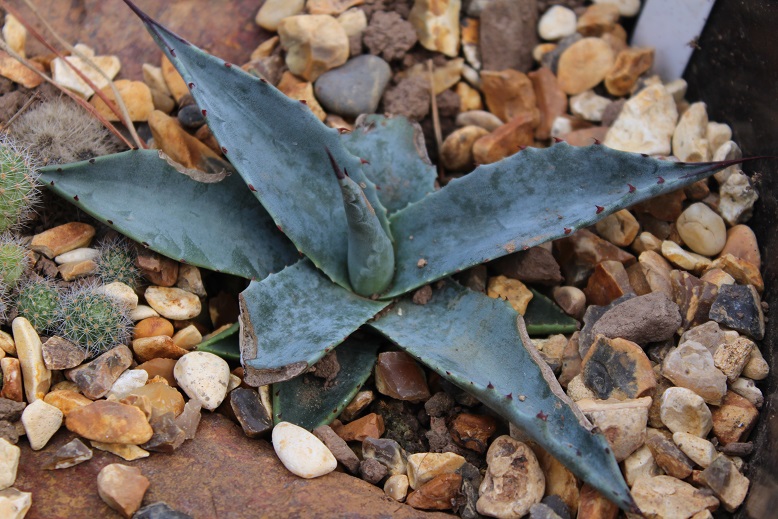
was the culmination of a lifetimes research and field trips to Mexico. This is a mountain species from the Sierra Madre Oriental in northeastern Mexico and Gentry identified these plants as A. macroculmis based on a type specimen grown in the botanic garden of Palermo, Sicily. However these northern plants have fleshy bracts on the flower spike, missing in A. macroculmis which has now been sunk into A. atrovirens. All of which left this northern population of very distinctive plants without a valid name so it was fitting that Bernd Ullrich named them after Gentry. Like A. montana it grows in mountains that have a moist, possibly even wet, winter climate which opens the possibility of Agave that will tolerate both cold and wet in winter. I bought a seedling in 2014 and if I had any sense, I would have bought half a dozen to try outside. Unfortunately ..... Under the name A. macroculmis Gentry says: "Agave macroculmis is a high montane species, living generally between 7,000 and 9,000 feet (2,150 and 2,800 m) elevations on limestones in oak and pine forest or with chaparral. Snow may fall in these elevations. Occasional plants are found at lower elevations, especially in northward canyons and slopes, as on the lower slopes near Saltillo at about 6,000 feet (1,850 m) elevation. For Agave, it is a mesophyte, requiring relatively high rainfall, cold hardy, and tolerant of some forest shade. It has a long range of over 500 miles (800 km) along the Sierra Madre Oriental. It has no natural type loca;lity but was probably first collected from the southern part of its range in the state of Hidalgo, where men were moving along the roads between the mines in the mountains. In the field I found no special name for this Agave. The people simply called it "maguay" or "maguay verde". Near Parras, and probably elsewhere, the flowering shoot in the asparagus stage is much cut for eating. The heavy shoota are packed down off the Sierra de Parras by mule and steam cooked on the outskirts of Parras. In 1972, I saw then hauled to market in a light truck. They were sold in one-half inch cross-slices for a few cents along the street near the Parras market, and elsewhere. It provides a crude sweet to chew out of the fibre, which is spit upon the ground." |
|
| 1st March 2015 | ||