 |
A clustering species from Guatemala and southern Mexico and at first sight, not one of the species most likely to tolerate low winter temperatures. However although
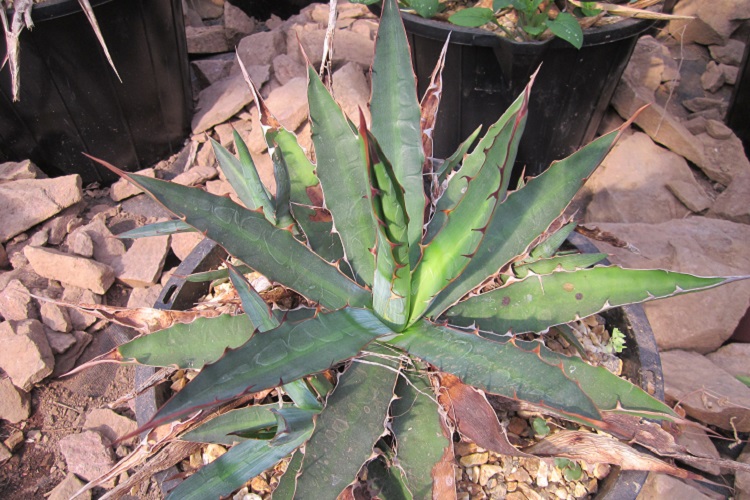
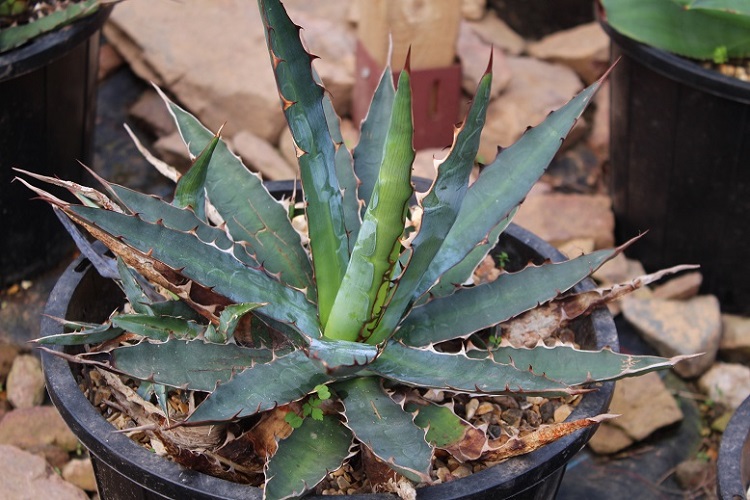
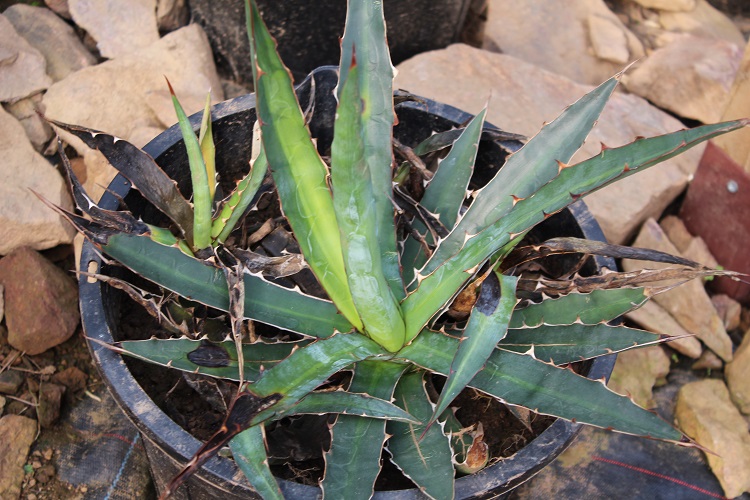
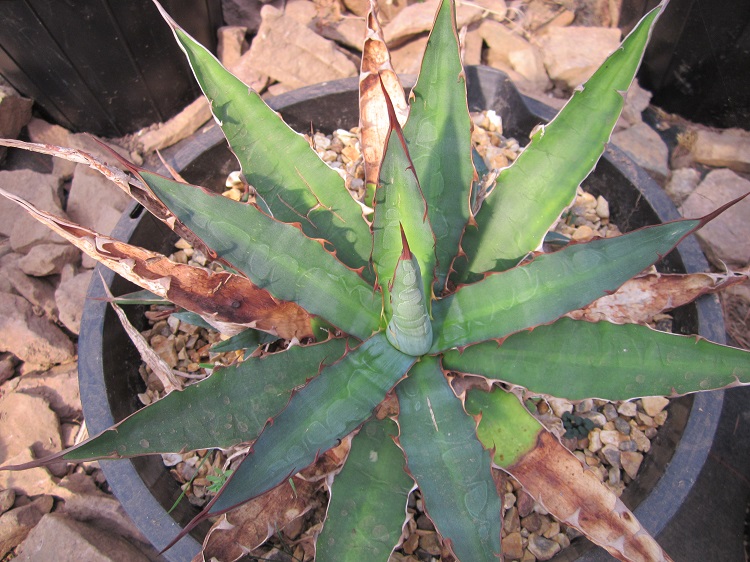
technically it comes from the tropics it comes from an climate with an extremely dry winter and spring period. I raised seed in 1993, and was sent a single offset in the same year. Although I now have two plants, I can't tell which is which. Both have survived a series of harsh winters, sometimes thanks to the care and effort I have lavished on them, but more often despite being ignored or forgotten. Gentry says: "The perimeters of this taxon are not clear to me. The suckering clones of A. ghiesbreghtii rarely flower and I failed to find an adequate series of flowering specimens from the richly diverse Marginatae about Tehuacan and elsewhere. Agave ghiesbreghtii (fid. Berger, erroneously spelled ghiesbrechtii) is closely related to A. kerchovei, from which it isa generally distinguished by its shorter broader leaves with more proximal smaller teeth on narrower dark corneous margins. Some of the small leaved forms may not be separable at sight from A. horrida and A. obscura, but the latter are usually separable by thier larger, more closely spaced teeth which continue nearly to the base of the spine and by the flat, ungrooved base of the spine. A. ghiesbreghtii is frequently cultivated as a fence plant. In time, and when kept trimmed, it forms dense inpenatrable obstacles up to 1m tall and 2-3m broad, as at Tlacotepec. and Miahuatlan, Oaxaca. The leaves of such forms are usually linear or deltoid, stiff, and strongly armed." San Marcos Growers say: "A medium-sized agave that has individual rosettes to 30 inches wide by 2 feet tall and offsets extensively on short rhizomes to form tight solid clumps. The 3 to 4 inch wide leaves are widest toward the middle, slightly guttered on the upper surface, and have attractive and varied contrasting leaf color. The terminal spine is about 1/2 inch long and the margins have down-turned spines. Young leaves have attractive red margins and spines that age to pale gray as the leaf ages, contrasting well with the dark green leaves, which are also marked with a paler green midrib stripe. When plants mature and flower, often during spring, the greenish-purple flowers are borne on 8-13 feet unbranched spikes. Plant in full sun. Requires little or no irrigation. Hardy to 20° F. This plant comes from the state of Mexico in Mexico south to Guatemala. It makes a great container plant and is useful in the garden as a low prickly hedge. " |
|
| 14th September 2013 | ||