 |
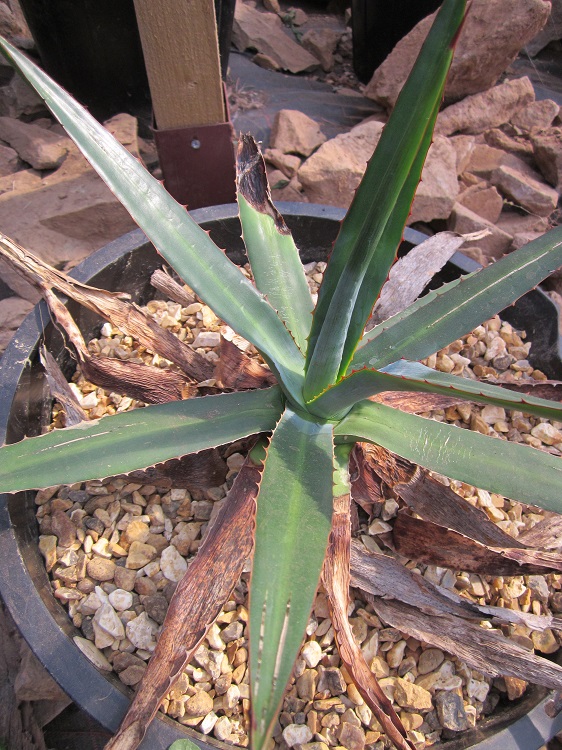
A vigorous spiny monster, part of a species complex including Aa. funkiana, lechuguilla and xylonacantha. A. lophantha occurs along the south east coast of Mexico. Some selections are quite cold tolerant, those from the extreme south less so. I bought my single plant in May 1993 (numbered 073A) and it survived a couple of decades of neglect before it was planted in the Agave house. Still fairly small and stunted for its age, it has started to grow strongly (and dangerously). Gentry says: The natural distribution of Agave lophantha is now known to extend from southeastern Texas southward in Mexico along the east coast of Mexico to central Veracruz. It is frequent on limestone, as on cliffs and rocky outcrops, where tropical forests are not too dense to prevent adequate sunlight, at elevations from 100 to 5,000 feet (30 to 1,500 m). The identity of the name lophantha did not become certain until it was recollected at the type locality by Trelease in 1905 and Gentry in 1963. When I relocated the topotypical plants in 1963, I had to look for the old mule trail from Xalapa to Naulinco (also spelled Naulingo), which more or less parallels the modern auto road at lower elevations along the forested slopes of the Huatusco Region. A. lophantha has responded well in our southwestern gardens. Some of the tropical forms may be frost sensitive, but in the Desert Botanical Garden we have collections from San Luis Potosi and elsewhere that have survived frost down to 20 deg.F (-7 degC) without damage. The leaves are bright green color. The Llifle encyclopedia says: "Agave lophantha (syn: Agave univittata) is an stemless, usually suckering agave that forms dense clumps to 60 cm tall by 1.5 m wide composed of very regular leaf rosettes of a light green to yellow-green, with or without pale mid-stripe. Leaves wide at the base, long tapering grey-green, slightly hollow on the upper side with or without pale mid-stripe, marginal spines stout, curved downwards, terminal spine very sharp, 25 mm long. It is extremely variable and has many varieties and forms. The name Agave lophantha was mentioned by C. J. W. Schiede (Linnaea 4: 582. 1829) without a description. C. S. Kunth (Enum. Pl. 5: 838. 1850) validated the name, but not before Agave univittata was proposed. Neither name is typified nor is any authentic material known. H. S. Gentry (1982) incorrectly retained A. lophantha and it is now widely used. A. J. Breitung (1959) was the first to adopt A. univittata, and that name is taken up here." |
|
| 14th September 2013 | ||