San Marcos Growers say:
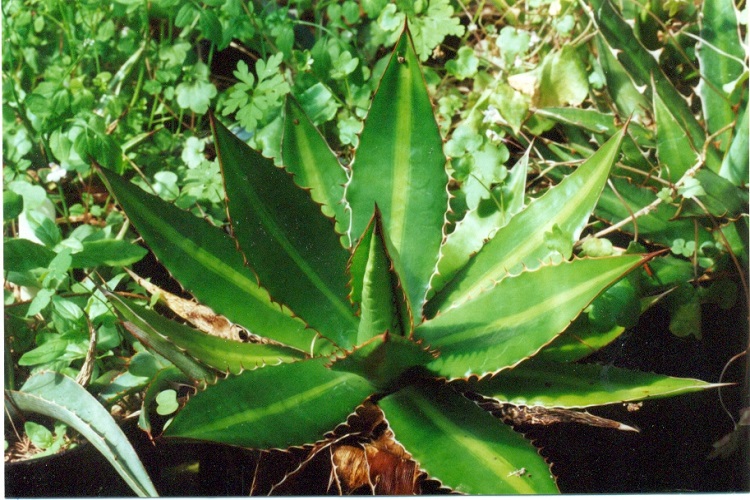
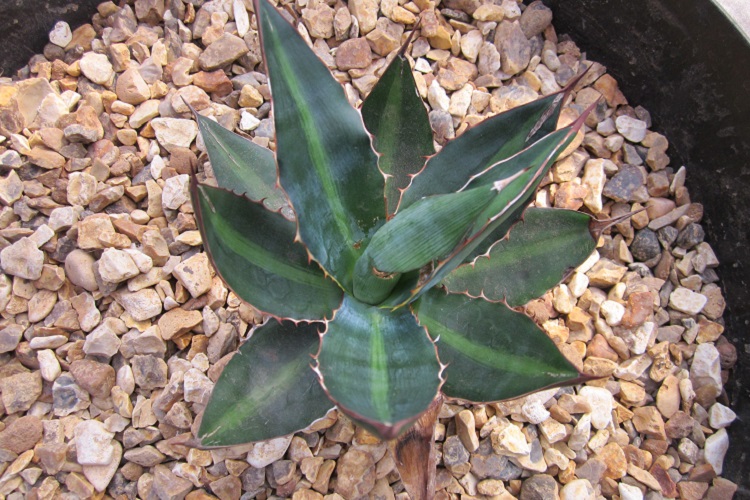
"A small distinctive looking low growing nearly unarmed agave that forms open clusters of 1 to 2 foot wide rosettes and spreading slowly by stolons.
The rosettes have only a few narrow leaves that reflex to spread out wide and then recurve downwards.
These narrow 6 inch to 1-foot-long leaves are a mid-green color with a pale mid-stripe and are and flat or slightly concave on the upper surface and convex below.
The margins have well-spaced minute teeth and the red terminal spines are not sharp. In bright light the leaves can turn a darker purple color but will always have a lighter central stripe.
The inflorescence is not often seen but rises 3 feet tall with a capitate cluster of greenish flowers.
Plant in bright shade or morning sun in a well-drained soil and irrigate occasionally. Hardy to only a light frost and short durations temperatures slightly below 32° F.
This unique plant might be best for a container or large dish garden but can grow outdoors as an interesting ground cover in a warm, frost-free climate in a well-drained soil
in a brightly shaded or morning sun location. This plant is a unique plant for the collector, but it is a bit brittle and needs to be in a location that provides protection from traffic,
frost and full sun, but a bright shade or morning sun location can bring out darker colors, sometimes attractive purple tone in the leaves.
Agave nizandensis comes from a very limited area on the Isthmus of Tehuantepec near the town of Nizanda in the southern state of Oaxaca, Mexico, where it grows in dry forests on steep limestone slopes.
The name for the genus is one given by Swedish naturalist Carolus Linnaeus. It comes from the Greek word 'agaue' (agauos or agavos) meaning "noble" or "splendid" and originates from Greek mythology.
Agaue was the daughter of Cadmus, the king and founder of the city of Thebes, and of the goddess Harmonia. The name was first used by Linnaeus in 1753 when he described Agave americana.
The specific epithet refers to the village Nizanda, where the species was discovered.
Though not listed on the Red List, some consider this plant to be an endangered species due to its limited range and continued habitat loss.
In an article in the Fall 1951 issue of the Cactus and Succulent Journal (Vol.23 No.5) titled "A New Dwarf Mexican Agave" Ladislaus (Lad) Cutak first describes this plant after finding
this plant with Tom McDougal in 1947. He noted: "A second maguey ... caught my immediate fancy for it formed dense mats and looked like it might make an excellent pot plant.
It was definitely different from all the Agaves of my acquaintance." In Gentry's introduction on the Group Amolae where he listed this species he expanded on this thought by writing
"The Amole is a heterogeneous group. Some of the species have extra-sectional characteristics … The diminutive A. nizandensis is especially anomalous because its small umbellate inflorescence
on a Littaea-like leaf rosette. It does not fit well into any section of subgenus Agave or Littaea and it is placed here as a provisional convenience." "
|