|
A new species, only described in 2002 freom the mountains of Nuevo Leon in Mexico. Reports from the USA said that it was by far the best species for surviving
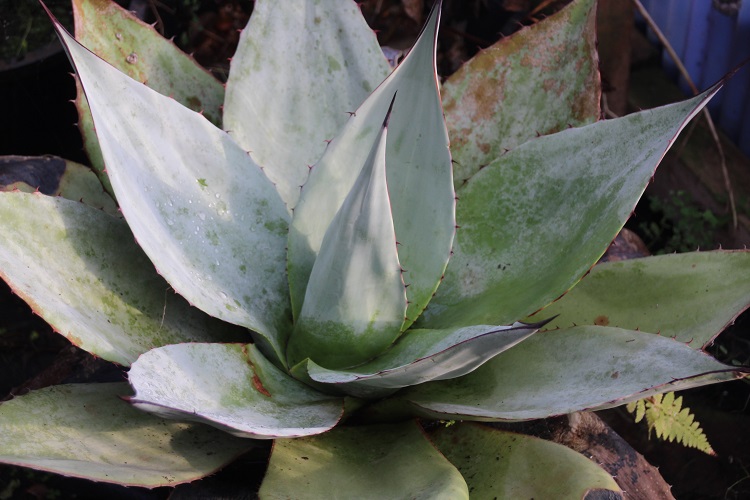
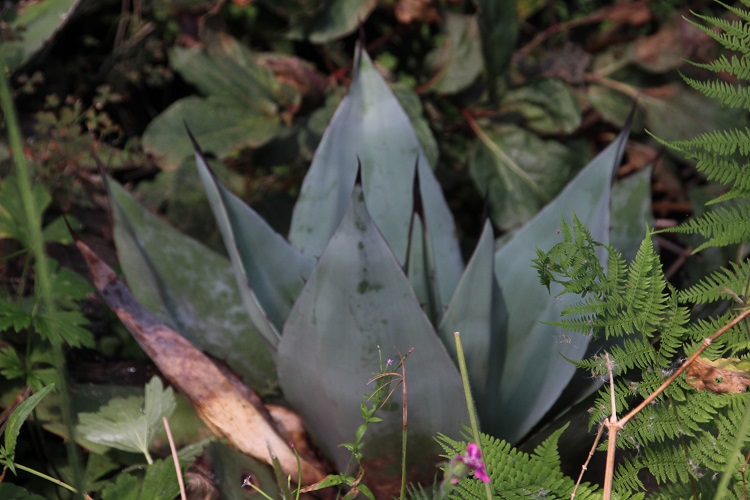
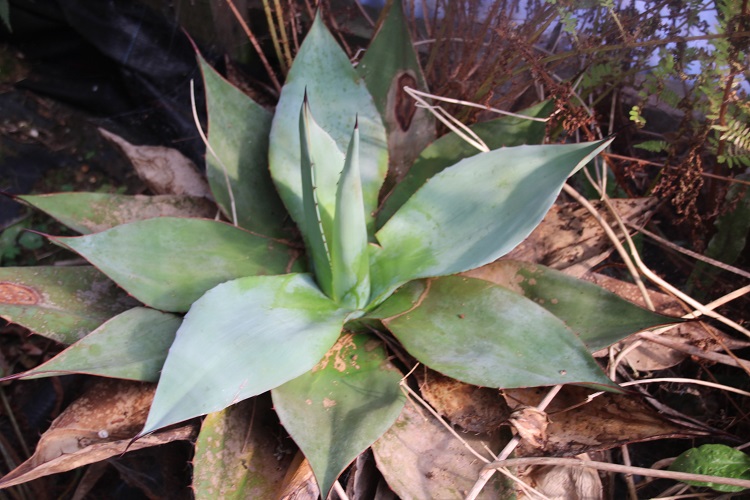
cold wet winters. It was high on my list of young plants to look out for. And then suddenly some mature plants appeared in a local nursery, grown from seed in Spain and looking wonderful. It would have been stupid to miss out, so I hurried over and got the chance to pick the best blue leaved specimen from the group (though several had already gone by the time I got there). It seems to have adapted well to life in the Agave house, and I know another looking good locally outside. I wish I had bought several to try (but big agaves don't come cheap)! In recent years it has become overgrown and shaded but I have not found the inclination or determination required to dig it out and move it. San Marcos Growers say: "A solitary (non-offsetting) succulent that grows from 2 to 5 feet tall by 3 to 7 feet wide with a rounded rosette of short wide gray leaves that are distinctively cupped. Leaves have small teeth along their margins and a 1-inch-long dark gray terminal spine. When this plant flowers it forms a 10-14 foot tall spike with greenish-yellow flowers. Plant in full sun in a well-drained soil and requires little to no supplemental irrigation. Has proven hardy down to at least 4-5° F. It has been noted that this plant has stayed smaller in hot dry locations where water has been withheld but responds well to irrigation and grows much larger. Agave ovatifolia occurs naturally at elevations from 3,700 to 7,000 feet int the Sierra de Lampazos in northern Nuevo Leon in northeastern Mexico. It was originally collected and distributed around 1894 by Mrs Anna Nickels as Agave "Noah" but was never properly described or published under this name as addressed by the article "Proposal to reject the name Agave noah (Agavaceae)" in the November 2003 issue of Taxon (52) by Greg Star, José Villarreal, Eduardo Estrada & Manuel de la Rosa. It was also once synonymized with Agave wislizenii by Trelease in 1911 and more recently included with A. parryi. It was properly described as Agave ovatifolia by Greg Starr and Jose Angel Villareal (STARR G, VILLARREAL JAQ. 2002. "Agave ovatifolia (Agavaceae) Una Nueva Especie De Maguey Del Noreste De Mexico" Sida 20 (2): 495-499). The specific epithet, from the Latin words 'ovatus' for "egg" and 'folius' for "leaves" is in reference to the broad ovate leaves and the common name, whale's tongue agave, also describes the leaf shape. There is speculation that this plant was distributed in California unnamed but there is no documentation on this or information how this plant performs in cultivation in California. As it is similar and related to Agave parryi the presumption is that it will grow as well as Agave parryi does in cultivation - so far this has proven true. Our original stock plants were purchased from Starr Nursery in 2004." |
|
| 19th June 2015 | ||