|
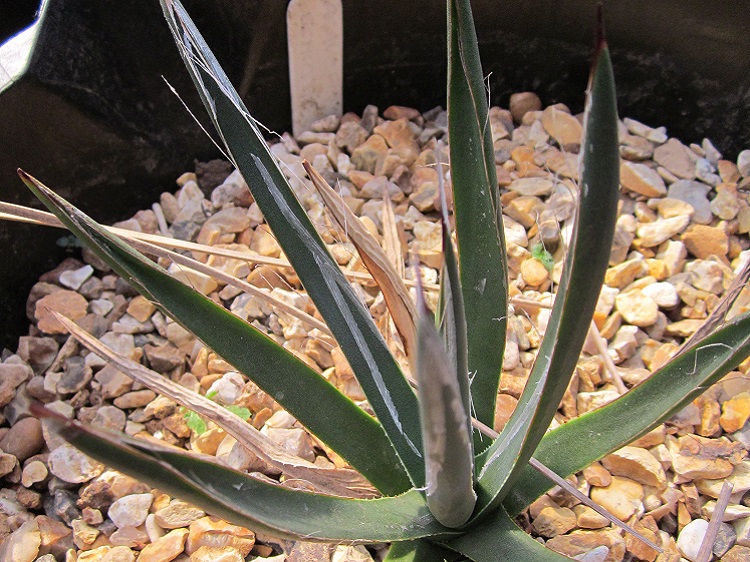
I have just been given these five seedlings (thanks Steve) from the Mazatal Mountains in Arizona. They have potential to be cold hardy,
but I have lost it outside in the wet before, so the next trial will be under a plastic cover. I had a rather lovely little group of them developing in the Agave house but unfortunately I lost a couple of them to theft in late spring. I'm not going to spend my life locking the greenhouse every spare moment and walking around with a big set of keys to get access in my own garden, so I'm going to live with it and hope it's just kids in that awkward period before they discover sex. Meantime I can enjoy the spikiness of the remainder and hope that the stolen plants put up a fight. Gentry says: "A.schottii has a relatively extensive distribution acrtoss southern Arizona and adjacent Sonora to southwestern New Mexico and northwestern Chihuahua. The low elevation disjunct populations near El Datil and Sierrita Picu in northwestern Sonora are ecologically exceptional, as the main habitat is on elevations above 3,000 feet (900 m) with grama grassland and oak woodland biomes. Here they are so abundant on some cattle ranges that cattlemen regard them with disfavour, as they are not edible to livestock. However, they contribute to soil building and hold soil on the steep rocky slopes. Among Spanish-speaking people these small nondescript agaves are known as "amole" or "amoliyo" and are lsed locally for washing clothes. They are not eaten because of the small size of the "heads" (stems) or because of bitter constituents. The plants have little if any value as ornamentals." Gardenworld says: "Agave schottii, also called Schott's Century Plant or Hedgehog Agave, is a small, compact succulent from southern Arizona, southwestern New Mexico, and northern Sonora, Mexico. Perfect for smaller gardens and rocky areas due to its compact size, growing only 30-45 cm tall. This unique agave is known for its thin, hairy foliage resembling small hairy tentacles, giving it a distinctive appearance. Frost-tolerant to -10°C, suitable for dry southwestern-style gardens and xeriscape designs. Minimal maintenance required. Agave schottii grows as a very small, compact rosette. Reaching only 30-45 cm height and width. Leaves are narrow, about 15-20 cm long, and notably hairy or woolly. Leaves are green with soft, wavy margins lacking strong teeth. After 8-12 years, the plant may produce a flower spike reaching 1.5-2 meters with yellow flowers. Relatively modest compared to other agaves. After blooming, the mother plant dies but numerous offset plantlets emerge from the base. This agave requires full sun. Plant in very sunny, warm locations. Tolerates full wind and extreme drought well. Perfect for roof gardens, dry slopes, and rock gardens." |
|
| 24th February 2008 | ||