 |
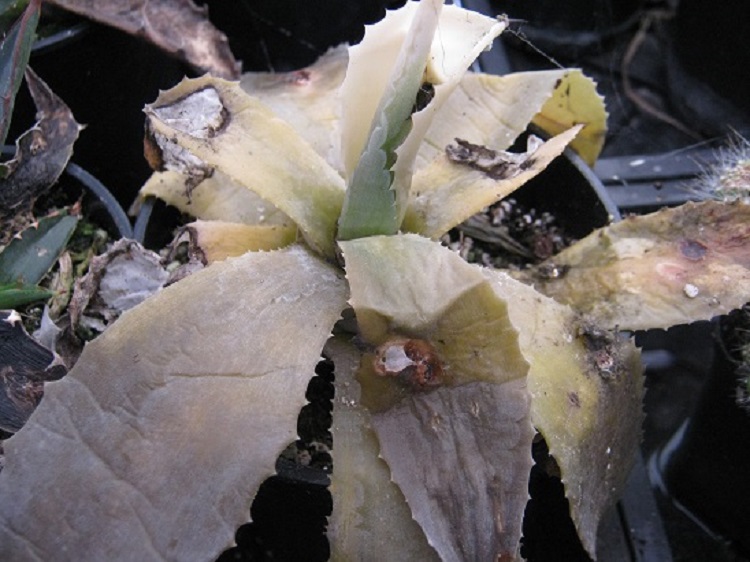
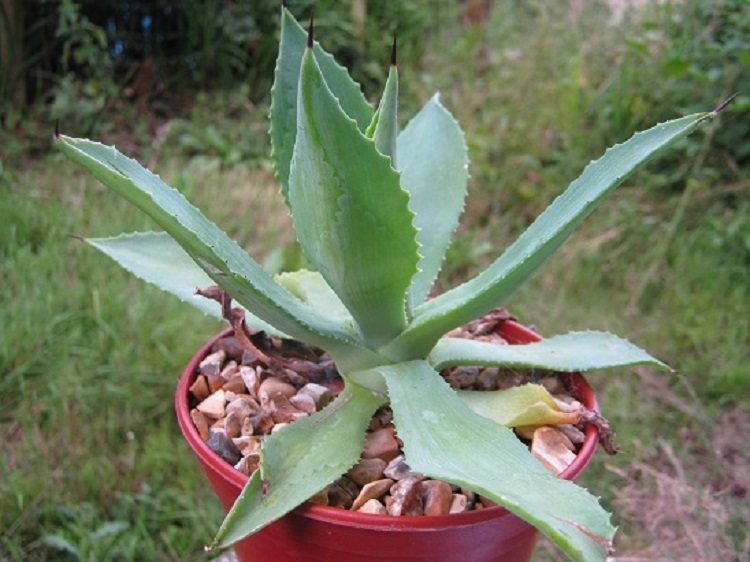
A small growing blue green species that grows from Chiapas in Mexico through to northern Nicaragua. I didn't find out that the species was exclusively tropical until this happened! Gentry says: "Agave seemanniana is generally recognizable in its area by its small compact rosettes with broad plane glaucous leaves, markedly narrowed at the base. It shows considerable variation in form and size of leaf and in margins and teeth. The terminal spike, widened at the base and sharply decurrent, with its broad flat groove of the upper surface, is also consistently characteristic, but it shares this character with its near relative, A. hiemiflora. The plant was originally introduced by Berthold Seeman, naturalist on the voyage of the H.M.S. Herald, 1849-51, who collected seeds in Nuevo Segovia (now northern Nicaragua or agjacent Honduras). Some of these seeds were propagated by a Mr. Bull of England, and through him plants reached the Royal Botanic Gardens, in Kew and perhaps other gardens. They are tropical plants and may have been killed by the occasional freezes that visit all these gardens." The Llifle encyclopedia says: "Guatemala (Baja Verapaz, Zacapa, Chiquimula, Jalapa, Jutiapa Solola), northern Nicaragua (type from Segovia), Costa Rica, Honduras and also in Mexico (Oaxaca, Chiapas: Colonio Cardenez to Las Cruces and along the road to Arriaga). The range of Agave seemanniana overlaps that of Opuntia decumbens but extends only as far south as Nicaragua. Altitude: (300-)400-1550(-2200) meters above sea level. Habitat: It grows in a wholly tropical area in dry, rocky, open or brushy slopes and arid pinelands. Agave seemanniana is a solitary, non-suckering medium-sized agave generally recognizable in its area by its small compact rosettes with broad plane glaucous leaves, markedly narrowed at the base. It is rather variable, resulting in its redescription under several names." |
|
| 3rd July 2010 | ||