| Home | Index | Web Stuff | Copyright | Links | Me |
|
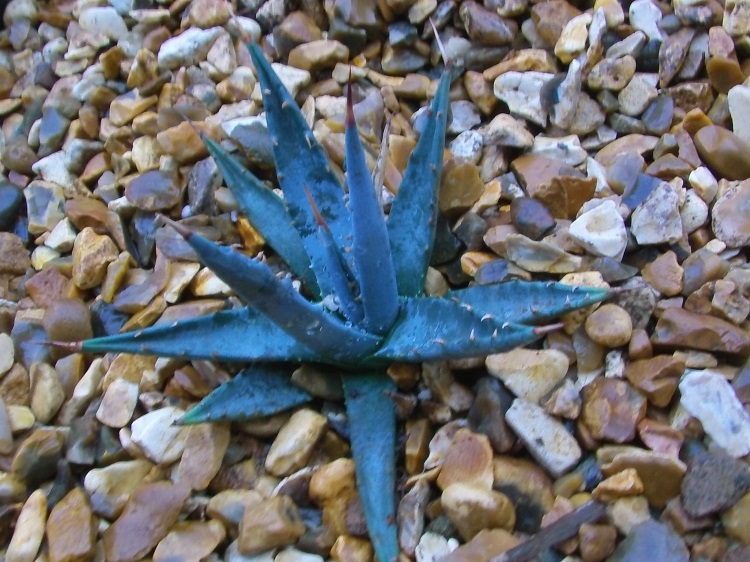
This subspecies of A.utahensis from Nevada grows in the mountains at altitudes of up to six thousand feet. Smallish rosettes, but very very cold hardy.
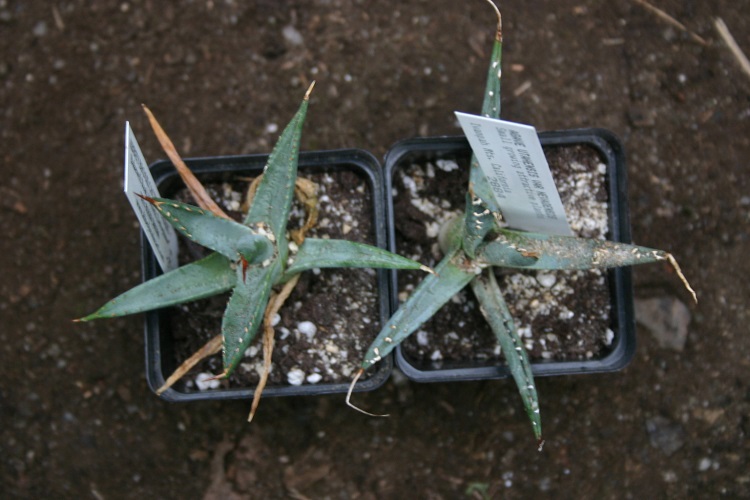
Does not tolerate winter wet at all well. This one was a bit lacking in charisma as a young plant, but it is developing well in the Agave house with a long brown spine on the end of the leaf. Gentry says: "Variety nevadensis is like var. utahensis but differs with smaller rosettes, 15 - 25 cm tall; leaves frequently bluish gray glaucous, generally with larger teeth; spines elongated especially in proportion to the fleshy part of the leaf. Inflorescence as for the species with both simpler spicte forms and paniculate forms. The main core of nevadensis exhibits a morphological difference from the general populations in the eastern areas of the species, but there are transitional forms between the two in southwestern Utah and perhaps elsewhere. Agave utahensis nevadensis is a montane endemic in the southern Mohave desert frequenting limestone outcrops betweeen 4,000 and 6,000 feet (1,240 and 1,850 m) elevations; southern Nevada and southeastern California. This is an arid environment with freezing tempetatures in winter, down to 0 degF (-18 degC)." |
|
| 22nd October 2005 | ||
|
Gerhard Bock writes in his Succulents and More blog:" "This post is about Agave utahensis var. nevadensis. Here is a separate post on var. eborispina, arguably the most spectacular form of Agave utahensis. Since both var. nevadensis and var. eborispina are heavily poached, exact habitat locations are kept secret. These agaves are under constant human threat, yet they are not considered endangered on a federal level. Agave utahensis var. nevadensis generally doesn't have the impressive terminal spines of var. eborispina, but it's highly decorative plant in its own right. Like many other agaves from extreme climates, Agave utahensis can be challenging in cultivation. The key is to plant in extremely well-draining soil, ideally on a mound, and to mimic the natural rainfall patterns of its native habitat: keep dry in the winter and water regularly in the summer. As I mentioned earlier, some taxonomists now think nevadensis and eborispina are simply local variations of Agave utahensis ssp. utahensis. In general, var. eborispina has much longer cream-colored terminal spines, often twisted into corkscrew shapes, but we saw var. nevadensis with long terminal spines as well. Some sources say var. nevadensis has bluish leaves while var. eborispina is more green than blue. Another difference I've heard is that var. nevadensis offsets, often prodigiously, while var. eborispina is generally solitary, although we did see clumps of eborispina in habitat. It's impossible comparing the two varieties side by side because they grow in disjunct populations, never together. " |
|
|
|
| 14th September 2007 | 13th January 2014 | 1st March 2015 |