 |
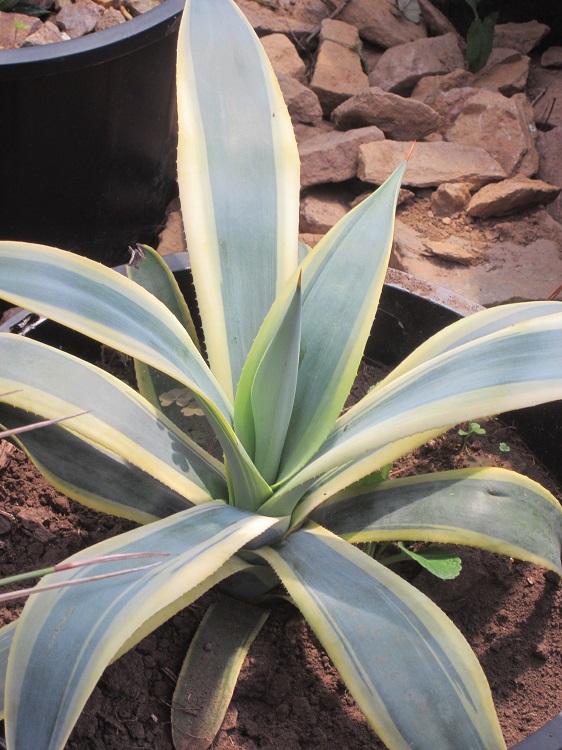
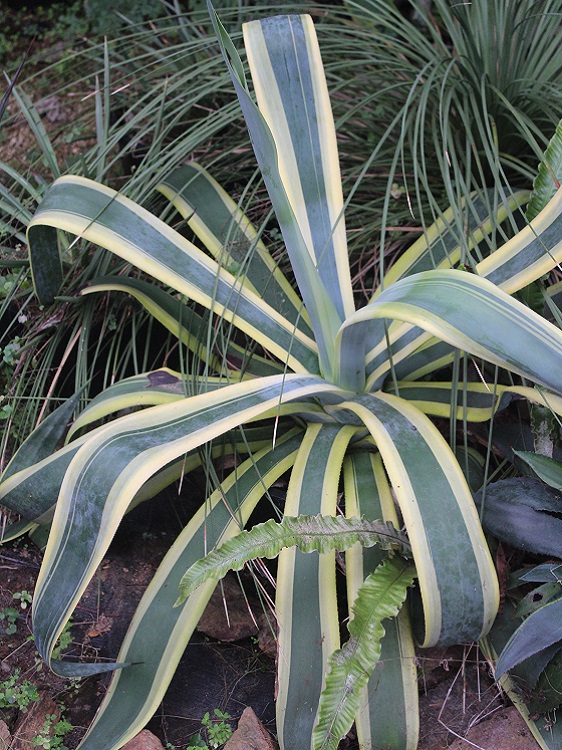
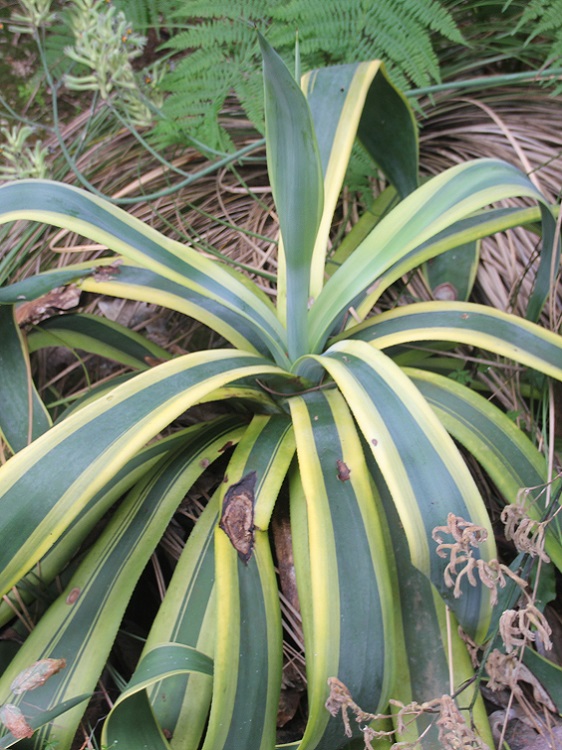
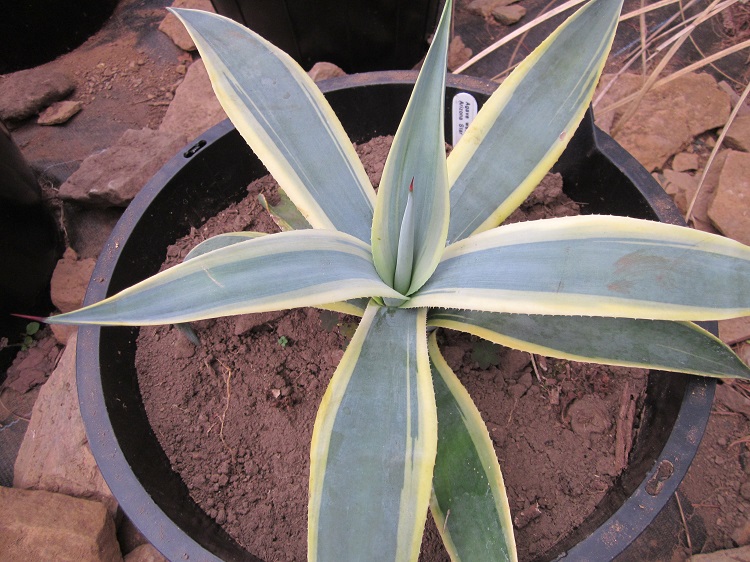
A large growing grey-green species with tiny teeth along the sides of the leaves. It probably originates in northern Mexico but can now be found as far north as Texas.
This splendid variegated form found at the Mountain States Wholesale Nursery in Arizona. Has grown well once it was planted out. There have been occasional moments
when I worried about winter damage but it seems to survive and grow out of the damage very quickly. Gentry says of Agave weberi: "The plant has a desultory local use for pulque and fiber, which is of fine quality. Plantings of it are small and widely scattered inn arid northern Mexico, usually about houses and as fences. It appears to be a latecomer in the lower Rio Grande Valley of Texas, where it is planted as an ornamental and the plants appear spontaneously freely suckering along roadsides. The grayer variants may be mistaked at uncritical sight for A. americana, but the smooth or nearly unarmed margins distinguish it as A. weberi." San Marcos Growers say: "Medium sized rosette-forming succulent to 4 feet tall by 7 feet wide with fleshy, spine-tipped blue-green leaves that have a wide marginal pale-yellow stripe along the nearly spineless margins. Like the species this plant should have bright yellow flowers on 20' branched stalks at maturity. Plant in full sun to light shade in a well-draining soil. Hardy to 10° F. A stunning plant when well grown with strong yellow variegation that stands out from the gray center of the leaf - must for any succulent garden that has room for it. The neotype for this species is noted as from between Laredo and Catarina in Texas but an occurrence of a native planting is no longer known although there are many variants found as cultivated plants in arid areas of north-central and northeastern Mexico and South Texas. It was described in 1901 in the Bulletin du Muséum d'histoire Naturelle by the French botanist Jules Poisson (1833-1919) who attributed the name to another French botanist Jean Francois Cels (1810–1888) based on a specimen collected in Mexico that was then growing in Paris. The name for the genus is one given by Swedish naturalist Carolus Linnaeus. It comes from the Greek word 'agaue' (agauos or agavos) meaning "noble" or "splendid" and originates from Greek mythology. Agaue was the daughter of Cadmus, the king and founder of the city of Thebes, and of the goddess Harmonia. The name was first used by Linnaeus in 1753 when he described Agave americana. The specific epithet honors the French surgeon and botanist Frederic Albert Constantin Weber who in 1902 described Agave tequilana. This selection was made by Tony Avent from a crop of Agave weberi growing at Mountain States Nursery in Arizona and and introduced at Tony's Plant Delights Nursery in 2007." |
|
| 27th September 2013 | ||