 |
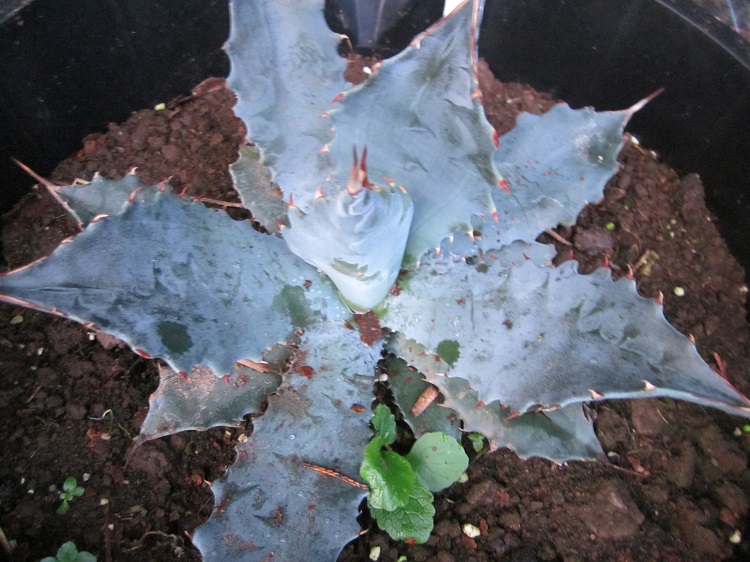
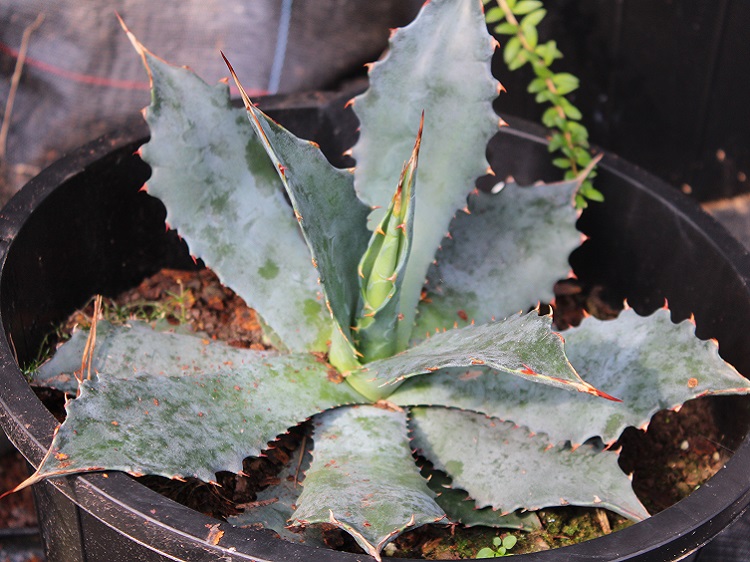
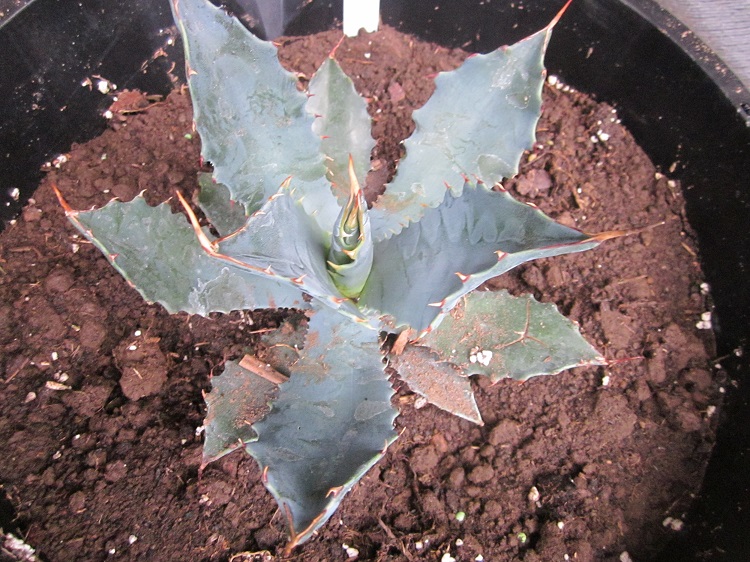
A compact blue leaved plant that occurs in small scattered colonies in a small area on the borders of Sonora, Chihuahua and Durango at high elevations.
I knew nothing about it until I was given this seedling. It has grown rapidly in the Agave house, lightly shaded in the hope of protecting the
broad flat leaves from damage by radiation frost. So far I appear to have been over-cautious, but I only have one plant and I don't want to lose it. Gentry says: "Agave wocomahi is native to the rocky, calcareous, open mountain slopes through the pine-oak forests at elevations between 4,500 and 8,100 feet (1,400 and 2,500 m), from southeastern Sonora and adjacent Chihuahua to southern Durango. As a montane mesophyte, one might expect it to be abundant through the Sierra Madre, but it is an uncommon plant, the populations consisting of small colonies with widely scattereds individuals. The Warihio Indians and their Mexican neighbours call this plant "wocomahi". stating that it is sweet and suitable for eating and making mescal. Both these peoples and the mountaineers of Sinaloa stated that the flowers were cooked and eaten like squash (Cucurbita sp.). The Tarahumara Indians call it "oijcome" and are reported to eat the cooked heads. They are eaten as fresh chunks out of hand or as pounded dried cakes, "mesagoli", or made into a fermented drink, "suigai" or "tesguino" as it is generally called through the Sierra Madre country. The fiber of the leaves is used locally for cord, rope and packsaddle bags. No vegetative reproduction has been observed in this species and it appears to be a confirmed seeder and outbreeder." Rare Palm Seeds say: "A highly attractive, large Agave native to northwestern Mexico in the states of Sonora, Chihuahua, Sinaloa, and Durango, where it grows in cold, barren, rocky highlands. Its symmetrical rosette consists of numerous broad leaves with a bluish hue and beautiful reddish thorns. In cultivation it is best suited to dry temperate climates. It can take drought and moderate to severe freezes." |
|
| 10th April 2013 | ||