 |
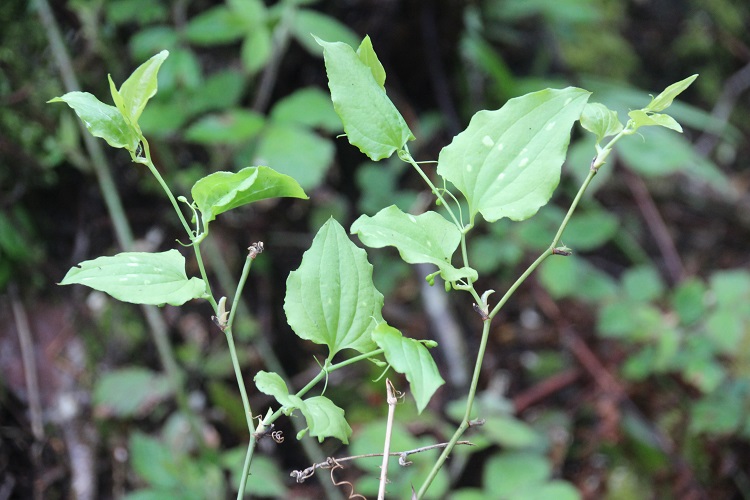
In the summer of 2015 I bought Smilax sieboldii BSWJ.12614 from Crug Farm Plants in a moderate frenzy of prickly enthusiasm. I got it home and wasn't sure what to do
so I defaulted to potting it up and growing it in the ghreenhouse for 'a bit'. It grew well but without attracting any photographic interest on my plant
despite sprawling and flowering for five years. Finally I decided to plant it in the garden rather than face the prospect of it going backwards in a pot.
It went out under a small evergreen, hoping that it would get some protection and sprawl upwards in a supported way. Not to be, I never saw it again. Crug Farm Plants say in their catalogue "Scandent to climbing deciduous sub-shrub with angled prickly branching stems to 5m long, with parchment textured heart-shaped leaves somewhat glossy above to 12cm long. With tendrils on their petioles (leaf stalk) and axillary simple loose umbells of greenish white flowers borne in May-June, followed by the autumn with globose black fruit. One of our seed collections gathered in the Waraksan area of central South Korea in the autumn of 2010. Easily grown in most types of fertile drained soils in either sun or shade." The Flora of China says: "Forests, thickets, grassy slopes; near sea level to 1800(--2500) m. Anhui, Fujian, Jiangsu, Liaoning, Shandong, Taiwan, Zhejiang [Japan, Korea]." Trees and Shrubs online says: "A deciduous or semi-evergreen species, the stems round or somewhat ribbed, and more or less armed with slender prickles; branches distinctly angular. Leaves ovate with a heart-shaped base and a long fine point, five-or seven-nerved, margins minutely jagged; green both sides, 11⁄2 to 3 in. long, two-thirds as wide. Flowers in small umbels of four to seven blossoms, green; main flower-stalk 1⁄2 to 5⁄8 in. long. Berries black, 1⁄4 in. wide, often in threes. Native of Japan, Korea, China and Formosa; introduced in 1908, perhaps before. It is a little known species in gardens, very distinct from S. china, which also occurs in Japan, in the smaller, black fruits, fewer flowered umbels, and triangular-ovate leaves." |
|
| 18th April 2020 | ||