 |
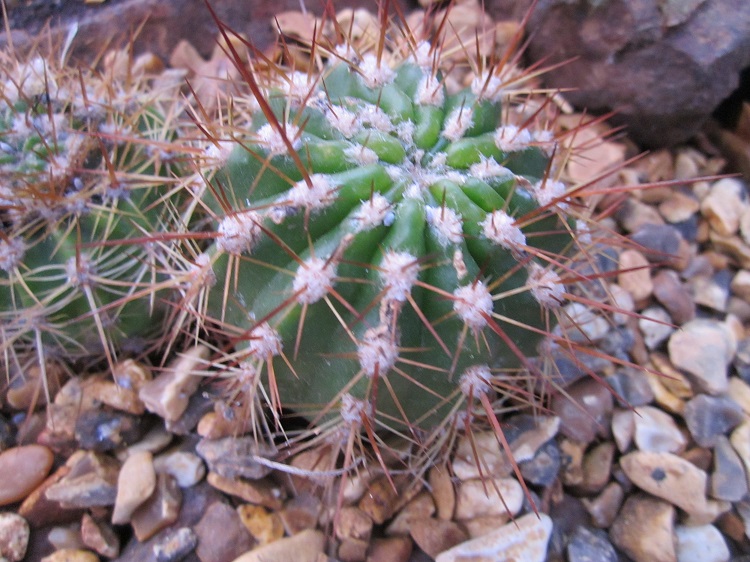
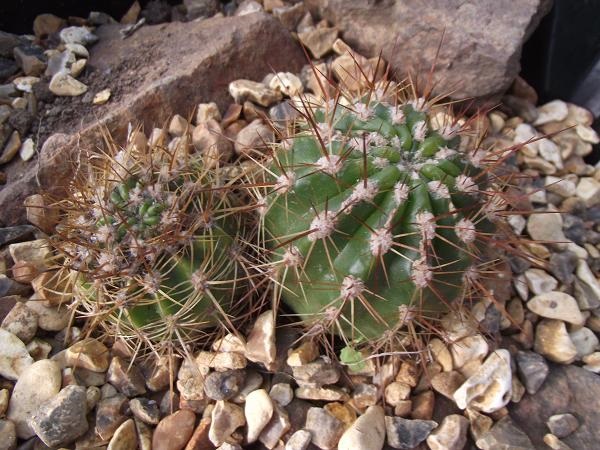
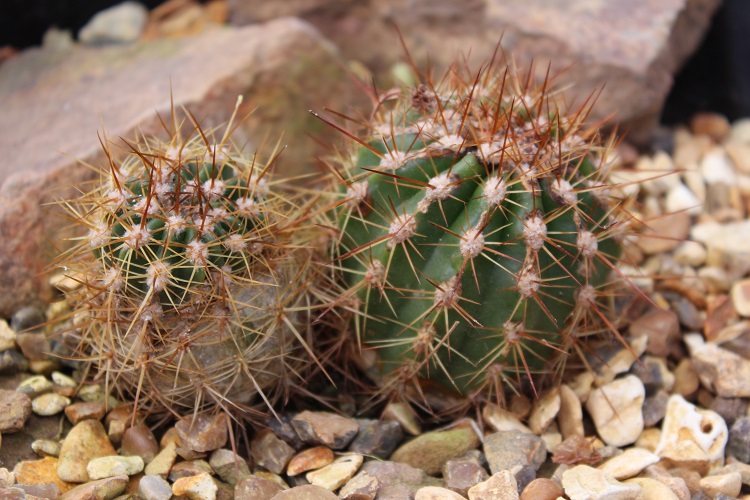
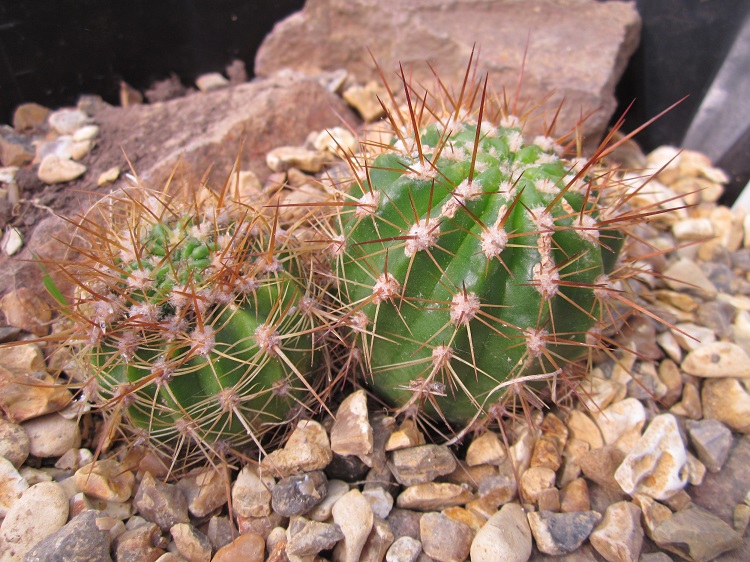
A large globular cactus from northern Argentina. It is not generally regarded as frost tolerant but it
has survived in the greenhouse for several years and I have some hope that it will prosper now it is
planted in the Agave house. The genus Soehrensia has now been absorbed into Echinopsis
by most botanists. I was given two plants that a friend had raised from seed with the coillection number DJF.411 (collected by David J. Fergusson at Tafi del Valle, Argentina). The last picture, I am sorry to say, was the last. Unfortunately some naughty little tinker slipped into the greenhouse under the cover of night and took it. I can't think why, it wasn't exactly impressive or in good condition. The Llifle encyclopedia of living forms says: "The species has a patchy distribution but is locally abundant in high altitude in puna and prepuna grasslands, monte shrubland, and altos andes among large boulders on flats, slopes and ridges, together with other succulent plants like Lobivia schreiteri and Parodia tafiensis. It grows at elevations of 1700-3500 meters above sea level. Echinopsis bruchii (still known in cultivation as Lobivia bruchii or Soehrensia bruchii) is one of the larger Echinopsis species, the multi-ribbed bodies grow to as much as 50 cm thick. It has yellow or brownish-orange spines and brilliantly red blossoms. It is a morphologically variable taxon growing widespread in the mountains of Argentina and has received numerous unnecessary names. The status of Echinopsis bruchii is controversial and some do not consider it an independent species, but a subspecies of Echinopsis formosa (Echinopsis formosa subs. bruchii) which form a multiform complex, where each form is linked to others by populations of plants with intermediate characteristics." |
|
| 14th September 2013 | ||