 |
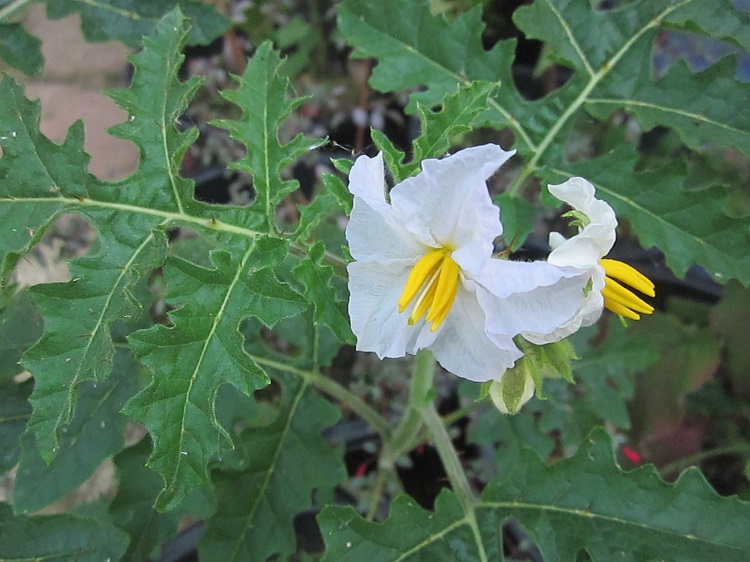
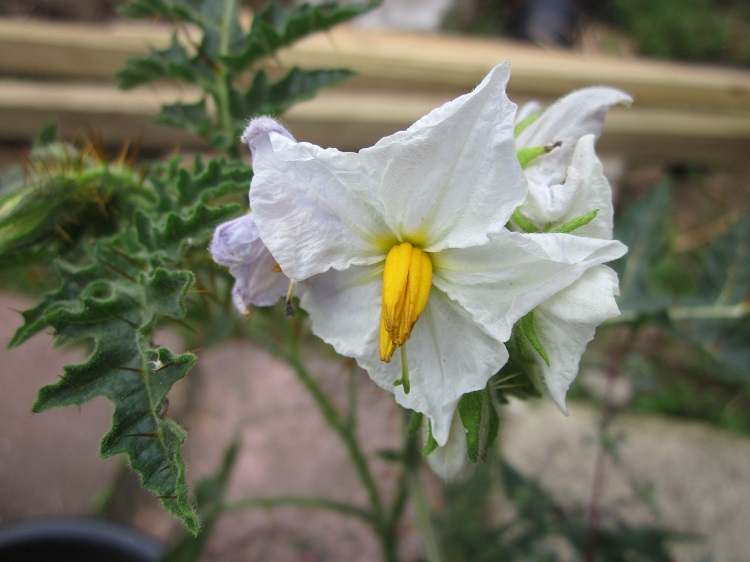
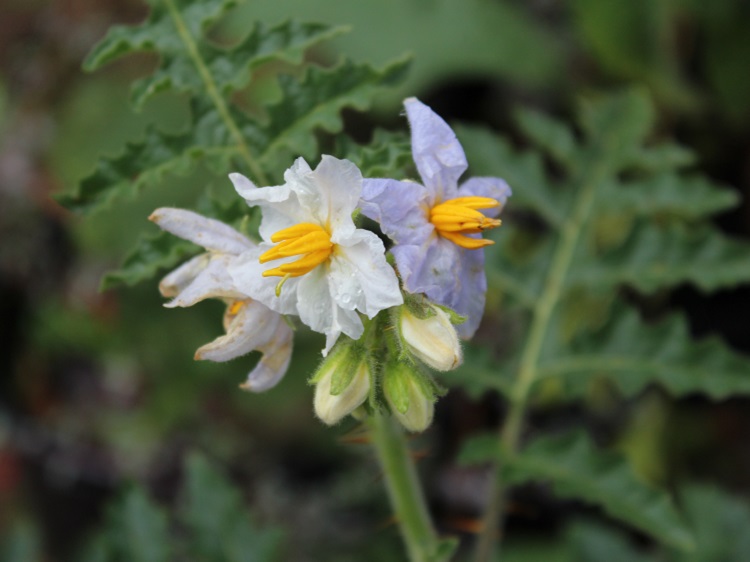
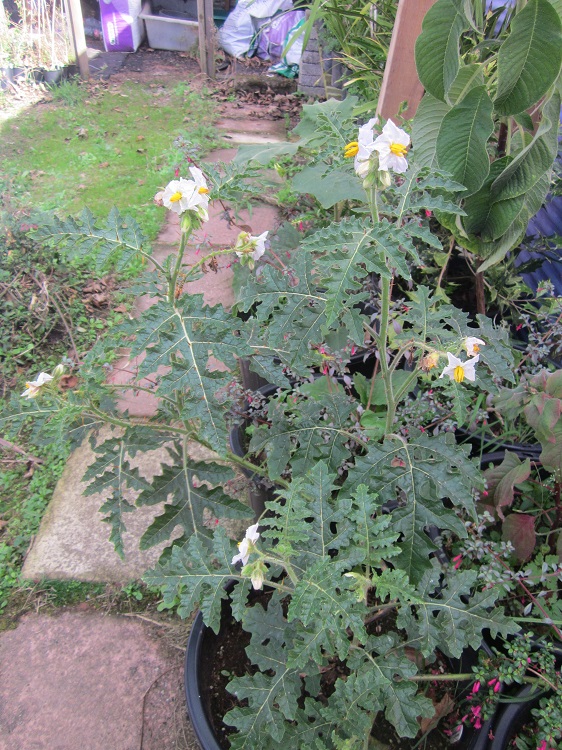
A prickly perennial that needs a frost free climte. The small red fruits are said to be edible but I didn't have the nerve to try it when I had the chance.
Solasnum can be tricky (and poisonious) things and I wasn't entirely confident of the identification. Writing in the Journal of the RHS, Helen Dillon wrote: "Sometimes I wonder which polant would make the best present for someone I don't like; and I have now found the overall winner, namely Brazilian Solanum sisymbriifolium (sticky nightshade or morelle de Balbis). Trying to save its life by taking a last-minute cutting in case the frost proved too much, it jabbed one of its wicked gold-brown thorns behind my thumbnail and it refused to budge. Ungrateful brute. Despite such behaviour, all autumn I love its disatinct, ice-blue flowers, making pretty contrast with an orange dahlia. "borrowed" many years ago by a friend from a neighbour's compost heap." The Botanical Society of the British Isles record it nas a new introduction to the flora. They say: "An erect or scrambling annual herb, found on cultivated ground and in waste places. It arose predominantly from wool shoddy, but latterly has been introduced with oil-seed, bird-seed and agricultural seed. Lowland. Jeremy Bartlett in his Let It Grow blog says: "Sticky Nightshade, Solanum sisymbriifolium is a native of South America: Brazil, Argentina, Uruguay and Paraguay. It is a member of the family Solanaceae and its white flowers (with a hint of purple or blue) are very similar to those of the potato (also a Solanum). Later in life, fruits form, which look like small, bright red tomatoes. These form inside a husk, like the tomatillo, Physalis philadelphica. The plant is an annual herb or small shrub and grows about a metre tall. Its stems and leaves are very prickly, with orange-brown spines. The leaves are sticky, and the fruits are slightly sticky too. The English name Sticky Nightshade is very appropriate. Sticky Nightshade is grown as a trap crop for potato cyst nematodes. If Solanum sisymbriifolium is planted in a field infested with PCN, the nematode eggs hatch and the nematodes try to feed on the roots, but these are poisonous to the nematodes, which die. The nematode lifecycle is broken and an ordinary potato crop can be planted in the field. In the UK the plant is marketed as ‘DeCyst’ or ‘Foil-sis’." |
|
| 4th October 2014 | ||