Given an Award of Merit by the RHS when exhibited at Northumberland AGS show, Robert Rolf says in the Bulletin of the Alpine Garden Society:
"For all that they are only very scantily represented in cultivation at present, Soldanella hybrids have arisen frequently wherever the
species co-occur. They seem to be highly interfertile, and articles have been published in the past camvassing any number of names.
There is obvious scope for artificial hybridising too, in particular to bring about more reliable flowering in some of the smaller species,
and vigour (few gardeners have ever grown Soldanella pusilla for example, to a high standard, or persuaded the Balkan S.pindicola to flower freely).
But because they were in flower together, and it seemed like a good idea, in the spring of 1982 the compiler of these awards (R.R.) used
pollen from S. carpatica to fertilise the flowers of a plant received from Inshriach Alpine Plant Nursery (Aviemore) as Soldanella alpina
hybrid. This was listed in their 1969-70 catalogue with the entry 'Probably with . Forms little spreading clumps of small round leaves.
Fringed bells of light violet.' This had a running habit, and reliably produced single or twinned flowers with dark internal striping.
A number of seedlings germinated, but only two were retained, then passed on to at least one nursery. Moving them from the humid atmosphere of an
old-fashioned wood built frame to an alpine house was a mistake, and the raiser's stock dwindled, but they were maintained by others, and for the past few years
Aberconwy Nursery (who keep their plants in a polytunnel alongside petiolarid primulas) have distributed young plants,
which sell on sight due to their floriferous habit. They benefit from a lime-free gritty but humus rich compost which should never dry out, even in the winter
(the exhibitor keeps his stock in the part-shade of an outhouse, where they often receive the run-off from the gutter),
overhead protection from October until flowering, a dose of Provado or similar to dispatch their greatest foe, the vine weevil, and
frequent repotting, with division every second or third year in the first half of the year. Kept well-watered they will produce new
flushes of initially bright green leaves right through to late summer, a sure sign of good health.
The small, salt spoon-like leaves vary in sixe from around 5mm in some examples to 20mm in the oldest and strongest; the upper surface
exhibits slightly raised venation, whereas the much paler reverse is fairly smooth, though covered with very small pitted glands.
They form a very congested clump, and only by parting them determinedly in late autumn and beyond can the clusters of flower buds be inspected.
These barely move until the weather warms up a little, then in March or earliest April they develop rapdly and are carried well clear of the foliage
on dark, erect scapes 18 cm tall as seen. Height depends on the amount of light available; in warm shaded positions they can over-extend.
At this time of the year full sun and a drafty position suit the plants best; but when summer-like temperatures register, they are much better
outside, in positions that receive little or no midday sun. The stems, often produced in abundance, even from small plants,
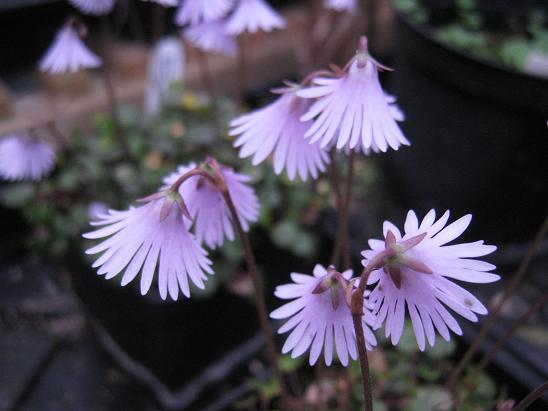
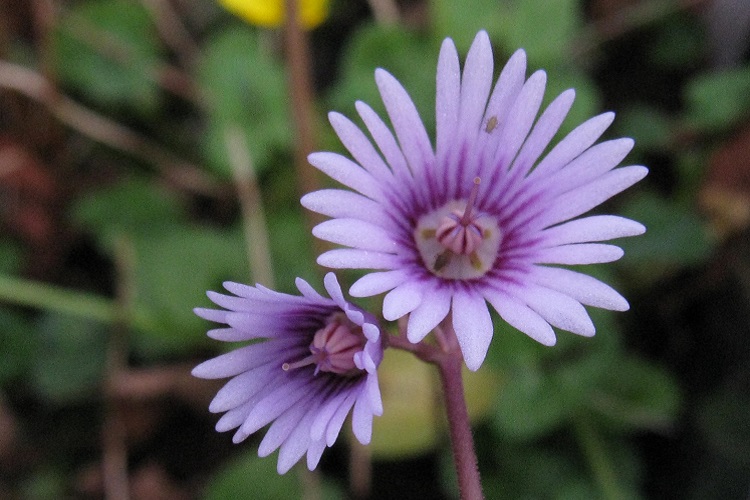
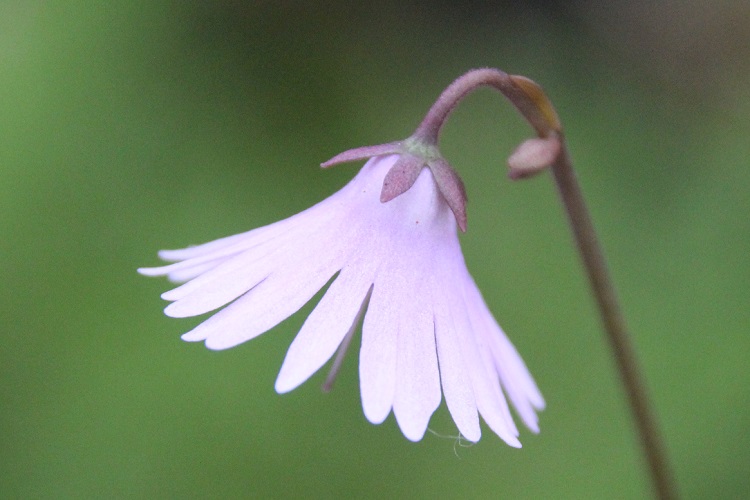
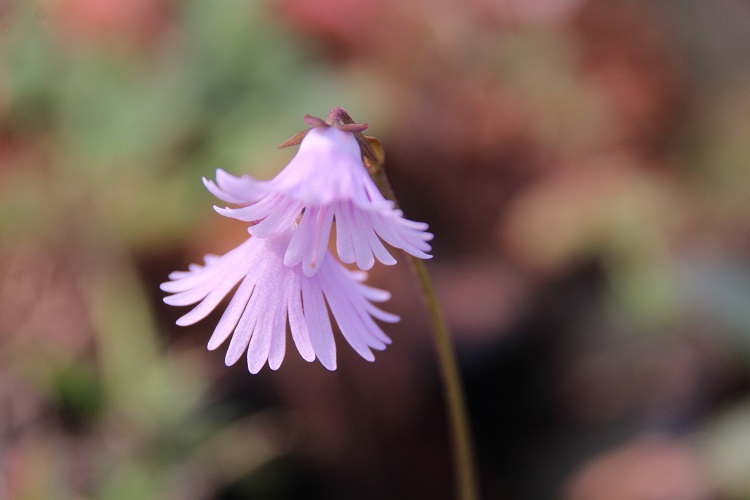
carry two or three 20 mm diameter, pale violet (84B), delicately fringed bells (cut almost the the halfway mark), outward or downward-facing,
and with interior reddish-blue markings.
There are other somewhat similar hybrids, possibly derived from this (a plant labelled 'Spring Symphony' was shown at Hexham), and back-crosses
have produced more."
|