|
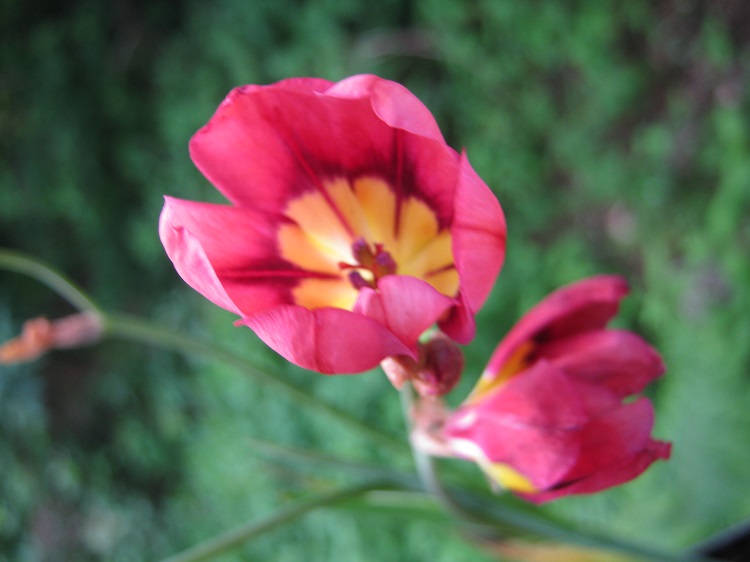
A South African bulb that has naturalised in California and Australia. I bought a pot of mixed bulbs
and planted them in the bulb house where they occasionally flower in a range of colours. From time to time
I get a surprise when a new colour appears. The Pacific Bulb Society says: "Sparaxis tricolor (Schneev.) Ker Gawl. has orange scarlet flowers with a yellow center edged with reddish black. It grows on damp clay and stony soils in renosterveld in the northwest Cape and flowers September to October (spring). It is one of the species used in hybridizing and is widely cultivated. Growing from 12 to 30 cm, it is very similar to Sparaxis pillansii, but differs in flower color and in having anthers that are not twisted and yellow to ochre." Peter Goldblatt and John Manning say: "Ixia tricolor was described by the Dutch gardener George Voorhelm Schneevogt based on plants cultivated at Haarlem, The Netherlands. The well-executed painting by Schneevogt accompanying the description in his Icones plantarum rariorum (1794) leaves no doubt about the identity of the plant, but there is, unfortunately, no record of their source. The long history of plant collecting at the Cape (Goldblatt & Manning 2001) and their subsequent cultivation, first in Holland and later all over western Europe, make the early appearance of Sparaxis tricolor no surprise. Schneevogt’s Icones appeared in multiple parts, each with three paintings, and Ixia tricolor (plate 39) was published in 1794 (Stafleu & Cowan 1985). All 48 plates were bound in a single volume and published in 1795. Plants cultivated in England some years later were described independently by Curtis (1797), who remarked that ‘though new to this country, this plant has been known for some years to the Dutch; we find it in their catalogues under the name of Ixia stellata tricolor. Minor colour variants, or possibly hybrids with other Sparaxis species, were named by Robert Sweet in the years 1826 to 1832, evidence of the favour that S. tricolor found in horticulture." |
|
| 8th May 2011 | ||