 |
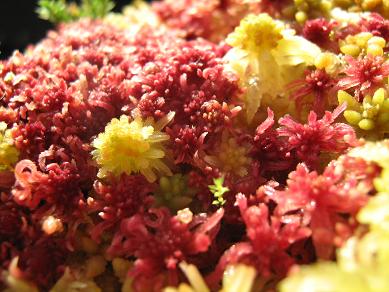
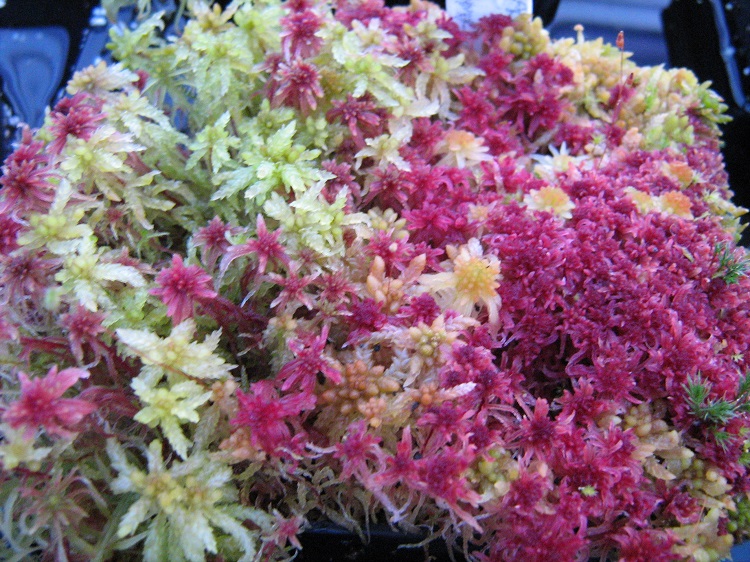
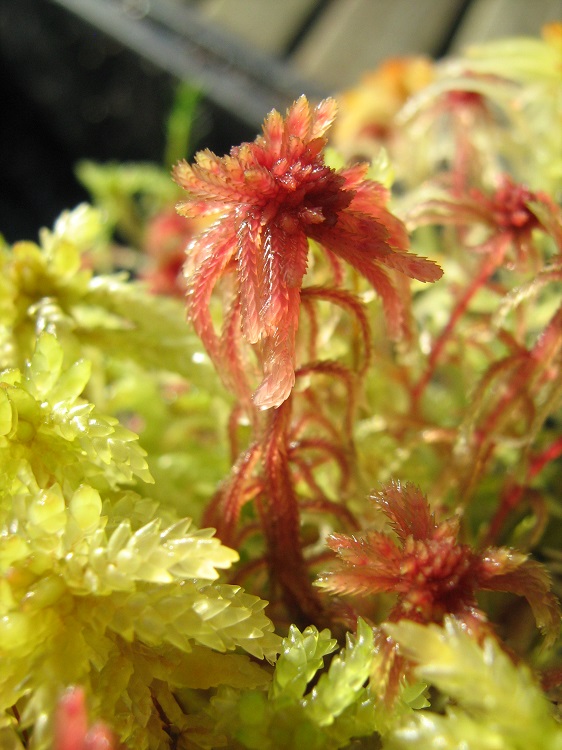
One of the great joys of living in the south-west is the variety of mosses that grow without much need for encouragement. I wish I was a bit better at identifying them. I grow a few species of Sphagnum deliberately among the Sarracenia and I am very slowly learning how to sort out names for them. This one was sent to me as packing material around a plant. It is the deepest red species I grow. As far as I can tell, there are two other species growing with it in the pot, and I am now trying to separate them out and identify them. The British Bryological Society website says: "Older bryologists may remember the days when S. capillifolium was a broad species concept that included S. rubellum, now a species in its own right. Although there can be a little overlap in identification characters, the two species are normally distinct enough not to be confused with each other. Until you’ve pressed your hand on a (peat-forming) hummock of S. capillifolium and felt its firm resistance, you may find it difficult to visualise what the books say about its habit. In these hummocks, the individual shoots are pressed tightly together and each convex capitulum (think baseball cap as a mnemonic for capillifolium) resembles a small reddish cauliflower. If in any doubt, check the stem leaves – they are larger than S. rubellum and a different shape. Although a common species of deep peat on blanket bogs and moors in oceanic districts, Sphagnum capillifolium is rare or absent in much of the south where its ecological niche is filled by S. rubellum." The Missouri Botanic Garden Plantfinder says: "Sphagnum capillifolium, commonly called small red peat moss or red bog moss, is native to Canada, the northern United States, and parts of northern Europe where it is typically found in acidic bogs, heaths, and occasionally wooded fens. This is a small to medium-sized sphagnum moss that forms dense carpets or hummocks of up to 5' across, with slender stems up to 1' long. The length of the stems and size of the colony depends on a number of factors including the depth of the water table, nutrient levels, and competition with other plants. As such, the plant may be much smaller or larger than what is listed here. The stems are topped with a slightly domed, terminal head of young branches that is typically red in color. In shady areas the plants will take on a green or mottled red and green coloration. Identification of moss in the field can be challenging. Microscopy is typically required for a positive identification at the species, subspecies, and varietal levels. The genus name Sphagnum comes from the Greek name for a different moss that was then applied to this group of plants. The specific epithet capillifolium means "hairy leaved", and may refer to the appearance of the branches of this species which are densely covered in tiny, narrow leaves." |
|
| 4th December 2008 | ||