|
A close relative of Hippeastrum from Mexico. Will tolerate a bit of frost if it is dry, but better if it is protected.
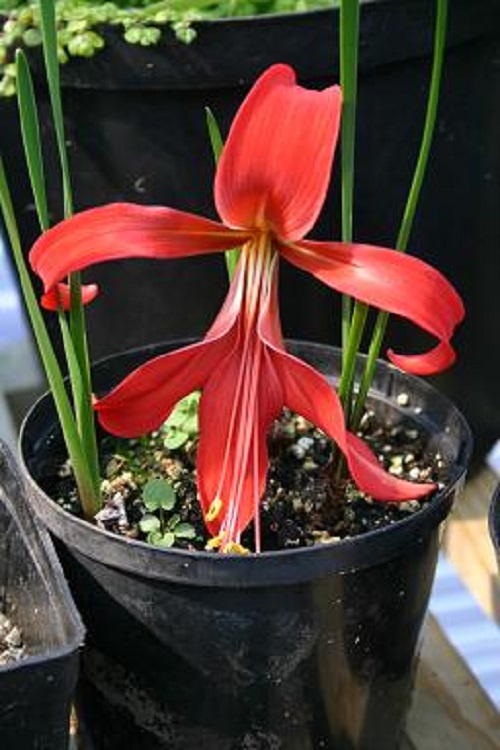
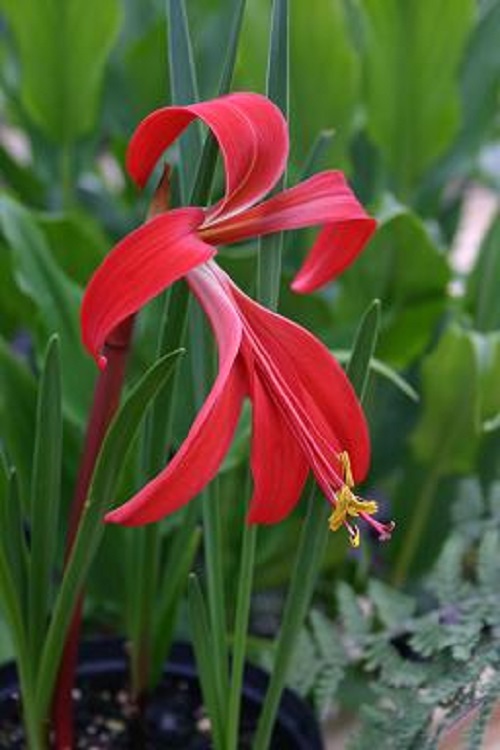
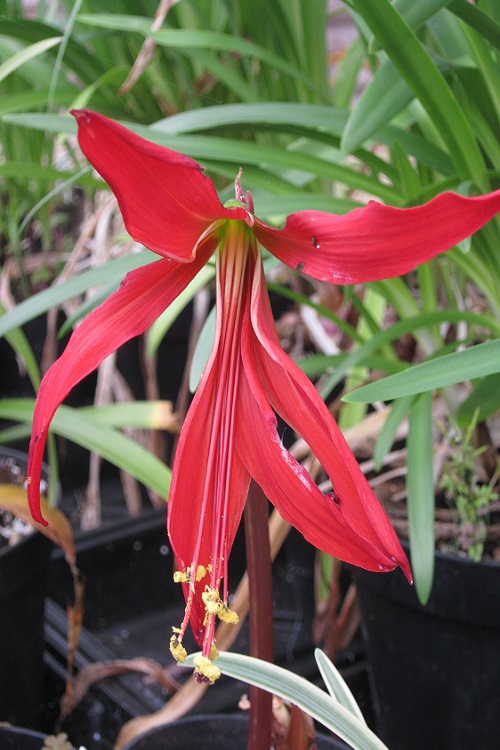
It has grown well for me planted in the ground in the Hedychium house but it is a bit too shaded in there for it to flower regularly. San Marcos Growers say: "Sprekelia formosissima (Aztec Lily) - A large bulbous perennial from Mexico that produces dark-green narrow strap-like leaves that arise during the bloom period. The interesting and large crimson-red flowers, which only last a few days, are nearly 6 inches wide and rise up individually on a stalk 1 foot or less above the ground during the spring and early summer, and sometimes again in fall. These flowers, unlike most plants in the Amaryllis family, are irregular (zygomorphic) having long narrow petals with the two side petals curling back, while the other four (one on top and three on bottom) are straight and from the middle of the flower emerge long anthers bearing large yellow stamens - quite the show!" The Missouri Botanical Garden website says: "Best grown in evenly moist, rocky to sandy, well-draining loams in full sun. The cultural requirements of this plant are similar to those of amaryllis (genus Hippeastrum). Fully hardy in frost-free Zones 10 and above, but can also be grown in areas with colder winters down to Zone 8 if sited in a protected location and given plenty of winter mulch. Best in climates with dry winter conditions, but winter moisture can be tolerated as long as the bulbs are planted in very well-draining soil. Grow in a container as you would an amaryllis in Zones 7 and colder. Requires a relatively dry dormancy period in winter before growth is initiated in spring and regular watering can be resumed. The foliage should be left on the plants after flowering and for the duration of the growing season. The bulbs will also benefit from regular fertilizer applications during the growing season. If grown in pots, acclimatize plants in spring to outdoor conditions and then allow them to spend the duration of the growing season outdoors in full sun. Propagate through division of offsets or by seed. Does not tolerate disturbance well, so only divide and repot when absolutely necessary. Plants grown from seed may take 3-7 years to reach flowering maturity." |
|