Home Index Web Stuff Copyright Links Me

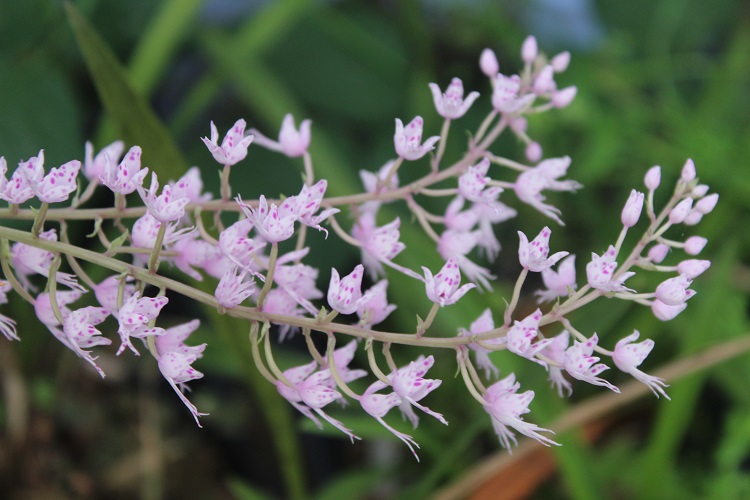
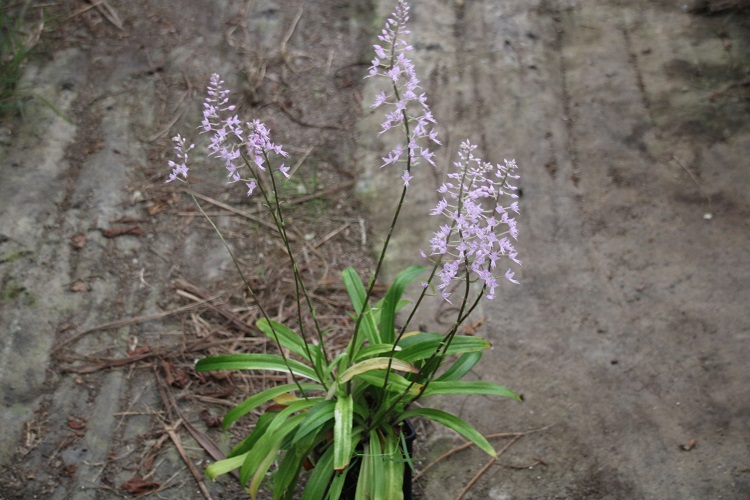
Stenoglottis longifolia clone.1


Archive entry 23.10.16
Archive entry 08.10.17
Archive entry 17.11.19
Archive entry 22.11.20
Archive entry 30.11.25

A splendid terrestrial orchid with thick white fleshy roots in clusters. Easily propagated by splitting up the roots during its short dormant period in mid winter. I refer to this one as "clone.1" because I have another plant with darker flowers (clone.2).
Isle of Portland orchids say:

"Stenoglottis longifolia lives up to its name with wonderful upright flower spikes up to 1m tall carrying up to 100 stunning spotty pink flowers.
Stenoglottis longifolia is a terrestrial species from South Africa. It is found on mossy banks in the Drakensberg Mountains and so is a cool growing orchid. We have grown the species in a frost free greenhouse successfully but we find that the species grows very well with a minimum of 7C in our Himalayas Greenhouse.
Plants are very seasonal and we keep plants wet all summer but let them dry out from the end of December when the leaves turn brown and fall off. We start watering again around mid February but sparingly until growth is underway in March.
Another delightful character of Stenoglottis longifolia is that even very small plants flower well and produce dainty little spikes with 10 to 20 flowers. Stenoglottis longifolia can easily be distinguished from the similar Stenoglottis fimbriata by looking at the end of the lip which is divided into seven points not three."

The International Orchid Species Encyclopedia says:

"A medium to large sized, robust and stout terrestrial, epiphyte or lithophyte that is closely allied to S. fimbriata as it may be synonymonous, albeit the plant is much more robust than S. fimbriata. It is a cool growing terrestrial or lithophyte from Natal and Zululand, South Africa in humus or on mossy rocks and rock outcroppings at elevations of 300 to 1300 meters with numerous oblanceolate or narrowly oblong, acute, light green leaves that have undulate margins in a basal rosette and it blooms in the fall on an erect, terminal, 14" [35 cm] long, racemose, many flowered inflorescence that has a few scattered sheaths along the scape, occuring in the summer and autumn. Grow in a fast draining medium such as coarse sandy soil and leaf mold, give cool to cold temperatures, moderate light and ample water while growing and a lessening after leaf fall in the winter and then restart as the new leaves appear."


17th May 2006

Plantzafrica says:

Stenoglottis longifolia is a summer-rainfall plant that occurs naturally in KwaZulu-Natal, South Africa, extending into the Lebombo Mountains of Eswatini and southern Mozambique. It is usually found at elevations between 230 and 1 200 m. Although previously reported from the Eastern Cape, recent taxonomic revisions refuted its presence in this province. Its natural range is characterised by annual rainfall of between 1 000 and 1 500 mm. Winter temperatures can approach freezing, but prolonged frost is rare.
Stenoglottis longifolia plants usually grow in forests or along forest margins in areas with deep or partial shade. They grow as lithophytes (plants that grow on rocks) on boulders, frequently along streams or on south-facing cliff faces, or more rarely in streambanks and the forest floor. S. longifolia prefers moist, humus-rich conditions, often establishing itself in rocky crevices or on moss-covered rocks in leaf litter and other organic matter.
Stenoglottis longifolia was first described by Joseph Dalton Hooker in 1891, making it the second species to be described in the genus after S. fimbriata, which was described by John Lindley in 1837. The genus remained poorly understood for many years and has been the subject of several taxonomic studies due to the substantial morphological variation within and between species, making species boundaries difficult to define.
The name Stenoglottis is derived from the Greek words stenos, meaning ‘narrow’, and glotta, meaning ‘tongue’, which refers to the narrow and lacerate lip of the type species, S. fimbriata. The specific epithet longifolia comes from the Latin words longus meaning ‘long’ and folium meaning ‘leaf’, referring to the relatively long leaves of this species compared to others in the genus."


16th October 2017 20th November 2021 24th October 2024


References:
  • Isle of Portland Orchids, https://www.isleofportlandorchids.co.uk/orchid-information-pages/stenoglottis-longifolia , accessed 09.12.2025.
  • International Orchid Species Encyclopedia, https://www.orchidspecies.com/stenoglottis.htm , accessed 09.12.2025.
  • Plantzafrica, https://pza.sanbi.org/stenoglottis-longifolia#:~:text=Stenoglottis%20longifolia%20is%20a%20deciduous,arranged%20in%20a%20basal%20rosette. , accessed 09.12.2025.