 |
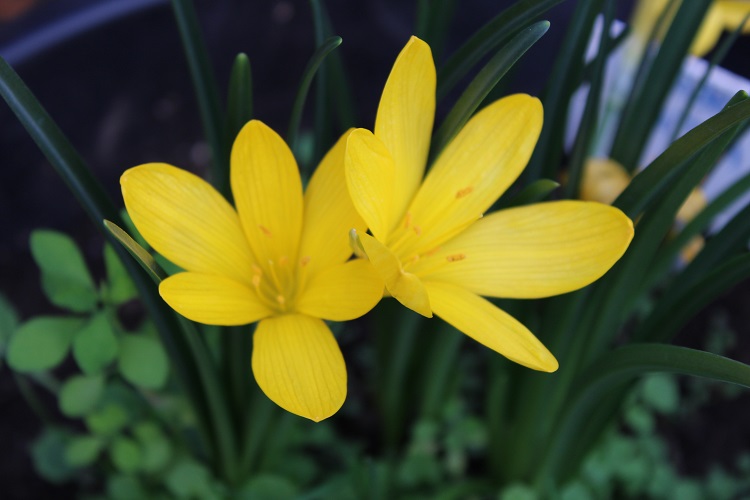
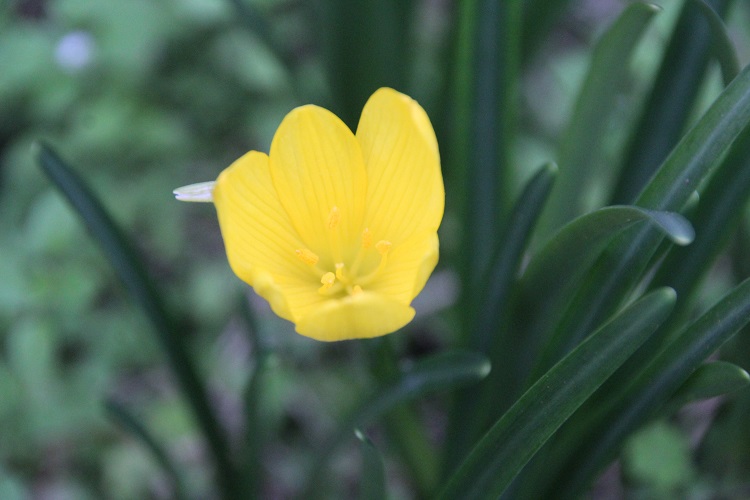
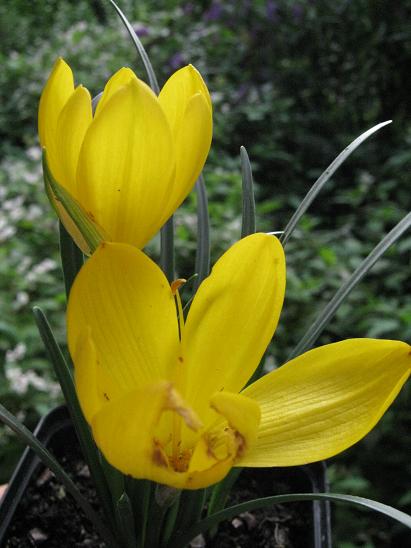
A pretty and distinctive autumn flowering bulb growing from the Western Mediterranean to Central Asia. It needs a sunny position and a dryish soil to prosper,
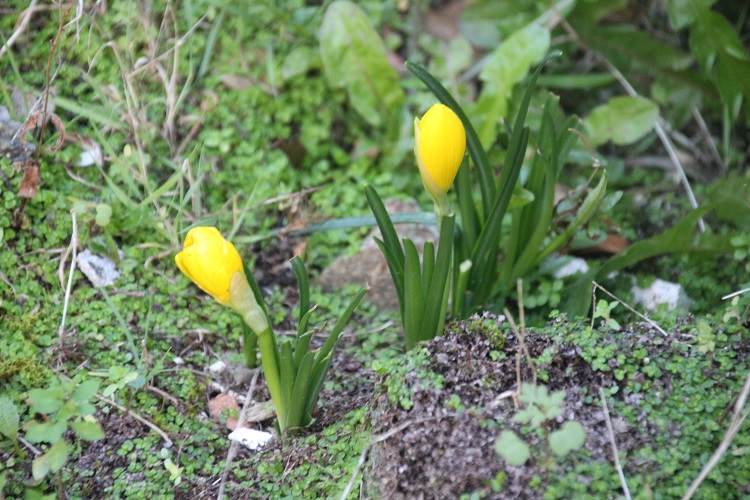
I have seen it doing really well in the eastern counties but with me it is a feeble grower outside and very prone to slug damage. It has persisted with me
in the south side of the house, beside the back doorstep but flowering is sparse and vulnerable. Writing in 'The Plantsman' in 1983, Brian Mathew says: "Sternbergia lutea is by far the best-known species in gardens where it is much used at the foot of warm sunny walls. It makes an ideal companion for other plants whose bulbs or rhizomes require a similar hot summer baking as Nerine bowdenii and Iris unguicularis, and it thrives on chalk or limestone soils: alkalinity is however by no means essential to its well being for it does extremely well in gardens on the poor sandy soils of Surrey. The amount of leaf development at flowering time is one of the most variable features of S. luteaand largely depends upon the moisture availability in the late summer or early autumn when growth begins. In dry seasons there may be a small amount of leaf visible which is preferable from the point of view of general appearance, but it is more normal for there to be considerable leaf development. Some experiments into this behaviour by A.Amico (1947) showed that both the flowering and leafing conditions of the plant are controlled by temperature and humidity. Sternbergia lutea has long been known in gardens, for example to Carolus Clusius (1601) and John Gerard (1597) who published illustrations of it, as Narcissus autumnalis major ot the "Great Winter Daffodil". Cultivation over a period of nearly 400 years has probably led to the obscuring of its true wild origins, for nowadays it is most frequently found in or near old gardens." John Gerard says: "The Autumn Daffodil bringeth forth long smooth glittering leaves, of a deep greene colour: among which riseth up a short stalke, bearing at the top one flower and no more, resembling the flowers of mead Saffron, or common Saffron, consisting of sixe leaves, of a bright shining yellow colour; in the middle whereof stand sixe threads or chives, and also a pestell or clapper yellow likewise. The root is thicke and grosse, like unto the precedent." |
|
| 8th September 2010 | ||