| Home | Index | Web Stuff | Copyright | Links | Me |
|
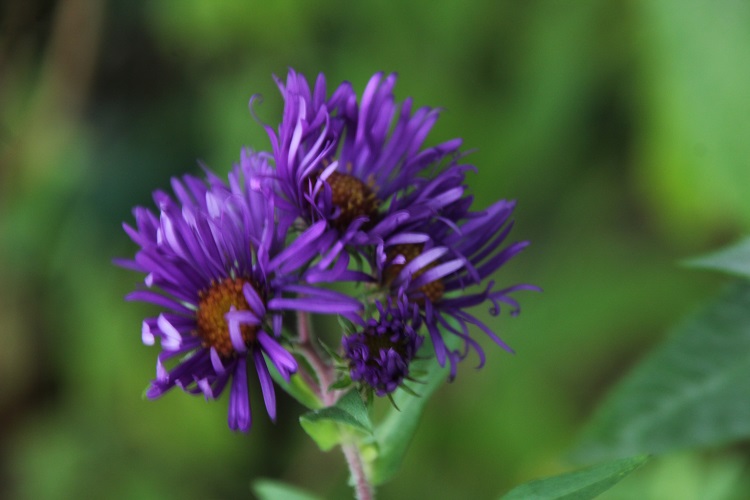
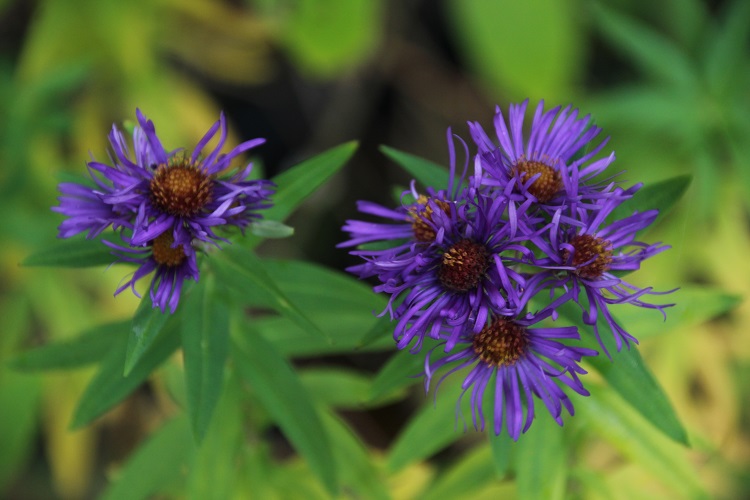
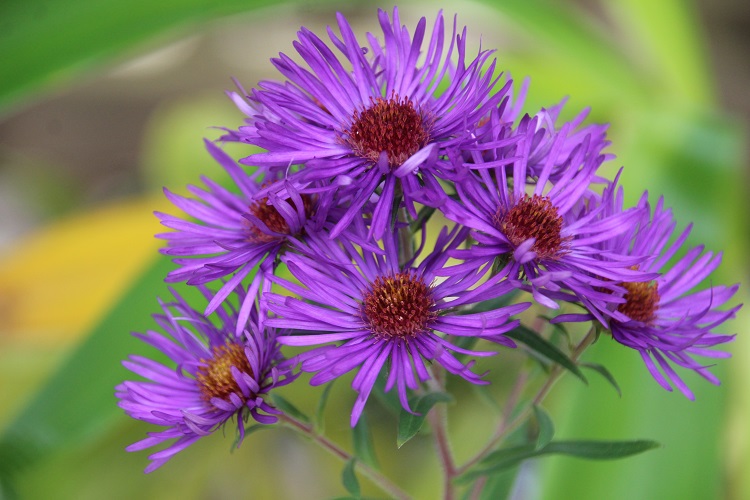
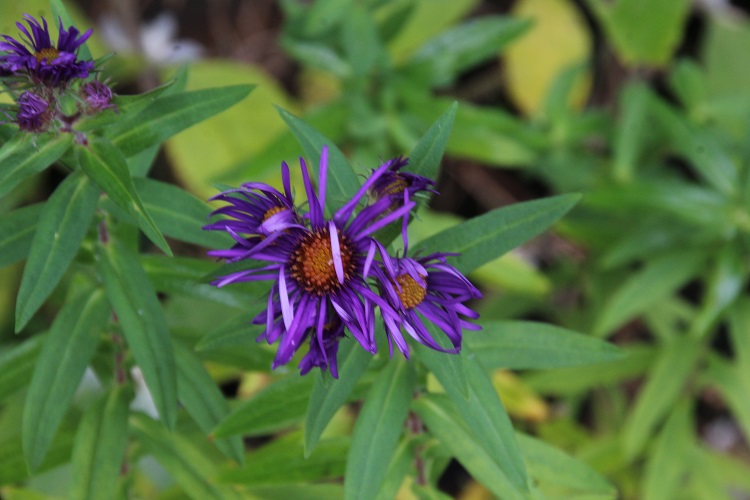
A seedling that I raised, almost by chance. The seed came as an extra in a seed distribution from the Hardy Plant Society. It's a striking colour and a strong plant. Wikipedia says: " Commonly known as New England aster, hairy Michaelmas-daisy, or Michaelmas daisy, it is a perennial, herbaceous plant usually between 30 and 120 centimeters (1 and 4 feet) tall and 60 to 90 cm (2 to 3 ft) wide. The usually deep purple flowers have up to 100 ray florets which are rarely pink or white. These surround the flower centers which are composed of just as many tiny yellow disk florets. The plant grows naturally in clumps, with several erect stems emerging from a single point. The stems are stout, hairy, and mostly unbranched. The untoothed, lance-shaped leaves clasp the stem with earlobe-like appendages, and the lower stem leaves often wither by the time of flowering. New England aster generally grows in wet environments but also has been found in dry soil or sand. The seeds and nectar of this mostly conservationally secure species, which blooms August to November, are important to a wide variety of animals, including birds, bees, and butterflies. It has been introduced to Europe, Central Asia, Hispaniola, New Zealand, and some western states and provinces of North America." |
|
| 24th september 2016 | ||
|
The USDA Forest Service says: "New England aster is a member of the Asteraceae (Aster or Composite) family. Until recently, it was placed in the genus Aster, a then large and complex group. Its name Symphyotrichum, means ‘united hairs’, and novae-angliae, ‘New England.’ The old name Aster meant star in reference to the shape of the flower. The ‘flower’ of this plant actually is made up of an aggregate of about 100-150 individual flowers of two types that form a capitulum or head. The ‘petals’ are actually each and individual flower called a ray flower. In the center of the head is the other kind of flower, tube flowers, because they are tube-like in appearance. This plant grows up to about 2 meters (6 feet) tall, but is usually 1-1.2 meters (3-4 feet) tall. By the time it is flowering, many of the lower leaves have fallen off, leaving a bare brown stem. Hundreds of heads on a single plant, but 50-100 is typical. Each head is between 19-38 millimeters (0.75-1.5 inches) across. Plants usually consist of 1-3 stems, but large clumps are occasionally encountered. The leaves are somewhat firm and softly hairy, 3-12 centimeters (approximately 1-5 inches) long x 6-20 millimeters (approximately 0.25-0.75 inches) wide. The species is an open lands plant, thriving in grasslands, old fields, savannas, and woodlands. It is frequently encountered on roadsides and in fencerows. It can also be found at the edge of forest. The species is known from most of the conterminous United States, except a few southern states and a few western states. It is present in much of Canada as well." |
|
|
|
| 2ndOctober 2020 | 3rd October 2020 | 9th October 2020 |