 |
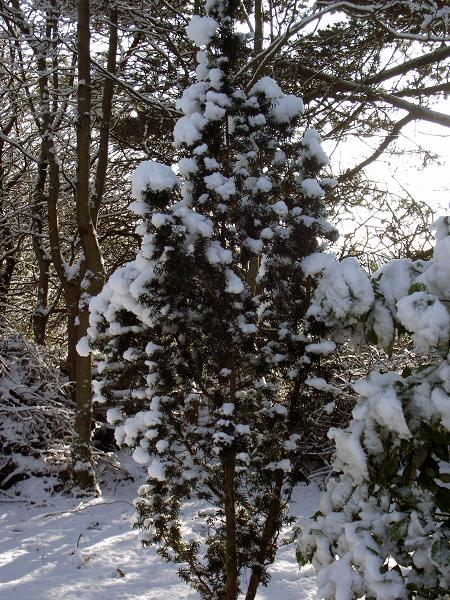
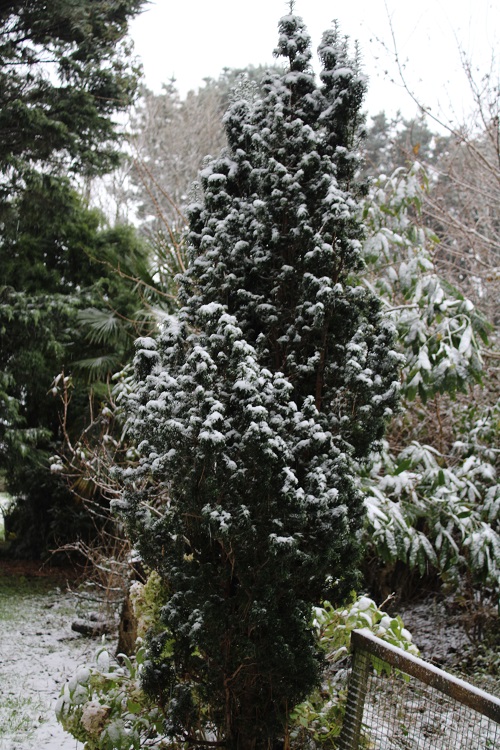
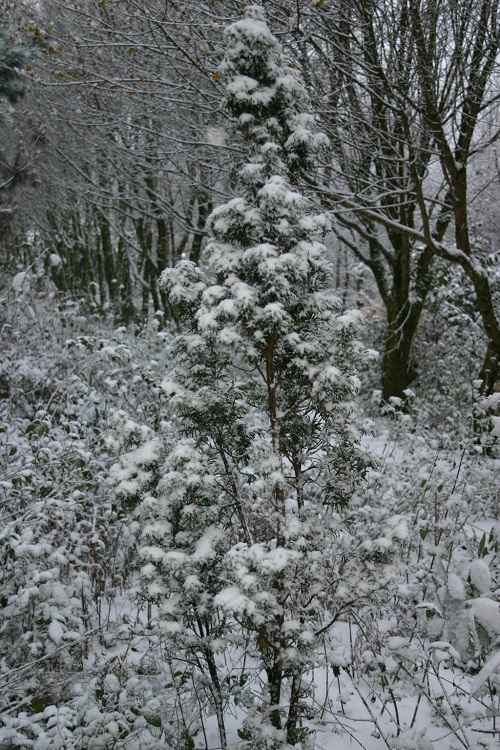
I have a pair of Irish Yews that I bought in 1984. They lived in pots for a decade like pencil thin
sticks. In the end I felt so sorry for them I planted them out as gateposts to the shade border. Eventually
they will grow so large that they block the entrance. They have started to grow a bit faster now they are in the ground
but it will be a few years before it is a problem. For some reason I only seem to photograph therm when it snows in November. It's a pity because they are a joy throughout the year. Trees and Shrubs online says: "Of columnar habit, with numerous spires, its leaves standing out all round the twig, dark, dull green. Two young plants were originally found by a Mr Willis on a rock in the mountain above Florence Court in Co. Fermanagh called Carricknamaddow or ‘The Rock of the Dog’. One, which the finder planted in his own garden, died in 1865. The second he took to his landlord the Earl of Eniskillen at Florence Court, and it is from this plant that all the true Irish yews are descended by vegetative propagation. Cuttings were given to Lee of Hammersmith at an unrecorded date but probably around the turn of the century, since the Irish yew was available at a low price from both British and continental nurseries by 1838, under the name ‘T. hibernica’. Being propagated by cuttings, the Irish yew is female, like the original parent. When its flowers are fertilised by pollen of a normal yew, as would normally be the case, the seedlings usually take after the male parent. |
|
| 25th November 2005 | ||