 |
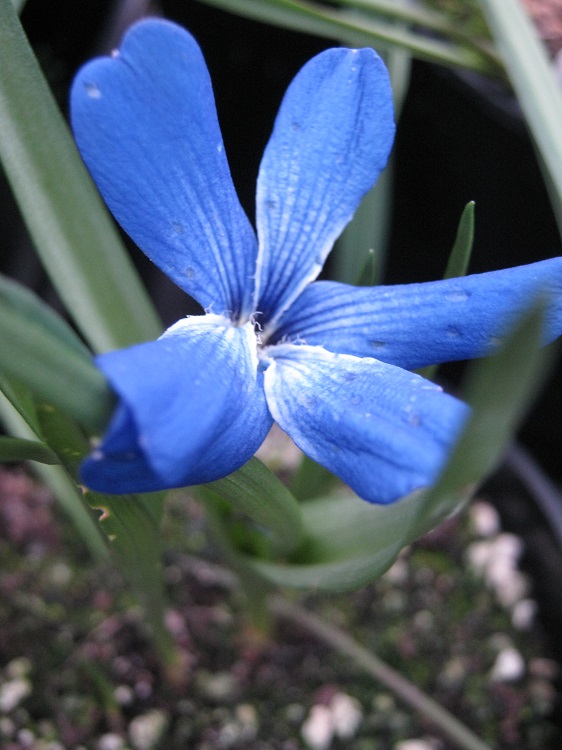
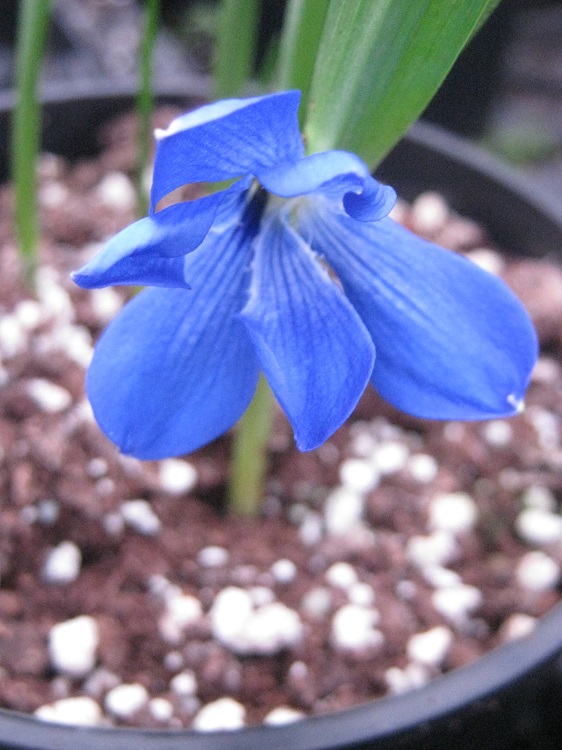
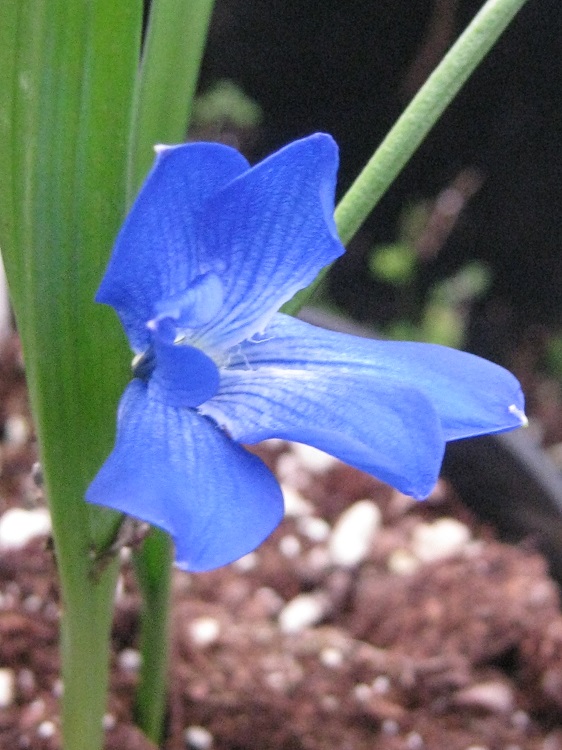
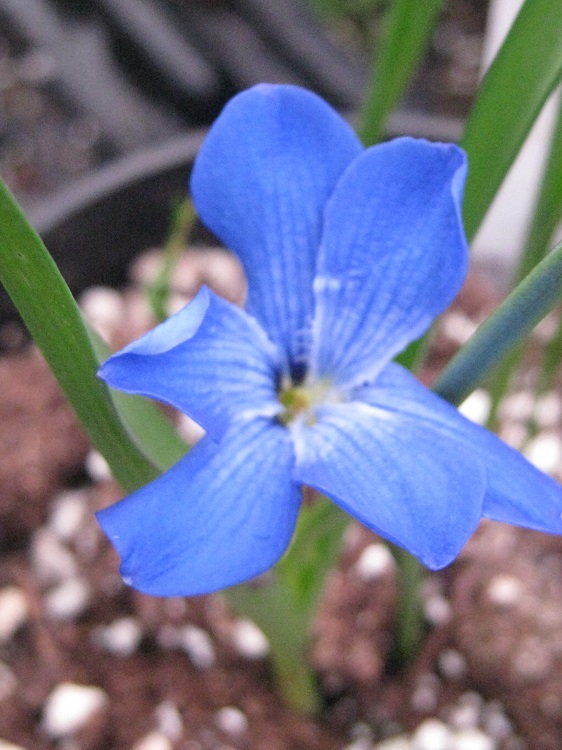
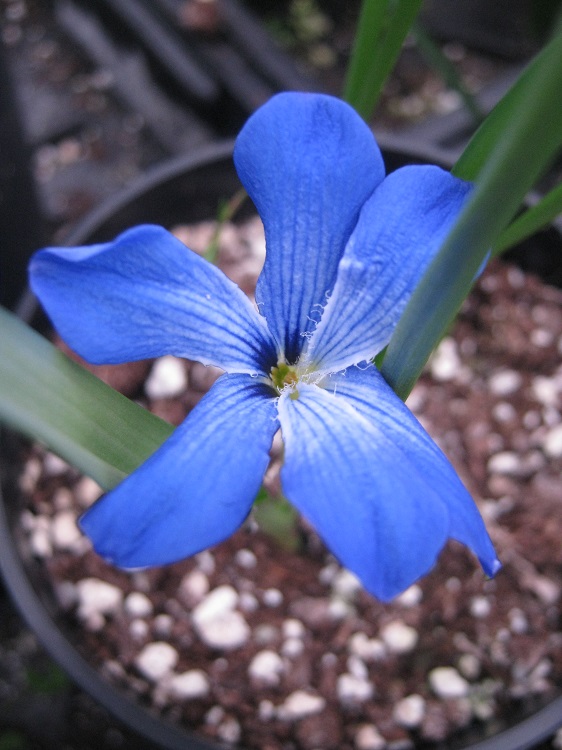
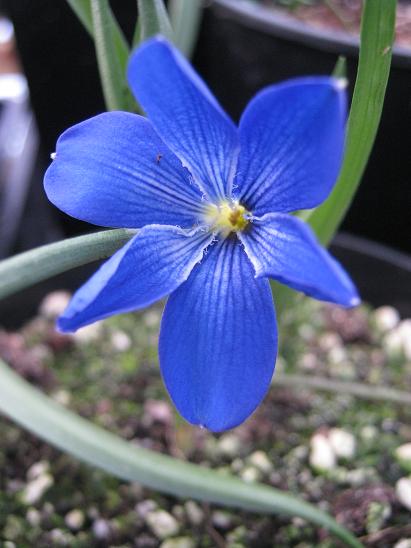
There are plenty of small growing blue flowered bulbs, so I'm not sure why this is astonishing, but it is. I have grown (killed) it once before. It was very expensive and I grew it in a heated greenhouse because I was frightened it might die. It did. It has taken me a long time to get around to trying again. I'm not made of money (my Mother says I'm made of slugs and snails and puppy dogs tails but that's another story). I bought this one last year at a significant discount when the nursery stocking them failed to sell it in flower. It has responded well this time (it isn't difficult to grow) and this year it has flowered. "Hunger, greed, lust, and extinction—it sounds like Edgar Allan Poe’s lurid tale The Fall of the House of Usher, but in fact it’s the story of the Chilean blue crocus. How did one small plant find itself at the center of such a turbulent drama? Easy—by being both very beautiful and very rare. By any account, the Chilean blue crocus bears some of the most ravishing flowers in the entire plant kingdom: two-inch cups of a blue that out-dazzles the most sapphirine gentian, delphinium, or Himalayan poppy. (For the record, it’s not a crocus, despite its specific epithet; it’s a corm-forming geophyte—a fancy word, meaning literally “earth-plant,” for any plant that suvives seasonal drought or cold by means of underground storage organs such as bulbs, tubers, rhizomes, or corms—that belongs to its own small family, the Tecophilaeaceae.) Native to the grassy slopes of the hills surrounding the city of Santiago, known as the Cordillera de Santiago, at an altitude of about 9,700 feet, it was never common to begin with, and was discovered only in 1862. Less than a hundred years later it was considered extinct in the wild. The culprits were hungry sheep, goats, and cattle, which found it a tasty snack; greedy bulb merchants, who paid the local ranchers to dig it up by the sackful; and, it must be acknowledged, lust-besotted gardeners, who were willing to pay the greedy bulb merchants extravagant sums for the pea-size corms. Fortunately, the story doesn’t end in complete tragedy: in 2001, a small colony was discovered growing on private land. There is also a plan afoot, drafted by the Royal Botanical Society/Kew and Chile’s Corporación Nacional Forestal, to reintroduce the plant into its former range." A document on its conservation was punlished by Kew in 2002 and says: "The Chilean Blue Crocus, Tecophilaea cyanocrocus, was described by Frederich Leybold in 1862. Its distribution in Chile was localised, only being known from the range of hills surrounding Santiago, the Cordillera de Santiago, at about 3,000 m. The plant was recorded in Gartenflora (Regel, 1872) as originating from the Juan Fernandez archipelago, it is suspected that this misinformation was circulated to mislead competing collectors by two German nurserymen, Haage and Schmidt. The plant was regarded as extinct in the wild from the 1950s onwards, attributed to over-collecting by bulb dealers, overgrazing by cattle ranchers and localised habitat change (per. comm. Alberto Bordeu, 1994). It is readily available from commercial dealers in the UK, Europe and North America." In the Alpine Garden Society News for 27th March 2025 theb AGS editor says: "Tecophilaea cyanocrocus was first found near Santiago, Central Chile, at 2000-3000 m on dry stony slopes in the Andes mountains. It disappeared at its known sites and was thought extinct in the wild, for many years, due to over collecting. Relatively recently it was rediscovered at previously unknown locations. The genus name was chosen to honour the botanical artist Tecofila Billotti, daughter of Luigi Aloysius Colla (1766 – 1848) an Italian botanist who first found it in 1836. There are different spellings of her name on the internet." In an editorial in Curtis's Botanical Magazine (10th October 2007), Martyn Rix says: "An even more famous example of a beautiful plant, ‘extinct’ in the wild, Tecophilaea cyanocrocus was rediscovered in Chile in some quantity in 2001 (see M. Teresa Eyzaguirre & Rosario García de la Huerta, Gayana Bot. 59 (2): 73–77 (2002))." |
|
| 19th February 2011 | ||