 |
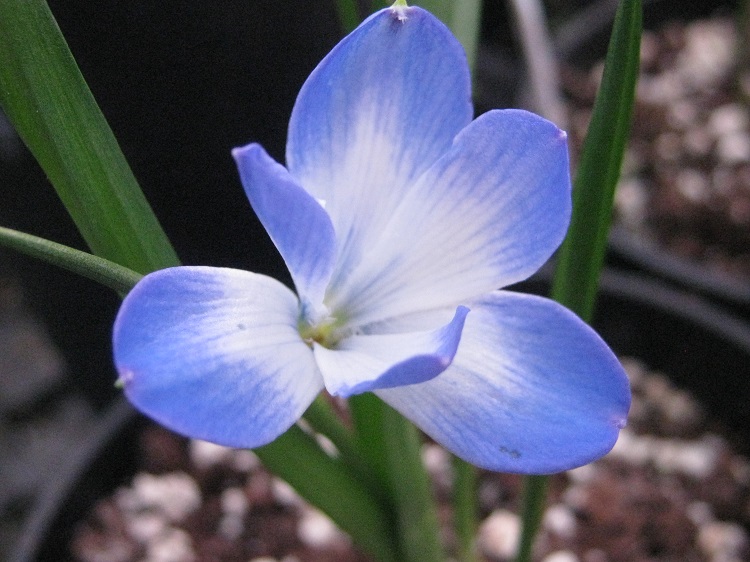
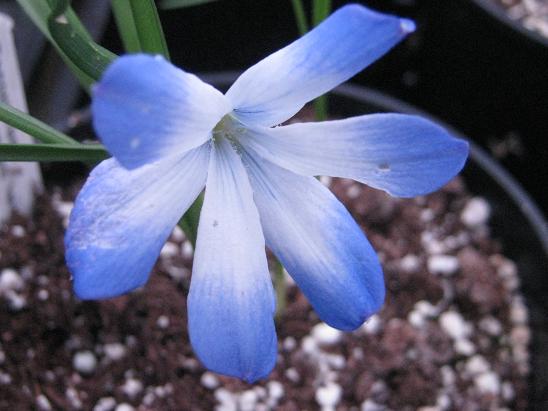
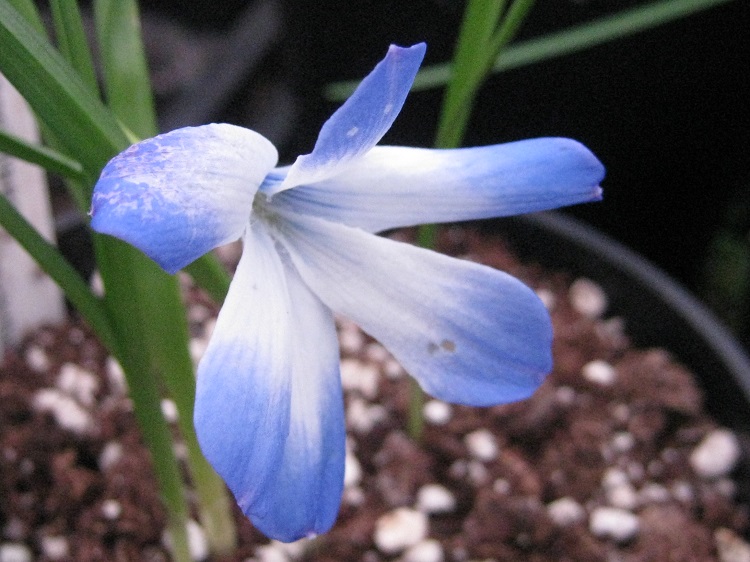
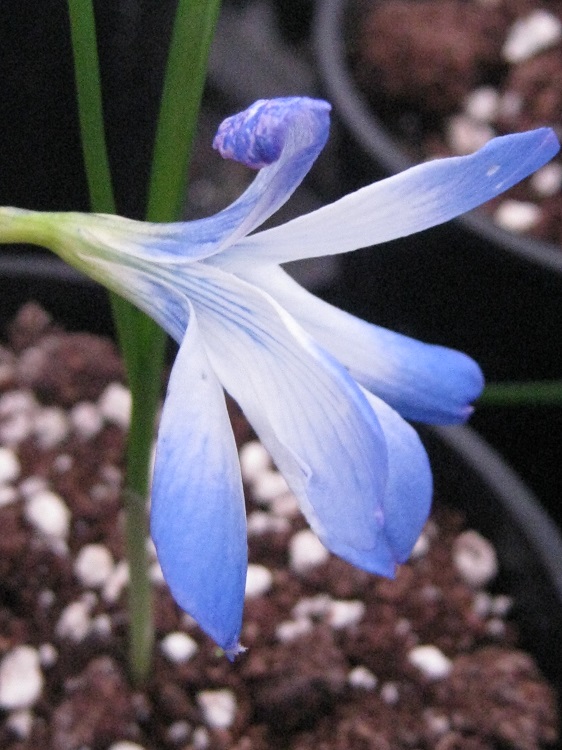
The blue crocus varies in colour slightly and growers have selected the most extreme forms. 'Leichtlinii' has a white throat
that softens and yet emphasises the colour. It received an Award of Merit when shown to the AGS in February 1995. In the write-up Tony Lord says: "I have always been fond of Mars bars and will wolf one downbefore you can utter 'midriff mathem'. But halfway through the second one, feelings of queasiness take over and the remainder is usually stowed until my appetite is restored. Tecophilaea cyanocrocus, with its relentlessly breathtaking gentian blue, has almost the same effect on me: the first pan of late winter is a glorious sight but repeated exposure leaves me longing for a little light relief. Which is why I prefer the softer blue and large white centre of 'Leichtlinii'. It was named (as var. leichtlinii) by Regel of St.Petersburg after German, Max Leichtlin, who introduced many bulbs at the turn of the century. Much has been written about the status of this species in the wild, about its hardiness, and about the debate on whether or not to dry off the pans in summer. To this, I would only add that since 'Leichtlinii' comes reasonably true from seed, I don't understand why it is still uncommon. Offsets are often produced as well, yet open almost any catalogue and you will find that just one corm is outrageously expensive (the same applies to T. cyanocrocus itself, which is easily grown, widespread in cultivation and very quickly increased by seed). A few offspring will inevitably resemble the straight species in intensity, sometimes with a smaller, fuzzier white eye, whilst recently I saw, winking suggestively from a nursery stand at Vincent Square, a childe of the violet-purple 'Violacea' which, with its large white eye, was obviously the result of chance mischief with 'Leichtlinii'. Footnote: I was chatting with John Watson recently. He thinks it probable that wild populations still exist; the Chilean blue crocus once grew on some of the hills around Santiago and nowadays very little botanising occurs at those altitudes in spring. Now, where is that half-eaten chocolate bar...?" |
|
| 30th January 2012 | ||