 |
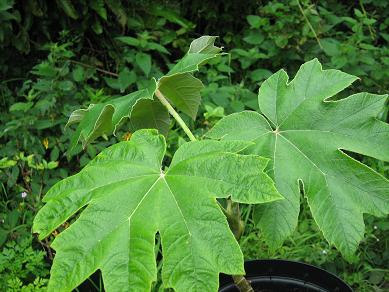
A Taiwanese shrub grown for the huge felted leaves. Damaged by frost but fairly reliable once established. I have this small plant - for years I have avoided growing it, and I'm not sure why. In spite of the plants popularity in modern gardens, I don't know very many good specimens and I'm not sure why that is? I haven't managed to establish it in the garden and I'm not entirely sorry, though I have another young plant in the greenhouse to go out when it's large enough. As a young plant it is magnificent and it grows into a spectacular adolescent. Unfortunately as it matures it lookes 'tired' to me and reminds me of the wrinkly person I see in the mirror when I have spent too long in the bath. Trees and Shrubs online says: "Tetrapanax papyrifer first came to the attention of western botanists in the guise of artificial flowers and watercolour paintings created from ‘rice paper’ (the species epithet papyrifer means ‘paper bearing’ in Latin). These items were popular souvenirs for European travellers in China at the beginning of the 19th century, where the earliest mention of pith paper is thought to be from the Tsin Dynasty (245–420 AD); it was also listed in the Chinese Materia Medica in 1590 and has traditionally been used in Chinese medicine (Nesbitt, Prosser & Williams 2010; Harvard University Herbaria and Libraries 2025). In 1830, William Jackson Hooker received a sample of the plant whilst Chair of Botany at the University of Glasgow, and wrote to his contacts for identification. It was mis-identified as Aeschynomene aspera (Fabaceae, whose pith is also valued, including for the manufacture of ‘pith helmets’), which perpetuated confusion in the literature for several years (Perdue & Kraebel 1961; Nesbitt, Prosser & Williams 2010). Hooker was tenacious in his quest, and after the First Opium War (1839–42) new opportunities opened up for Western contacts, leading to the discovery of the plant’s origins in the forests of northern Taiwan. In the latter half of the 19th century it appears that Tetrapanax papyrifer was somewhat forgotten, as a preference emerged for more compact Araliaceae with interesting juvenile or variegated foliage; however, changing horticultural tastes and unfavourable economic circumstances marked a general downturn for the family’s horticultural fortunes (Frodin et al. 2003). Although frost can damage the growing tip and cause plants to be deciduous, or perhaps relegated to the status of a gigantic herbaceous perennial in colder climates, Tetrapanax papyrifer is root-hardy once established, and has been observed to re-grow from suckers at the base (or lower down the stem) when cut back by air temperatures of –8° to –12°C." |
|
| 31st August 2008 | ||