 |
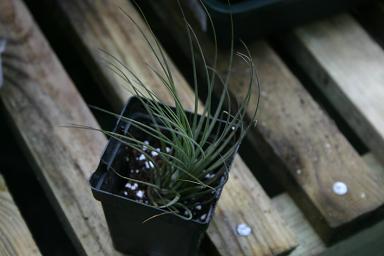
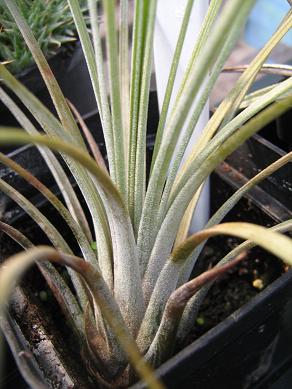
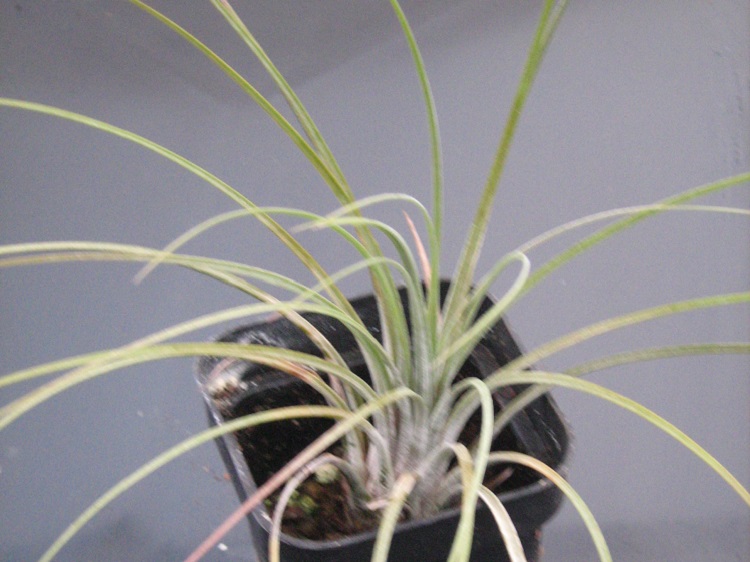
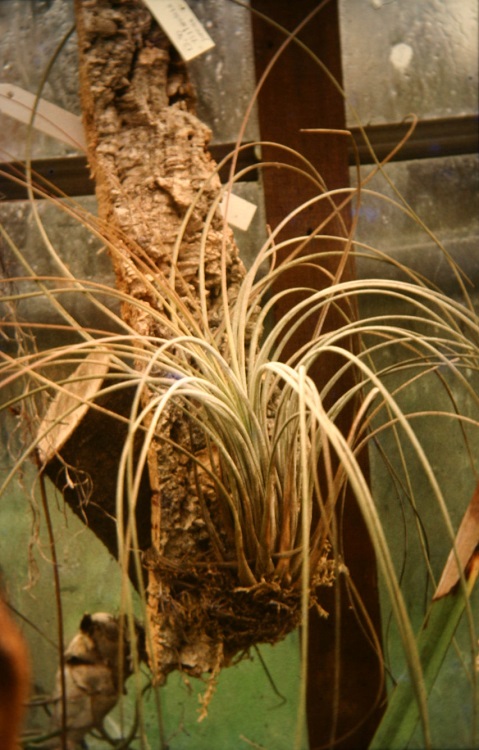
Large curved sprays of grey leaves producing strong orange bracted flower spikes. As a mature plant it seems to be quite tough, but as a youngster
it is a bit fickle. Werner Rauh says: "T. juncea inhabits an enormous area reaching from Florida, through Central America to Bolovia and Peru. Consequently T. juncea has many forms and is quite variable. In southern Ecuador and northern Peru it is among the characteristic plants of the deciduous dry forests at altitudes etween 700 and 1,200m. Easy, bright and sunny, moderately dmp. Robust, but at the same time very decorative." Grokipedia says: "This species, first described as Bonapartea juncea by Ruiz & Pavón in 1802 and later transferred to Tillandsia by Poiret in 1817, is accepted under the name Tillandsia juncea (Ruiz & Pav.) Poir., with synonyms including Tillandsia juncifolia Regel and Platystachys juncea (Ruiz & Pav.) Beer. It features numerous fine, silvery-green leaves, typically 3 mm wide or less, that can reach up to 50 cm in length and often develop a reddish tinge in full sun. The inflorescence is erect and compact, roughly matching the leaf length, with short lateral branches bearing greenish to dull red bracts and purple petals; it produces a capsule 25–35 mm long containing small, wind-dispersed seeds, and the plant is self-fertile." |
|
| 11th November 1982 | ||