| Home | Index | Web Stuff | Copyright | Links | Me |
|
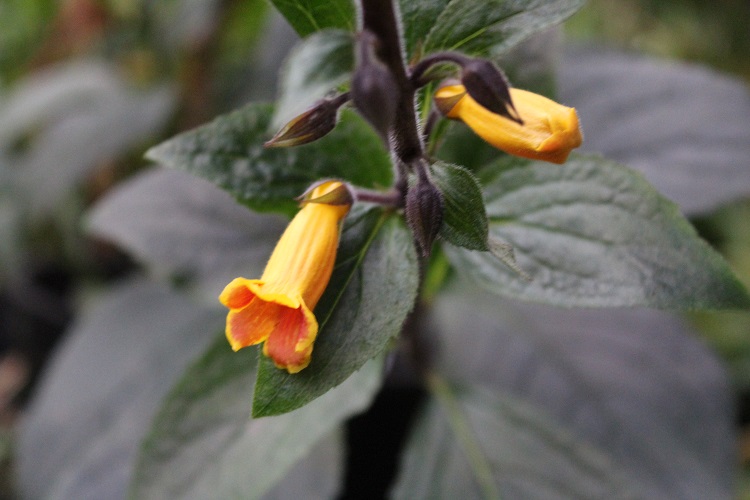
A large gesneriad from Taiwan and China. I have wanted it for a couple of years and was finally able to get one from
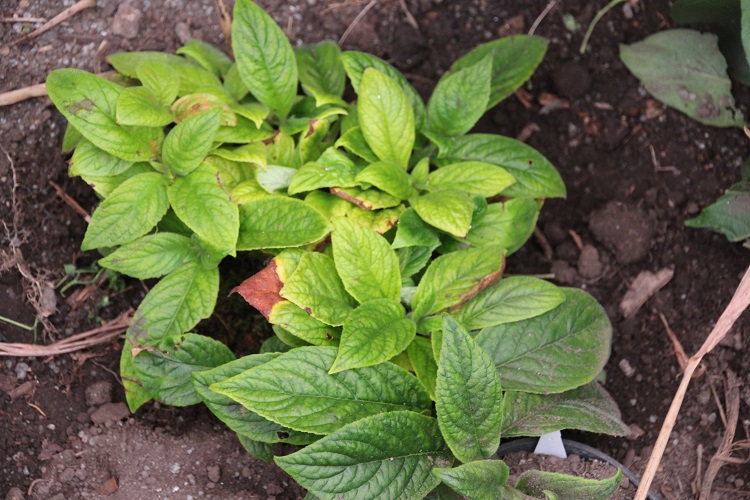
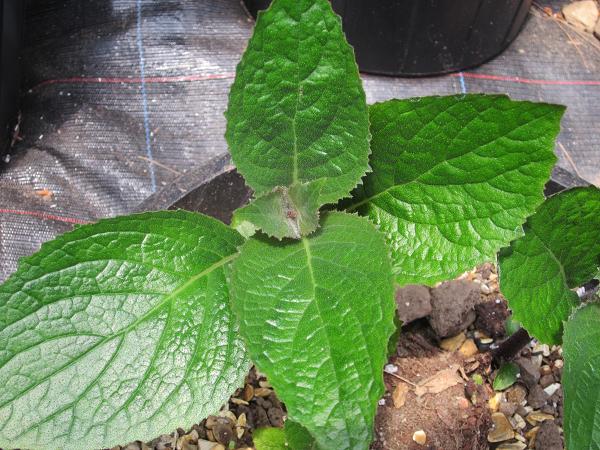
Edrom Nursery. I started it off in the Agave house but as soon as it developed full sized leaves it dried out
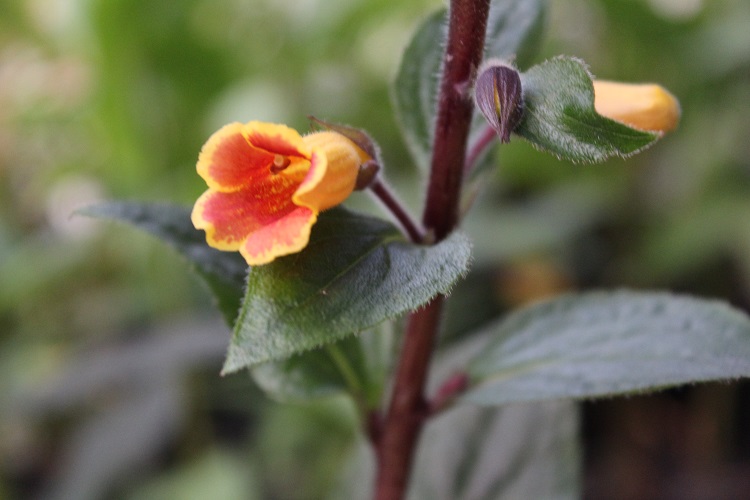
too rapidly and I had to move it back to the greenhouse where it is growing in light shade with the Aspidistra. Much easier to keep moist, which is said to be the secret in getting it to flower. The Edrom label says: "A rhizomatous gesneriad which has fleshy green/purple leaves and attractive yellow/orange foxglove-like flowers in late summer. Needs summer moisture." Plant Delights Nursery say: "Titanotrichum oldhamii is an amazingly hardy African violet relative, originally shared in 2002 by our friend, Georgia gardener Ozzie Johnson. After growing this Asian gesneriad in the garden, it was great to finally see it growing wild in Taiwan in 2008, where it clung to nearly vertical rock cliffs. The fuzzy basal leaves make a nice small clump to 12" wide which, in September and October, is topped with 1' spikes of dramatic, golden yellow bells with vivid, cinnamon-red centers. One look at a flowering Titanotrichum oldhamii will bring you to your knees faster than a passing pope...we promise! Titanotrichum oldhamii has survived 0 degrees F in our garden with good winter drainage." |
|
| 9th May 2014 | ||
|
Writing in 'The Plantsman' in 2019, Ian Hodgson says: "Oldham's golden foxglove, Titanotrichum oldhamii, has remained a surprisingly elusive element of our garden flora for decades, despite being relatively hardy in the UK. But now, of the thousands of exotic plants that have captured the imagination and enthusiasm of gardeners, it is one currently enjoying a late renaissance. Titanotrichum oldhamii is the only rhizomatous member of the Gesneriaceae to be found in Asia, rather than in the Americas. It is mainly found in Taiwan, but is also distributed in the adjacent regions of China and the Ryuku Islands of southern Japan. It typically inhbits the edges of broadleaved rainforest in valleys and on wet limestone rocks or moist cliff faces beside streams, from 300 - 1,000m. Titanotrichum was first collected by Royal Botanic Gardens, Kew's last professionally-contracted and ill-fated botanical collector Richard Oldham, who arrived in Danshui and Keelung, Taiwan (then Formosa) in March and April 1864, collecting more than 600 species, 61 of which were new to science, including T. oldhamii. Already ill and debilitated by the hardships of the climate, he died shortly after from dysentry, aged 27. The plant is currently considered vulnerable in the wild as populations are small and widely scattered, largely due to ongoing habitat loss. Titanotrichum is self-sterile, and, unless different clones are artificially pollinated, it won't produce seed. However, it is easy to propagate by division or separation of the scaly rhizomes in early spring. The tiny bulbils can be rooted and leaf cuttings and softwood stem cuttings taken in spring will also readily give rise to new plants." |
|
|
|
| 25th October 2014 | 28th October 2014 | 14th August 2020 |