|
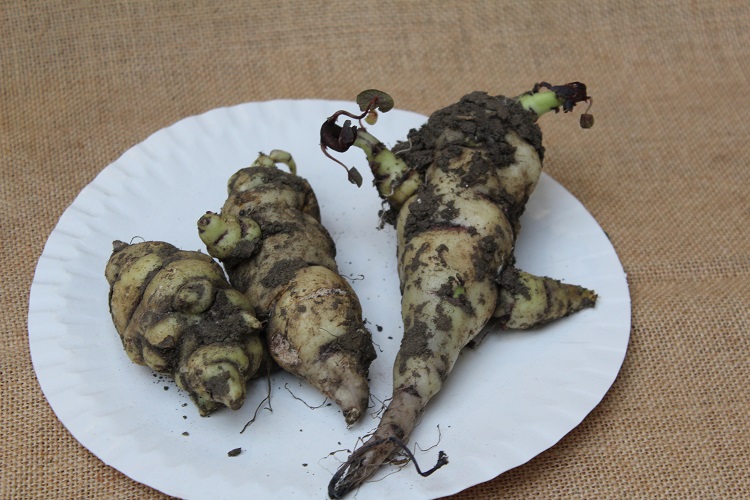
A tuberous species grown in the Andes as a subsistence crop, producing a practical yield of stachy tubers
even at high altitudes. Scarlet and orange bicoloured flowers are produced in late summer except
in my garden, where they aren't. Cultivariable say: "Mashua has long twining stems on which three to five lobed leaves form. In the fall (or mid to late summer for less common day neutral varieties), mashua forms trumpet shaped orange, orange and yellow, or occasionally red flowers. It is an attractive plant and is probably better known as an ornamental than an edible outside of its native range. Plants grow up to at least 8 and possibly 12 feet (2.4 to 3.6 m) tall if given something to climb. They are fast growing in cool, wet weather and are generally able to out-compete and smother weeds. Underground, the plant forms tubers that reach up to at least 13 inches (33 cm) in length, although more typically in the 3 to 8 inch (7.5 to 20 cm) range. the tubers have a shiny, waxy skin that cleans easily. Tubers cluster relatively closely under the base of the plant. Most mashua varieties have predominantly white tubers, although yellow, orange, red, and purple tubers are formed by some varieties. Given a long enough frost free autumn, plenty of water, and an overall cool climate, mashua can produce very high yields. We average 5 pounds (2.3 kg) per plant, but have seen as much as 16 pounds (7.25 kg) from a single plant. Warm climate yields are smaller, reaching perhaps two to three pounds (about 1 kg) per plant. Evidence exists for ancient use of mashua, as much as 8000 years ago, probably with later domestication. The first archaelogical evidence of mashua use dates to roughly 700 to 1400 years ago (Grau 2003)." |
|
| 29th May 2011 | ||