 |
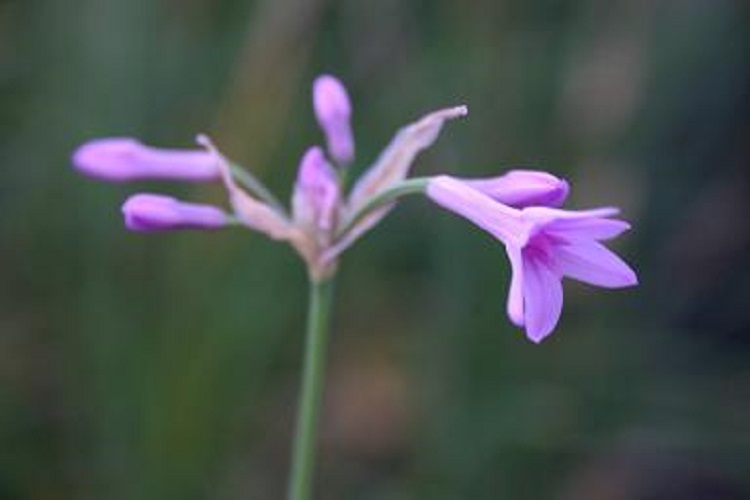
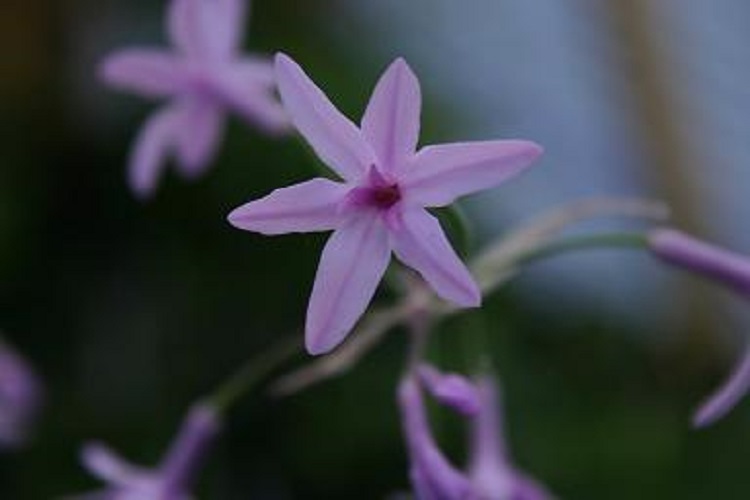
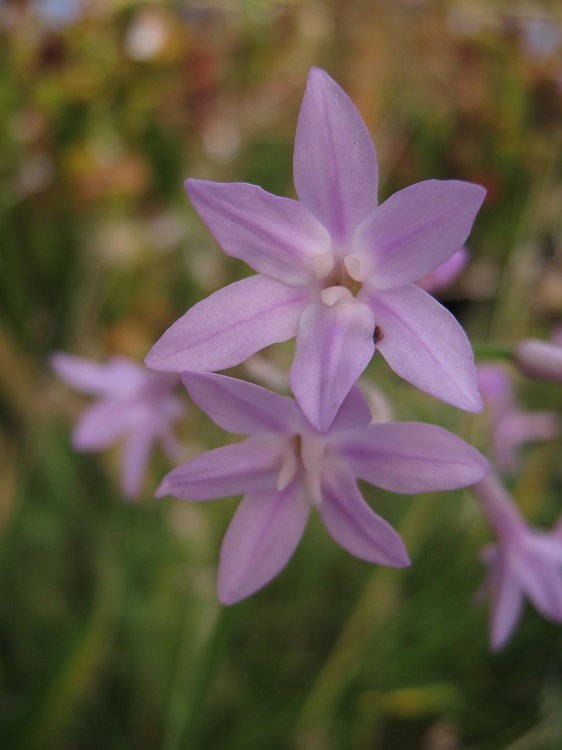
Grown from Alpine Garden Society seed in spring 2005 and just reaching flowering age. Other plants I have seen have a short, creamy yellow corona so this may not be true to name. Vosa says: "This variety of T. violacea Harv. has been found, so far, only near the sea-shore hence the epithet maritima. It differs fron the type species by its broader, shiny, dark green leaves without a prominent central vein. It has somewhat flat flowers with very small coronal lobes. All the collections are very similar to one another and self-fertile." Plantzafrica says: "Tulbaghia maritima is a coastal plant species endemic to the Eastern Cape Province of South Africa. It is distributed from Nature’s Valley to the mouth of the Gamtoos River, the area of distribution falls within the Humansdorp and Willowmore districts. This species grows close to the seashore, often in coastal forest or at river mouths, where it thrives in sandy soils amongst rocks. Tulbaghia maritima favours steep gorge-like terrain, with dense vegetation, the conditions of which alternate between freshwater input from rivers and saline water from the sea. This marine-influenced habitat’s environmental conditions are unique and challenging for seed germination and plant growth. Tulbaghia maritima is assessed as Vulnerable (VU) on the Red List of South African Plants. This can be attributed to its small natural range and the ongoing degradation and loss of its habitat to make room for coastal and tourism infrastructure development. This conservation status highlights the ecological sensitivity of the species and the importance of protecting its remaining coastal habitats. Tulbaghia maritima was formally described in 2011 by C.G. Vosa. It was previously considered to be a variety of Tulbaghia violacea but was elevated to species status following extensive fieldwork and taxonomic research. This work revealed clear morphological distinctions between the two taxa, as well as the unique and specific habitat requirements of Tulbaghia maritima. A 2016 phylogenetic study by Stafford et al upholds this status, showing that T. maritima forms a strongly supported clade of its own, beside one containing T. violacea and T. cominsii." |
|
| 13th September 2009 | ||