 |
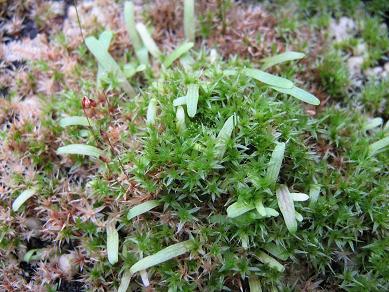
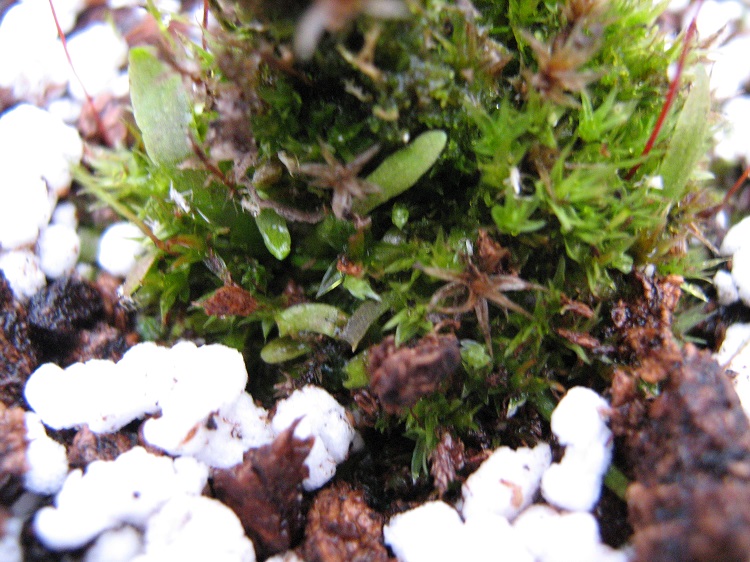
Unexceptional narrow leaves, the flower spikes wrap around a support like a runner bean. I only grew it for a short time. It survived one winter in the greenhouse
but didn't manage two. Writing in the Carnivorous Plant Newsletter in 1994, Barry Rice said: "Cared for properly, a small clump of U. prehensilis will quickly colonize its entire growing area. When the leaves are so densely packed they lie on each other in tangled confusion, the plant may produce a green or golden brown scape about 1 mm thick and round in cross-section. It grows vertically until it is 15 cm or more tall and then it starts to twine. As it grows, the upper several cm waves and wanders through the air in search of something to spiral around. The motion is slow--it takes a few hours for it to move appreciably--but when it finds something it winds tightly about it. Strangely, sometimes the next day you may discover that the plant has unwound itself and wound onto something else. This prehensile nature is the origin of the specific epithet prehensilis. Only the most recently developed 5 cm or more of the scape is mobile, so as the tip continues to grow, the length of non-twining scape increases. The scape always twines to the right when viewed from the side. In other words, a scape winding its way around a stick as it climbed it would wrap itself around the stick counter-clockwise as viewed from above. About twenty Utricularia species may twine, and all grow in this direction except the African plant U. appendiculata which grows in the other direction. Each U. prehensilis inflorescence produces one to several odorless flowers. They are spaced by up to several cm, and mature slowly. When each flower bud is ready to open, the portion of the peduncle it is attached to is no longer twining and has stabilized. No matter what orientation the peduncle might have gotten itself into, even straight down, the pedicel twists around so the flower is borne level. In the wild, U. prehensilis grows in tropical and South Africa, and in Madagascar. In this range it grows in bogs and often shallow water. It typically flowers during the wet season, but in permanently wet conditions it flowers all year. I keep my plants constantly wet and they flower year round, but most heavily during the late winter and spring." |
|
| 14th October 2007 | ||