 |
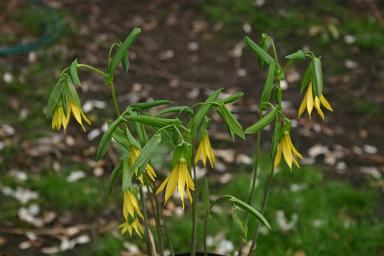
A very impressive North American species, it grows vigorously in light woodland conditions, but needs to be regularly 'topped up' with humus and plant food, or it dwindles away.
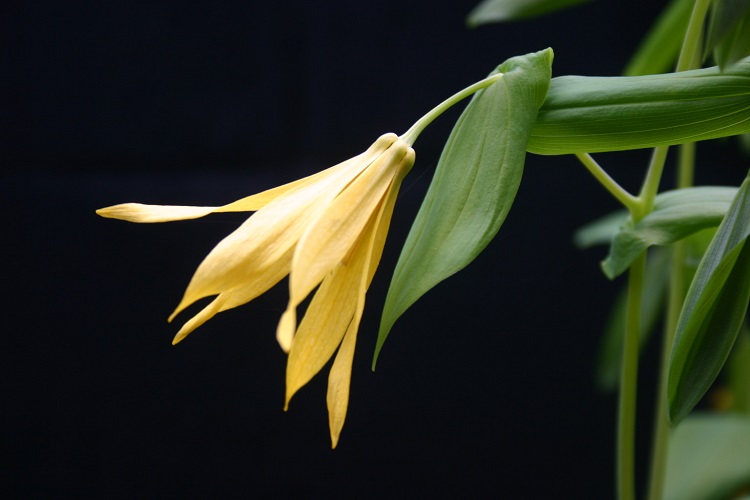
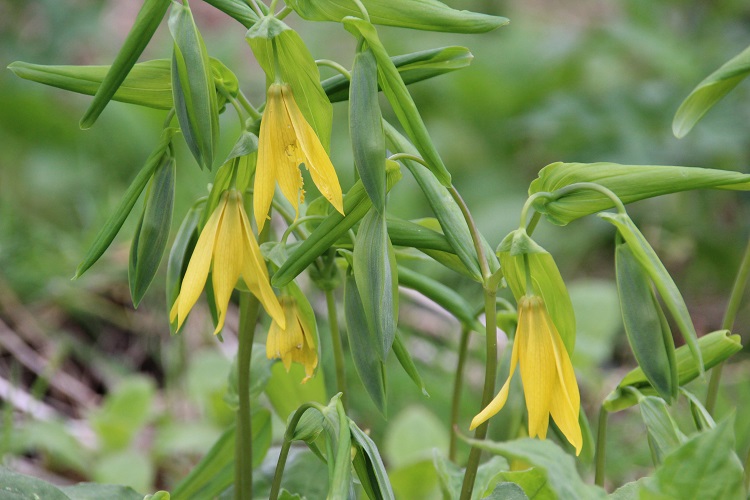
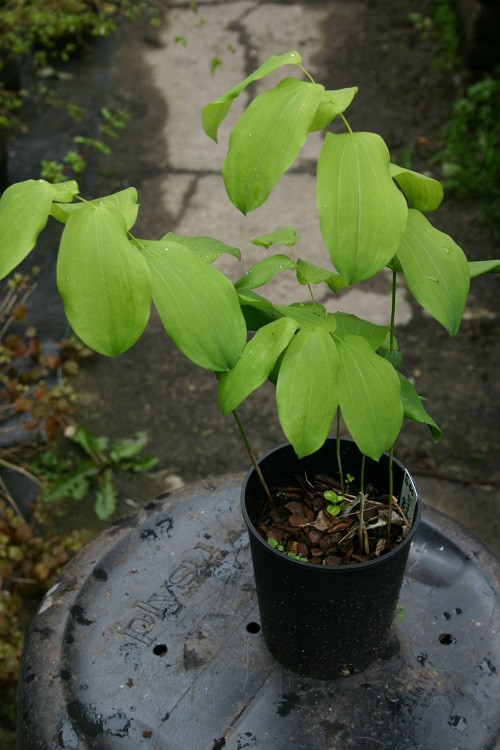
It is not a plant that you will find persisting in old abandoned gardens. The dangling clusters of unfolding leaves slowly reveal dangling yellow flowers in their midst. Wisconsin Horticulture says: "Uvularia grandiflora is the most commonly planted of the five species of Uvularia all native to eastern North America, from southern Quebec and Ontario south to Georgia and east to Minnesota. With a common name of great merrybells or large-flowered bellwort, this woodland plant is one of the first wildflowers to emerge in spring. Plants are produced in dense, vase-shaped clumps 12-20” tall. Single or 1-branched stems arise from short underground rhizomes with fleshy, fibrous roots and no stolons. One terminal inflorescence is produced on each stem, with 1-4 hanging flowers. The hanging yellow flowers are about 1 ½ inches long. The six overlapping tepals flare at the ends. The fruits that follow the flowers are a 3-cornered capsule with 1-3 brownish-red seeds per locule. The flowers are followed by bluish-green, alternate, perfoliate leaves. The plants remain throughout the summer, unlike many spring wildflowers that go dormant after blooming. The plants typically appear droopy, as though wilted, as they are expanding and during bloom. U.grandiflora does best in a lightly to moderately shaded spot in moist, fertile soil. This species rarely needs division, although it can be propagated by cutting up and moving clumps in the fall. Plants may self seed and the seedlings can be transplanted more easily than dividing established clumps. It may take a few years for transplanted clumps to get re-established." |
|
| 20th May 2005 | ||