 |
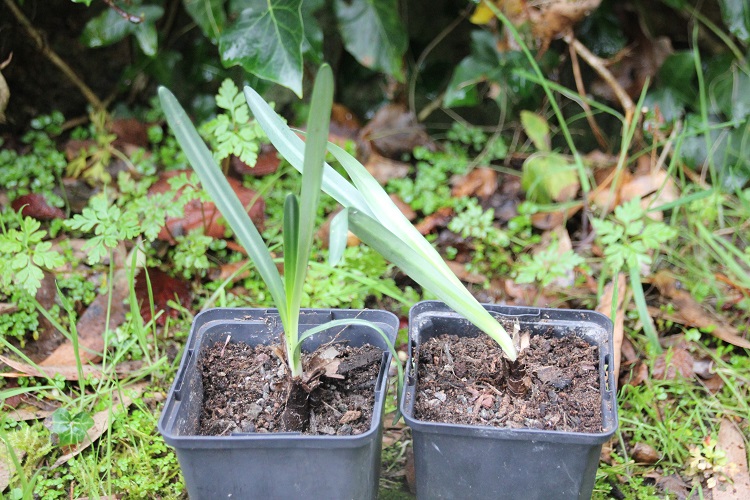
An uncommon bulb with white flowers from Syria and Israel. I got two young plants from a South African Bulb Group meeting and they are now growing in the Nerine House. In 'New Plants from the Society's Garden' (1849) it says: "A tender bulb, needing the protection of the greenhouse, and requiring the same kind of treatment as Amaryllis. It is best grown in a mixture of sandy loam and a little rotten dung, and is increased in the usual way. A neat, but not a very showy plant." Writing in 'The Plantsman' in 1982, G.A.C. Herklots says: "The name Vagaria is derived from vagus or vagans meaning 'wandering'. A bulb first flowered in the autumn in a Parisian garden in about 1815 - a stem pushed through a cluster of dead leaves and bore an umbel of flowers. No one knew from whence the bulb had wandered. Even when Herbert described the genus of a single species as new in 1837 its true home was unknown. Herbert observed that it had some affinity with Eurycles and with the Australian genus Calostemma and whilst is was not a Pancratium it resembles that genus in some respects. Eventually its true home proved to be Syria extending south to Israel. Harding and Hardy (1946) and Hardy (1947) record finding bulbs in full flower in mid September fairly widespread on the rocky, limestone hills near Jerusalem also on the sides of the Carmel and beyond Latrum at about 275m (900ft). The bulbs were wedged about 23cm deep (9in) in crevices of the rock thrusting their thick contractile roots tenaciously into the cracks. The bulb was of the same size as a rather large daffodil bulb (8x5cm: 3 by 2 in.) and covered by thin outer scales of a most distinctive satiny, blackish brown colour giving it a most characteristic appearance. In October the plants were in seed and the woodland paths to Bab el Wad were bordered by bunches of their bottle-green stems with globular swellings of the seed-heads. The seeds resembled glossy black beech seeds with their three sides. The bulbs are drought-resistant and come into bloom before the great drought breaks. Mr Harry Hay told me that he purchased a bulb from Messrs van Tubergen in 1969. When grown in a pot it produced no flowers but when planted in the ground in an unheated greenhouse and kept completely dry during dormancy it multiplied and produced many flowering scapes in 1979 but no viable seeds were formed." |
|
| 20th October 2025 | ||