 |
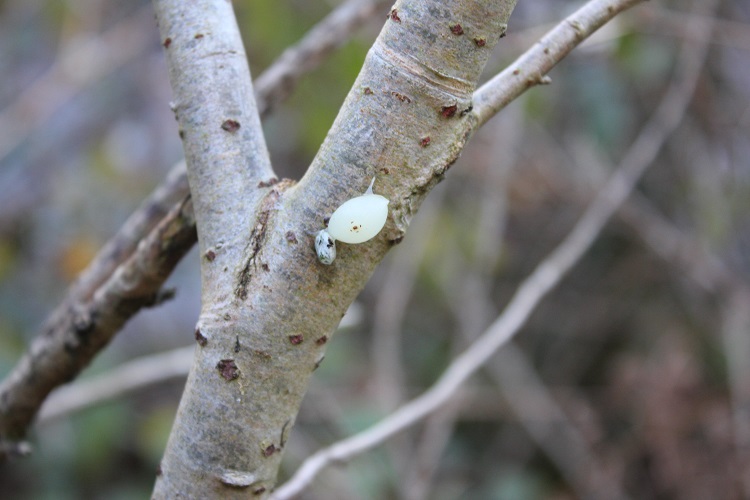
I am trying to establish Mistletoe in the garden. This berry came from a plant in my partners garden (isn't that romantic) and I spent a happy hour sticking them to likely host candidates.
Days later Storm Goretti hit the garden and blew down a number of large trees, damaging many of the potential hosts. The Mistletoe might have survived to germinate, I
might have to repeat the process. I'm told that it doesn't grow very fast initially. Kew say: "Nothing says Christmas like a kiss under a poisonous parasitic evergreen plant, right? Mistletoe grows from inside the branches of trees, including apple, oak and lime, stealing away nutrients and water. Before becoming a festive favourite, mistletoe was highly valued in ancient Greek, Roman and Celtic culture. But we don’t actually know exactly where the kissing tradition originated from. Mistletoe is a small woody shrub with a roughly spherical shape that can reach around 1m across. It grows on the branches of other trees, attached by a swelling known as a haustorium. The stems fork out at semi-regular intervals, finishing with long, oval shaped pale green leaves. The small yellow-green flowers are produced in clusters of three to five flowers where the branches fork. The berries are spherical, white, around 1cm across and contain a single green seed surrounded by a sticky pulp." The University of Oxford (Oxford Plants 400) say: The appearance and chemistry of mistletoe has endowed it with all manner of mystical, mythical and murderous powers in Eurasian folklore. The Roman writer Pliny records Celts attaching special properties to mistletoe parasitising oaks, whilst Norse mythology relates how the god Balder could only be killed by mistletoe. However, the most pervasive belief in the English-speaking world is the association of mistletoe and kissing, especially at Christmas." |
|
| 3rd January 2026 | ||