| Home | Index | Web Stuff | Copyright | Links | Me |
|
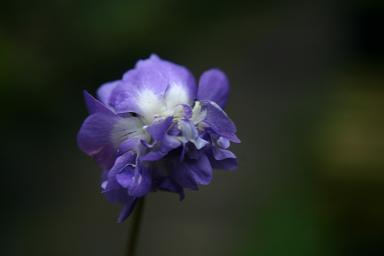
It is ridiculous that I only have one picture of 'Duchesse de Parme', it is the classic Parma violet. A very wonderful scent, but attractive flowers are a rarity. Most of them are dingy dish rags on sticks. Raised in 1870. Xera Plants say: "There’s nothing like the smell of sweet violets in late winter and early spring. But the regular species in our climate is nothing less than a thug. It seeds and grows where you really would rather not have it. Well, forget that. Enter this exquisite fully double flowering Parma Violet. The rich violet blue flowers appear on long stems from January to April. Parma violets are the Mediterranean form of V. odorata and they are less hardy to cold and not so rampant. This form we have never seen set seed- but there are always exceptions. Very glossy green foliage frames the flowers well. Excellent in containers in an unheated greenhouse, conservatory. In the garden choose a protected spot (under evergreen shrubs for example) and give this violet rich soil with regular summer moisture. Tolerates full sun but looks better with some shade. Flowers tend to lean horizontally, they are great for cutting and making little fragrant winter posies. Spreads by runners to form a nice patch in time. Tolerates summer drought when established." |
|
|
Ali Barwani wrote in the Capital Gardens blog in 2023" "The origins of the Parma violet are not fully understood. The Parma violet is said to have originated in Italy in the 16th century and then moved around Europe. They are thought to be derived from the mixing to two different varieties of Viola alba. They are most similar to the sweet violet in looks and perfume. Parma violet flowers and perfume were fashionable in the 19th century in both France and England. The scent of the Parma violet is powerful and haunting. The plants can flower from autumn to May. However, they are tender and need some kind of protection under glass during the winter and shade from the sun in summer. For me, mention of Parma violets evokes memories of the musky sweetness of Swizzle’s famous Parma violet sweets." Carvalho et al write: "In the United Kingdom, from the late eighteenth century to the middle of the nineteenth century, all major centers for the cultivation of violets were located at the county of Middlesex, near London. In 1873, the new violet called ‘de Parme.’ listed by the British nurseries, probably was the cultivar Viola ‘Duchesse de Parme’ which had come from Florence (Italy) three years earlier. Viola ‘Duchesse de Parme’ (1870) pale lavender blue flowers; very prolific and probably the easiest to grow . Roy Coombs says in 'The Plantsman' (1979): "Nurseries here began listing a cultivar named 'de Parme' from about 1873. It had been obtained from Florence three years earlier and as it appeared in the same lists as 'Neapolitan' it was obviously distinct. This is probably the violet still grown today as 'Duchesse de Parme' with flowers of lavender-mauve, a shade deeper than 'Neapolitan'. The stems were stronger and the plants more vigorous. Recently for several years it was the only Parma violet being sold here." |