 |
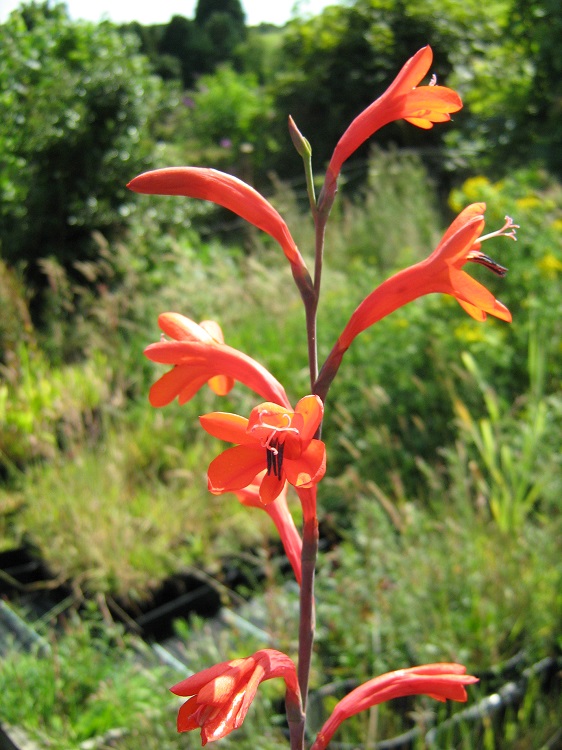
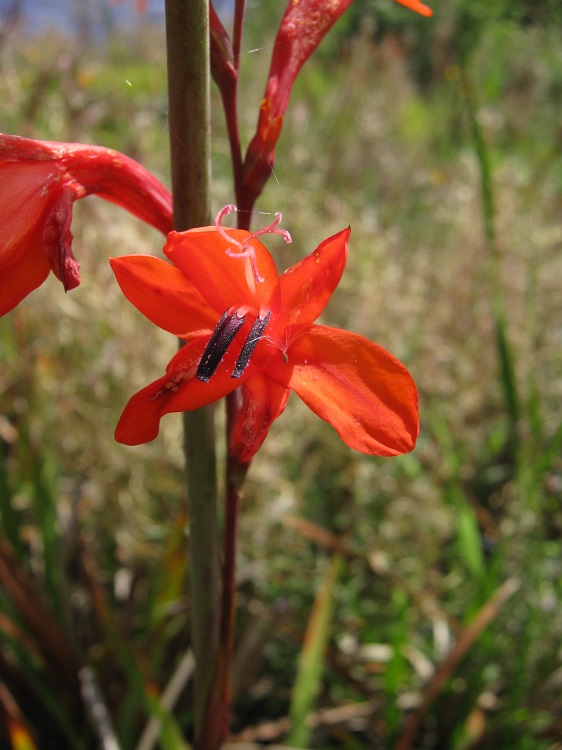
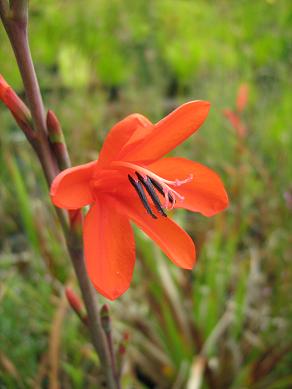
This plant fits the original description of the species reasonably well, but it isn't currently regarded
as a valid species. I got it from Paul Barney at Edulis. David Cooke writes in his adarsajnana blog in 2023: "Watsonia fulgens (Andrews)Pers. based on Antholyza fulgens Andrews was regarded as a nomen confusum by Goldblatt (1989) because the type illustration could not be matched to any wild population. Andrews’ description of this plant whch had been introduced to England in 1792 [as Antholyza fulgens] was little more than a diagnosis differentiating it from Antholyza ringens (= Babiana ringens): it had much longer glabrous leaves that remained green until new growth appeared, and bright scarlet, curved trumpet shaped flowers with large spreading lobes. Ker Gawler (1802) treated it as a distinctive variety of Watsonia iridifolia (Jacq.)Ker Gawl., which is another name of uncertain application. An illustration by Planchon (1856) under W. iridifolia var. fulgens matches a clone that is still widely grown in Melbourne although apparently not commercially available. Planchon noted that it flowered in autumn with a scape to 1-2 metres long, far exceeding the leaves, simple or sometimes branched in vigorous specimens. Plants of this name were being sold in England by 1820 (Loddiges, 1820). The plant known as Watsonia fulgens has been a "thing" for over 200 years. If it does not match any wild population, perhaps it should be treated as a cultivar. Unfortunately the name has been loosely applied in horticultural literature, for example to W. angusta by Campbell (1986). Watsonia fulgens sensu Montague (1930) was probably a hybrid cultivar; it was described as having pale-rose flowers appearing early in spring. It was distributed by Law Somner (1933) and may have been identical to the Watsonia fulgens described as a deep pink in Brunning’s 1905 and 1918 catalogues." Peter Goldblatt says: "The type figure is a species of Watsonia with bright red flowers, a long cylindrical upper perianth tube and more or less symmetrically disposed tepals. The floral bracts are short with the inner nearly as long as the outer, and the lower part of the perianth tube is well exserted from the bracts. The inner bracts are not figured in detail so it is not possible to see whether they are forked at the apex. Details of the bracts, leaves and fruit needed for identification to species are lacking and W. fulgens must be regarded as a species of uncertain identity. It resembles most closely the southern Cape species W. fourcadei and W. wilmaniae." Plants of the World online says: "Antholyza fulgens Andrews First published in Bot. Repos. 3: t. 192 (1801). This name is a synonym of Watsonia meriana." |
|
| 10th July 21009 | ||