 |
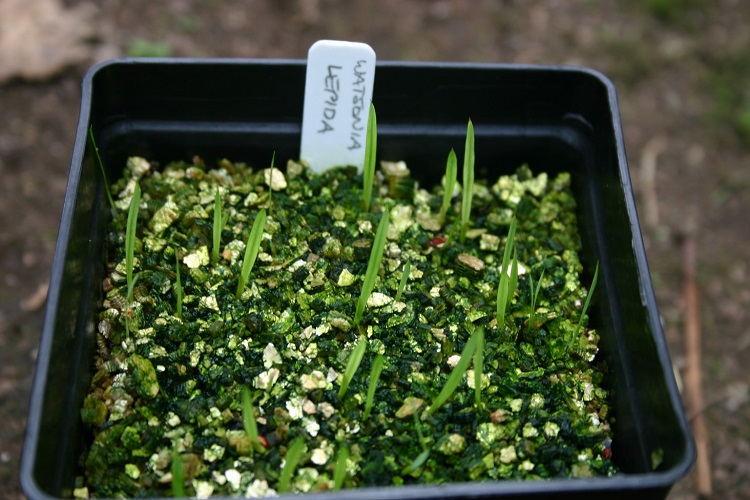
I have sown seed a couple of times without rearing the seedlings to maturity. In the end I bought a plant from a UK nursery and
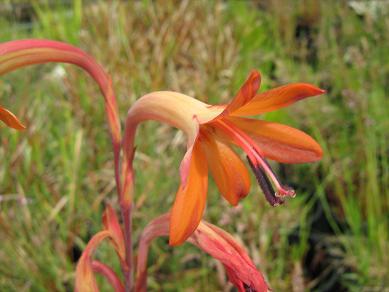
it was another one that has turned out to be W.meriana ssp. bulbillifera. It should have short spikes of upward facing pink flowers. The nursery label said: "coll. W of Oliviershoekpas, 1700m.Kwazulu Natal Drakensberg. In theory one of the hardiest species and close to densiflora. Stumpy dense spikes of arching, narrowly tubular, pink flowers; early summer. Best in a scree bed." The description comes from a Jim Archibald collection but clearly the plants were mixed up at some point. In his seedlist for January 1997, Jim Archibald provides the collection details: "JCA.3.952.800 Watsonia lepida KwaZulu Natal, Drakensberg, W of Oliviershoekpas.1700m. Themeda-grassland on open NW & NE facing, sandstone slopes.29.03.96 (This should in theory be the hardiest species in the genus, from between 200m & 2500m in the N Natal Drakensberg & Lesotho. In the W. densiflora complex & sometimes growing with another member, W. confusa, which tends to be a taller, clump-forming plant of wetter habitats. Usually with solitary 20-60cm stems carrying dense spikes of pink flowers. Possibly best tried in a well-drained sunny site, in the rock garden or in a scree bed in the UK.) Plantzafrica says: "Watsonia lepida has showy pink flowers in midsummer, it is a summer-grower from the Drakensberg Mountains, that occurs as scattered individuals amongst grasses, in full sun and well-drained soil, and that is the way it is best displayed in the garden. Watsonia lepida is endemic to southern Africa, occurring in South Africa and Lesotho. In South Africa it is recorded as growing wild in the Drakensberg, from Richmond in KwaZulu-Natal to Harrismith and Ficksburg in the eastern Free State, growing in grassland, in rocky areas at 1 500–1 980 m. In Lesotho it is recorded in the Maluti Mountains. The shape and colour of Watsonia lepida flowers is remarkably similar to those of the orchid species Disa pulchra and both are pollinated by the long-tongued fly, called Philoliche aethiopica. The watsonia flowers produce nectar and the long-tongued flies visit open flowers to collect the nectar, transferring pollen from one flower to another in the process. The Disa pulchra flowers however do not produce nectar, it mimics the watsonia in order to trick the pollinator into visiting and pollinating its flowers." |
|
| 24th May 2005 | ||