 |
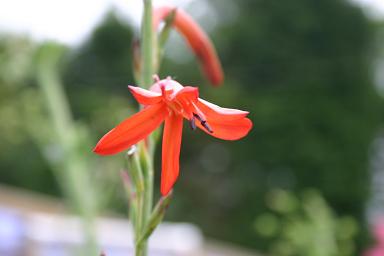
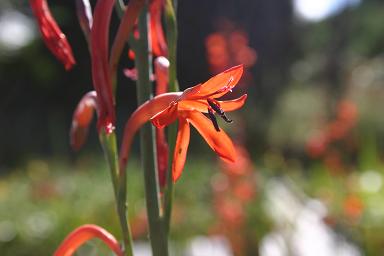
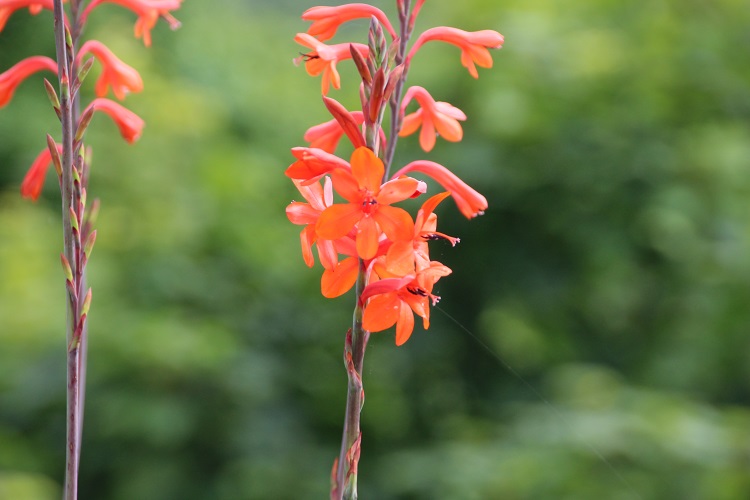
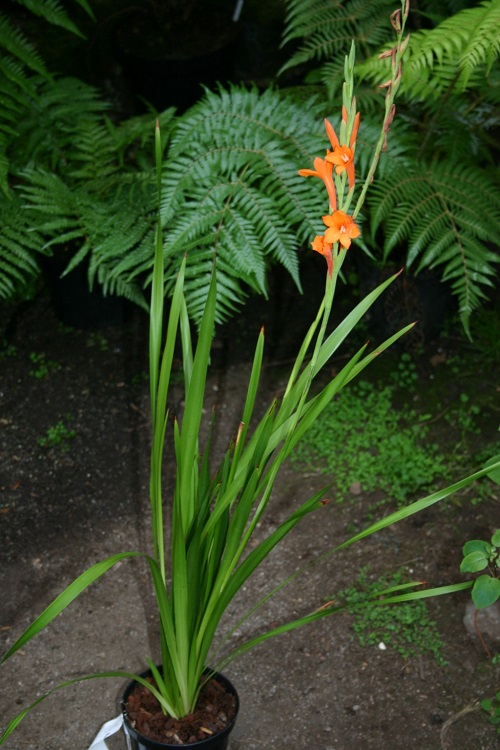
This is genuine Watsonia pillansii.
Pure orange flowers, white anthers and bright green leaves, it came from Trevena Cross nursery.
The species comes from the summer rainfall area of eastern South Africa, it likes some moisture when in growth, and suffers
a bit if wet and frosty in winter. This plant was destroyed outright by a serious frost.
I have a second plant with much narrower tepals that I got from Fir Tree Farm Nursery. It is the right colour but I am not convinced of the identification.
Plantzafrica says:
"Watsonia pillansii has bright orange summer flowers and is a rewarding garden plant, ideal for a sunny, well-watered but well-drained spot in the garden.
Watsonia pillansii occurs in the eastern half of southern Africa, from the Langeberg near Swellendam and Outeniqua Mountains near George in the Western Cape,
through the coastal mountain ranges of the Eastern Cape to the Drakensberg in KwaZulu-Natal. It occurs at the coast to the lower and middle elevations,
at 2 400 m altitude, usually in mixed grassland, but also in exposed sites among rocks, in clumps and large colonies.
Watsonia pillansii is closely related to, and very similar to, W. knysnana (Knysna Watsonia), but can be distinguished by flower colour, W. knysnana flowers being pink to purple.
The two species hybridize where their ranges overlap. It is also difficult to distinguish from W. schlechteri (Schlechter’s Watsonia), which has narrower leaves and more heavily thickened midribs,
and in the flowers, W. pillansii has staminode-like ridges between the lower parts of the filaments that W. schlechteri lacks.
Watsonia pillansii flowers have no scent, are brightly coloured, are held up high on a sturdy stalk and produce lots of nectar, which indicate that they are pollinated by nectar-feeding birds such as sunbirds,
although at Kirstenbosch, which is well out of its natural range, the local sunbirds are not seen visiting the flowers.
The stamens and stigma are positioned in the right place, just underneath the uppermost tepal, to touch the bird’s head as it probes the flower for nectar."
Peter Goldblatt says:
"The first collection that can be assigned with certainty to Watsonia pillansii were collected in the 1820s by Ecklon and Zeyher and by Drege.
These early collections were placed in W. angusta or W. meriana and it mwas only in 1921 that Louisa Bolus recognised it as distinct, describing it from plants grown at the National Botanic Gardens."
|