 |
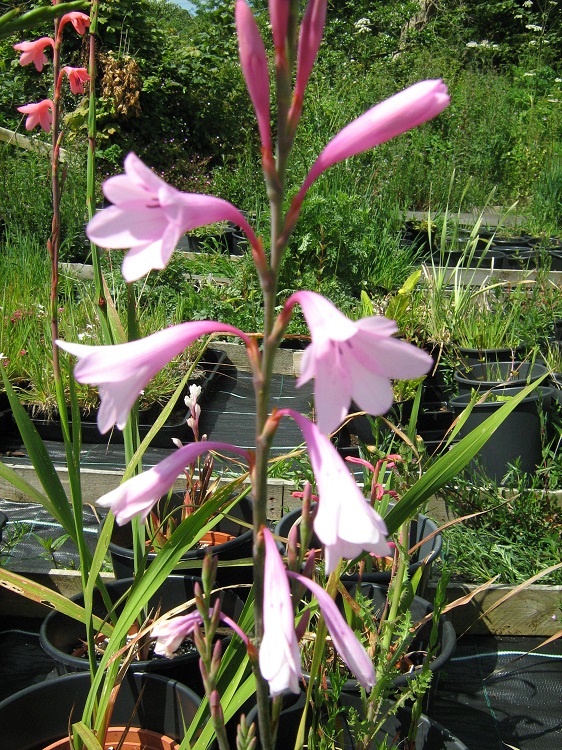
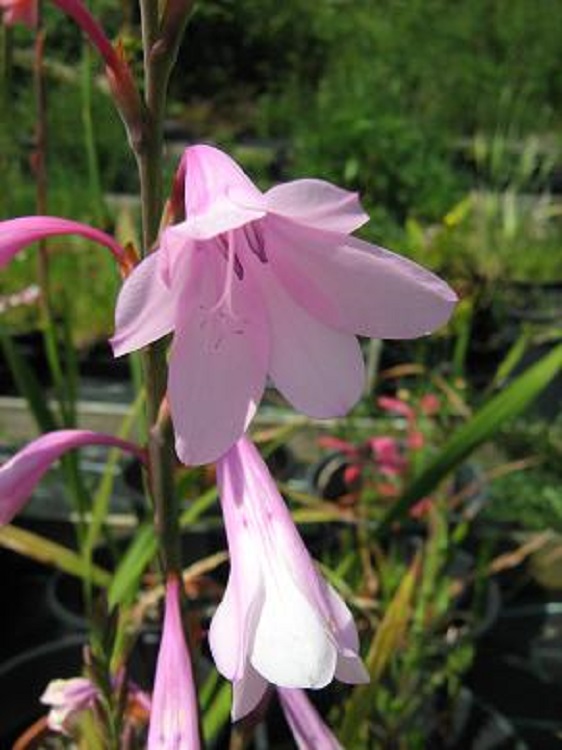
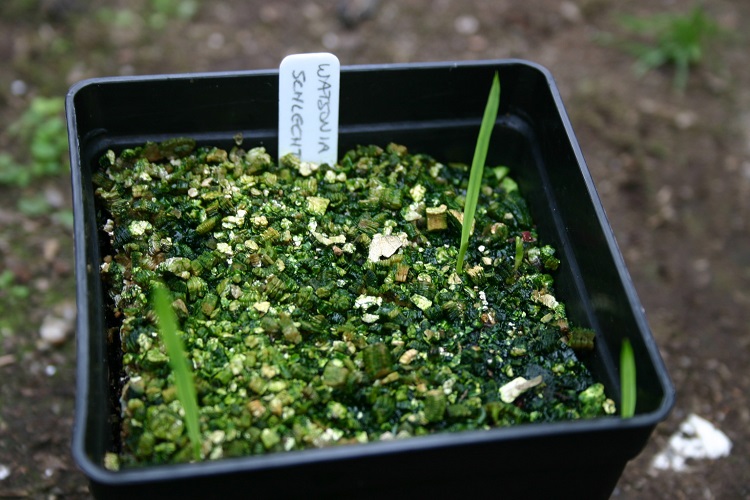
Another new one in 2005. The seed came from Silverhills seed in South Africa and should be the real thing, though sadly none of the seedlings survived. In 2009 I bought a plant from a UK nursery. Watsonia schlecteri has bright scarlet-orange flowers arranged fairly compactly at the top of the spike. This plant - not even close! The nursery label read: "From seed collected in Napier in S. Africa this has spikes of warm, soft orange flowers held at different angles on tall stems during mid to late spring. Fans of leathery strap-like leaves. Never too dry yet well drained soil in sun. 90cm." Phillipskop Mountain Reserve says online: "In the shimmering heat of summer, the spikes of Watsonia schlechteri appear as beacons amongst the fynbos. Often producing a single spike of up to 30 large trumpet-shaped lurid orange-scarlet flowers, the individual plants can be spotted from considerable distance across the mountain slopes. While this certainly attracts the attention of the mountain hiker, its main purpose is to draw in the scarce pollinators that are around at this time of year. Both the Mountain Pride Butterfly, Aeropetes tulbaghia, and sunbirds, such as the Malachite and Orange-breasted Sunbirds, are attracted by the strong colour and long-tubed flowers, which provide a good nectar source. Watsonia schlechteri is easily identified amongst the Watsonia of the Klein River Mountains because of its summer flowering habit. The other species have finished their flowering by December but Watsonia schlechteri starts around then and continues on into February. It is also unusual in that it grows on dry rocky slopes, frequently amongst rocky outcrops, where its corms are protected from predation by baboons or porcupine. In such confined spaces, it rarely forms large clumps, like many of the other species, and produces just a single flowering spike per plant. Other key characters include the leaves, are narrow, less than 1.5cm across, with thickened margins, and the flowers have long bracts, which enclose the lower part of the tube. The colour is bright orange to almost red. The colour is so intense that when photographing it, the detail can easily be lost." Peter Goldblatt says: "named in honour of Rudolf Schlecter, the late nineteenth century collector and botanist, who was one of the first to record this species. Plants grow singly, or occasionally in small clumps, on rocky exposed slopes and plateaus." |
|
| 24th May 2005 | ||