 |
A large growing species from Asia, there is some difference in opinion about its hardiness. Those who sell it list it is frost hardy.
Those who grow it have a less optimistic assessment! I keep it in the conservatory for now.
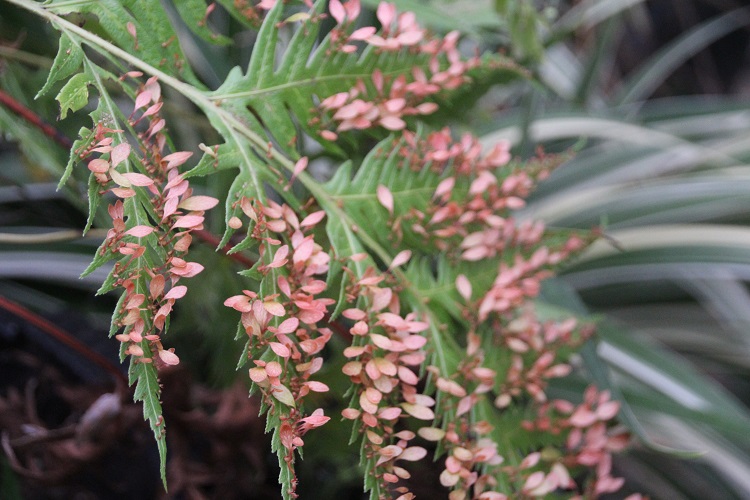
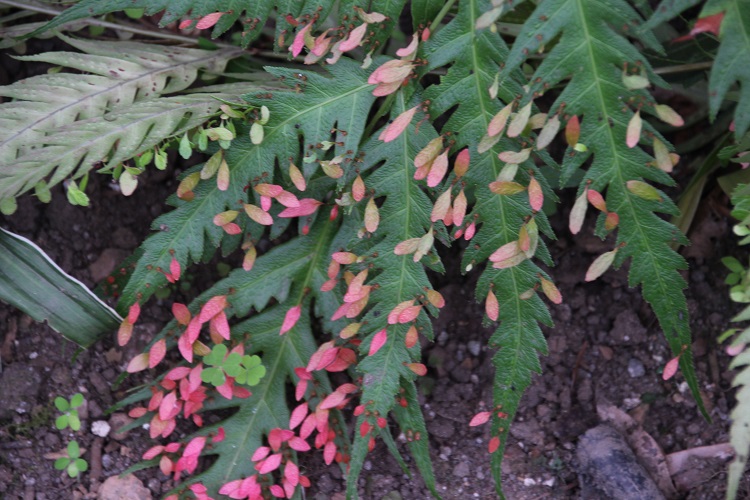
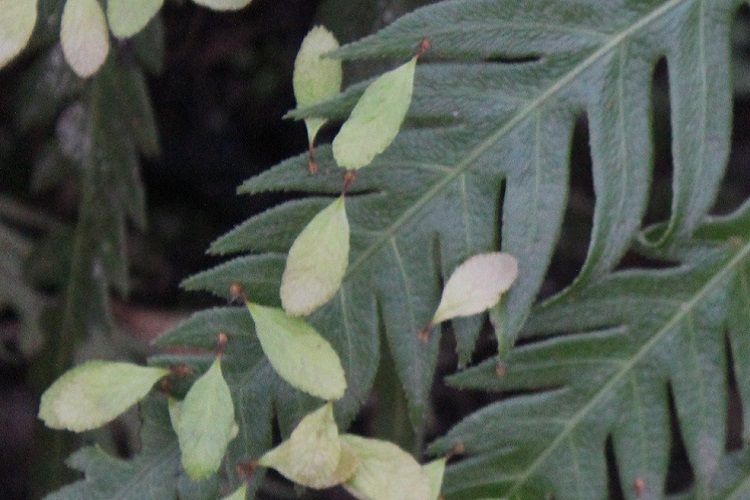
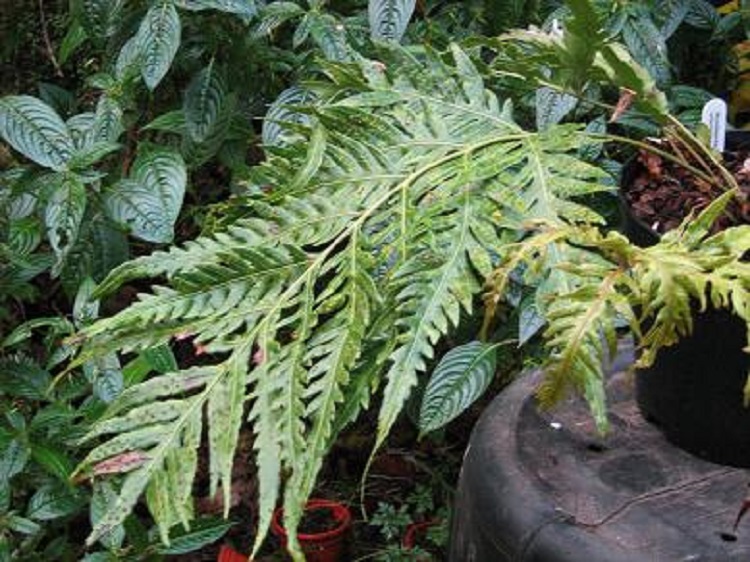
Large leathery fronds that grow rather laxly from the crown and flop towards the ground. W. prolifera and W. orientalis are closely allied species. There is significant doubt over the identity of the plant in cultivation, it is currently thought to be W. prolifera. Plantlets start to form on the surface of the mature leaves but they drop off before they reach any size and need to be kept moist and humid if they are to develop. Plants of the World online says: "The native range of this species is SE. China to S. Central & S. Japan and Philippines (Bataan Islands). It is a rhizomatous geophyte and grows primarily in the subtropical biome. Tim Pyner says: "W. orientalis.In western horticulture a lack of understanding of the characters used for separating the species has led to confusion regarding the correct name. Both species produce tiny plantlets on the upper surface of the frond that are very different from the larger, scaly bulbils produced in the pinnae axils of W. radicans and W. unigemmata. Plantlets occur in both species, sometimes completely covering the frond surface. It is now known that W. orientalis is a fertile allotetraploid species derived from a sterile hybrid between W. prolifera and a second, as yet uncertain, species. Most plants in cultivation appear to be W. prolifera. True W. orientailis is possibly grown and I am currently searching fern collections for plants that may be it. Woodwardia prolifera is a large plant that can have fronds more than 2m in length. The young fronds vary in colour, sometimes green but often very intensely coloured carmine or orange, frequently more colourful than nthose of W. unigemmata. When well-grown the pinnae and pinna lobes of W.prolifera are characteristically narrow and attenuated. Another important difference is that two or three basiscopic pinna lobes adjacent to the rachis are not developed. However both these characters may be less prominent in small or young plants. Woodwardia prolifera does not seem to be as hardy as W. unigemmata However, it has a similar wide geographic range and I have noted some variation in cold tolerance, but it is best treated as an H3 plant." Pan Global Plants say "Usually sold, incorrectly, as the closely related but different W. orientalis. A spectacular evergreen fern originating from the Himalaya to Eastern Asia with most attractive deeply divided and tapered fronds up to 1.5m long. A mass of bulbils/plantlets are produced on the upper surface of fertile fronds, giving an easy means of propagation. Requires a sheltered moist-ish position in shade or semi-shade in not overly cold gardens. This isn't desperately tender, but is not for the coldest areas." |
|
| 27th November 2008 | ||