 |
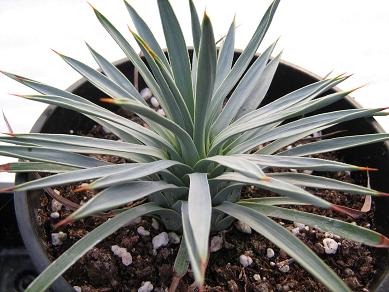
A small growing subspecies from the coastal slopes of the San Gabriel and San Bernadino mountains in California. Compact growth that does not usually produce offsets,
and has very tall spikes of flowers. I got my plant from Cotswold Garden Flowers because of the sensational blue colour, and it will be staying in a pot for the forseeable future. This one came with the collection number NNS 05.699. Cotswold Garden Flowers label says: "Spiny rosettes of blue-green leaves, 1 x 1.3m. Very tall very large heads of creamy flowers Jul-Aug. 4.5m. Collected 7525 feet altitude, San Bernadino Mtns, San Bernadino Co. CA. Synonym Hesperoyucca parishii." Las Pilitas Nursery say: "This is a very large Yucca that can stop all intruders (or friends). Flower spike can be 10-15 ft. tall. This particular form is usually found in sandy washes in the areas between the mountains and the desert or inland valleys." In 2009 the Tropical Centre said on their website: "Yucca whipplei parishii has the tallest flower stalk of all subspecies of Y. whipplei and can reach heights of 2-5m. It has flat flexible blue leaves of about 1m in length. It grows particularly well on mountain slopes and along the coastal slopes of the San Gabriel and San Bernardino mountains in California, on elevations of 300-2400m. Y. whipplei parishii grows as a solitary stem and produces no offshoots. After many years, the plant sends up a long showy inflorescence of 3m, approximately twice as large as that of ssp. whipplei. The stalk blossoms with creamy-white or sometimes purplish-tinged flowers, produces seed, and then dies. Y. whipplei parishii generally complete their life cycle within 5-7 years. This form is rare in cultivation and is a collectors plant. Hardy down to -12degC. Keep it dry in winter, better to keep as a pot plant." |
|